Fenian Cycle · story
The Battle of Gabhra
The High King turns against the Fianna. At Gabhra, Oscar kills the king but receives a mortal wound, and a military defeat becomes the grief of a father and grandfather.
Also found as: Cath Gabhra · The Battle of Gavra · The Death of Oscar · The Lay of Osgar
Research reviewed 17 October 2026.
Read the story
This retelling follows Lady Gregory’s “The Battle of Gabhra”, Gods and Fighting Men, Part II, Book IX, chapter III. Her narrative calls Oscar’s opponent the High King; the compared Scottish lay below names him Cairbre.
The High King had come to hate the power of the Fianna. Their demands, their pride and the tribute they received seemed to him a burden that Ireland must no longer bear. He told his followers that he would rather die in a battle which destroyed them than continue living beneath their influence. His council agreed. Messengers went out to gather support.
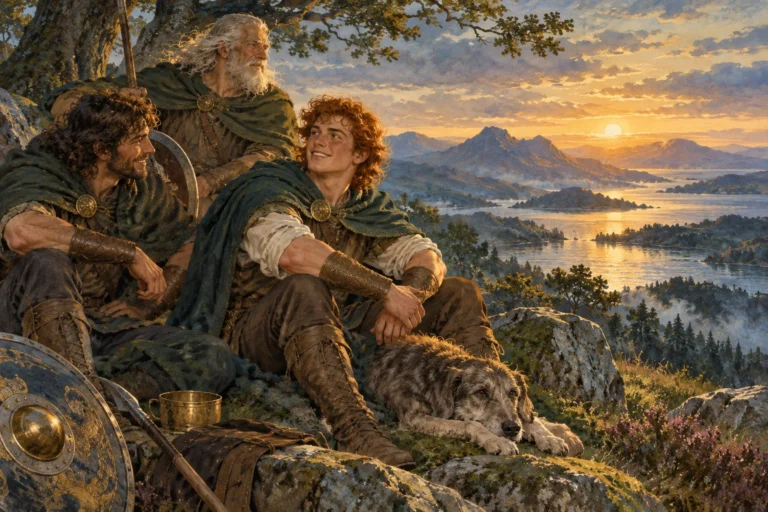
When the preparations were ready, the king invited Oscar to a feast at Tara. Oscar travelled with three hundred men. On the way they saw a woman washing clothes in a river. Red spread through the water around her hands. Oscar understood that she washed for the dead.
The woman told him that the ravens would soon gather above his own head. He refused to let fear stop him. If he was to die, he asked, would any of his enemies fall first? Nine hundred would fall by his hand, she answered, and he would give the High King his death-wound. Oscar continued towards the feast with that promise and warning together.
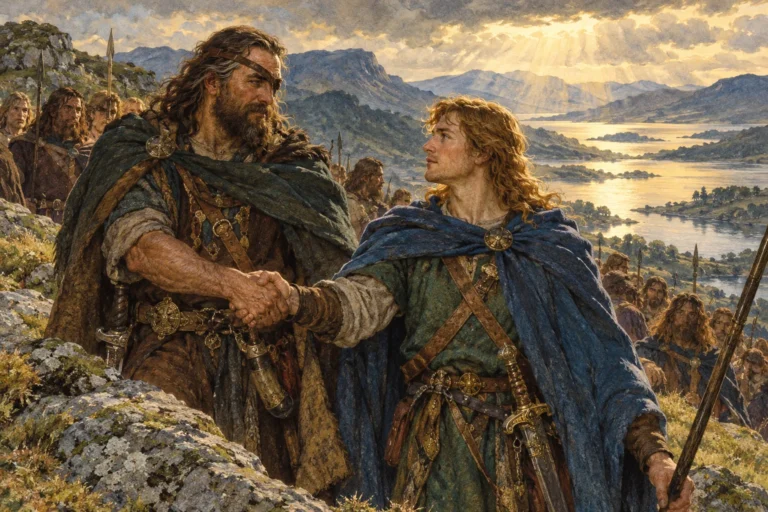
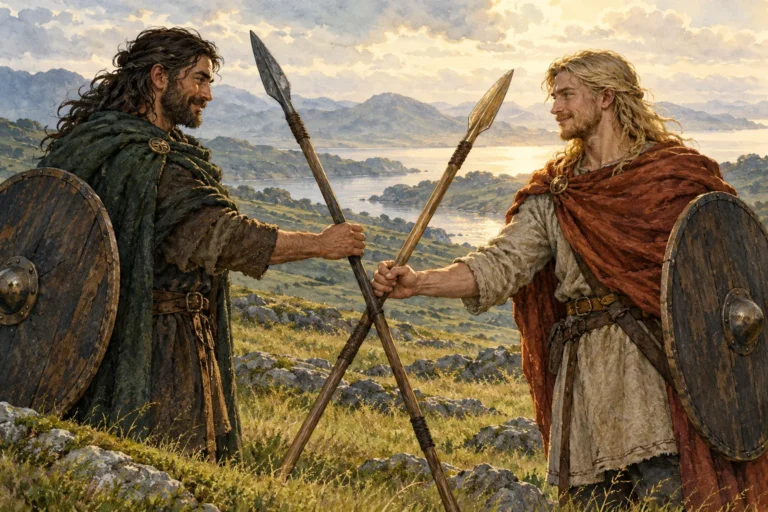
For three days the visitors received good hospitality. Then the king demanded an exchange of spears. Oscar asked why a man he had already helped in battle should want his weapon. He would willingly give gold or treasure, but surrendering the spear was another matter. Their words hardened. The king threatened to drive his spear of seven spells through Oscar’s body; Oscar promised to strike the king with his own spear of nine spells.
Oscar and his men left Tara. Beside a river they heard a harp playing music like a lament. Angry at its foreboding, he roused his followers and returned to Fionn. The king’s messenger followed with an open refusal: there would be no more tribute and no further tolerance of the Fianna.
Fionn answered with a challenge to battle. He called together those who still remained with him, but the sons of Morna joined the king. At the hill of Gabhra the opposing armies met. Gregory’s tale gives the king twenty men for every one on the other side.
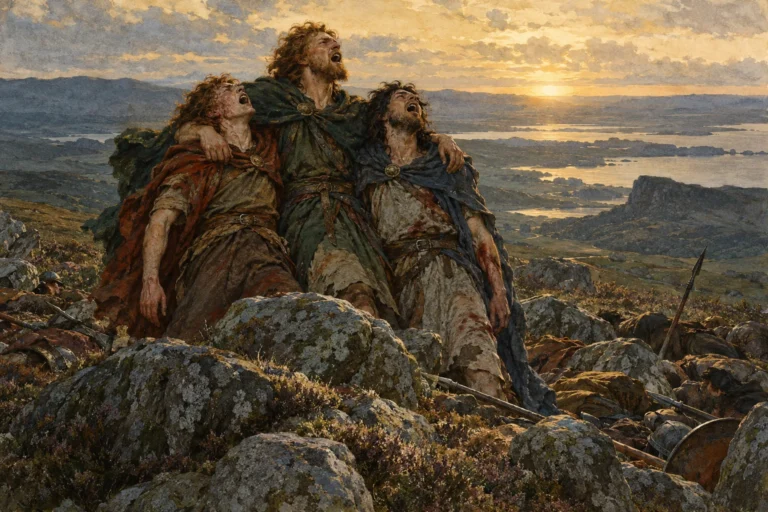
Oscar fought through the day, cutting down men from the many forces assembled against the Fianna. By the time he saw the king, his strength was failing, but he moved towards him. The king cast his spear. It passed through Oscar’s body and brought him down on one knee.
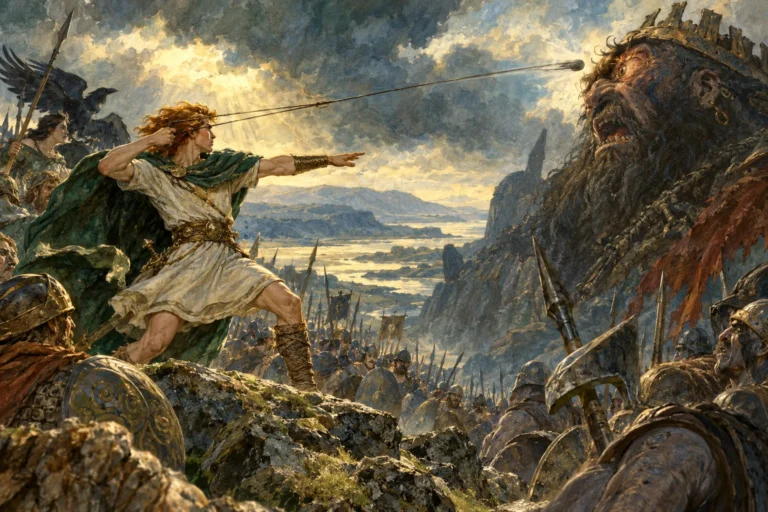
Oscar still had his own spear. He threw it into the king’s face and killed him. The royal followers put their leader’s helmet on a pillar to make the army believe that he remained alive. Oscar saw the deception. He lifted a slab of stone and hurled it at the helmet, breaking it before he too collapsed.
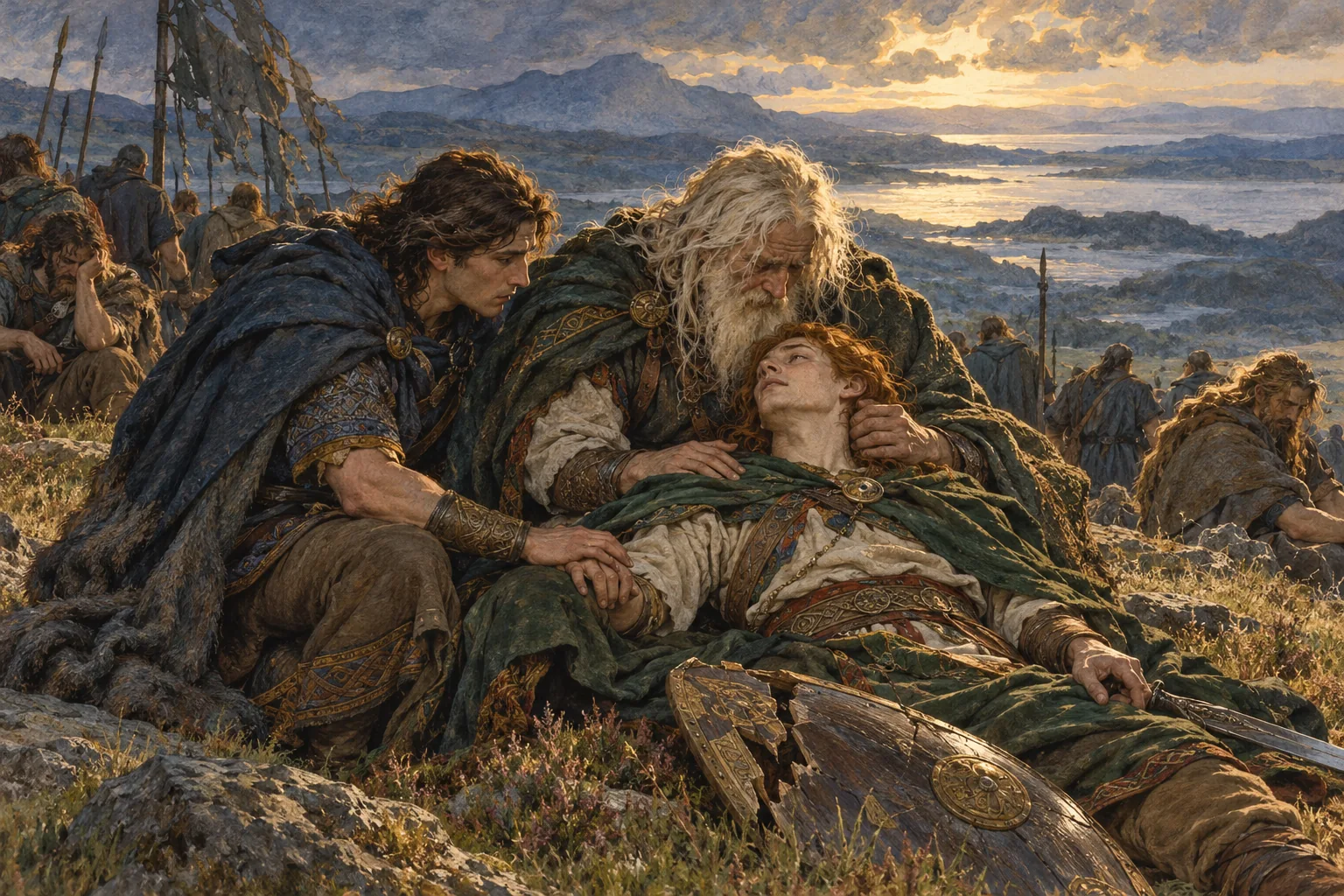
The battle ended in defeat for the Fianna. Caoilte found his seven sons among the dead. Oisín searched for Oscar and discovered him propped on his arm, his shield broken, his sword still in his hand. Oscar reached towards him and was glad that his father had survived. Oisín could find no answer.
Caoilte examined the wound and understood that it could not be healed. They lifted Oscar on their shields and carried him to a grassy hill. Around him gathered men who had lost brothers and sons of their own, yet for that moment all their mourning turned towards him.
At noon Fionn arrived beneath what remained of his banner. He reminded Oscar of an earlier wound at Ben Edair, when his own hand had restored him. This wound was different, Oscar said. The king’s enchanted spear had made recovery impossible.
Fionn wished that he had fallen instead, leaving Oscar to lead the Fianna. Oscar spoke of the hard heart he had always believed himself to possess, and of the cries of dogs, warriors and women that now troubled it. Fionn mourned the child of his child and the ending of everything they had shared.
Oscar stretched out his hands and closed his eyes. Fionn turned away and wept. Graves were made across Gabhra; the tale gives Oscar a grave the length of the entire rath. Those who remained had survived the battle, but Fionn never again found peace in the world it left behind.
Versions and variations
An Irish literary synthesis and a Scottish Gaelic lay. Gregory’s chapter can be compared with “The Lay of Osgar”, in J. F. Campbell’s Popular Tales of the West Highlands, volume III, pp. 320–347. Hector MacLean obtained most of its printed wording from Donald MacPhie, a smith at Breubhaigh, Barra, on 1 October 1860, supplementing it with lines from Patrick Smith of South Boisdale, South Uist, recorded on 17 September. The published text is therefore already an edited combination, not an unaltered transcript of one performance.
Where the heroes belong. The Scottish introduction calls the Fianna Highland Gaels who visit Ireland for better hunting. It names the antagonist red-haired Cairbre and frames Oisín’s account as a conversation with Patrick. Gregory places the conflict within her continuous story of the Irish Fianna. Her Authorities for Book IX includes Campbell, so agreement between the two cannot be counted as independent corroboration of the event.
The battle and its portents. In Campbell’s stanza 8 the washerwoman predicts five hundred deaths at Oscar’s hands; Gregory gives nine hundred. Campbell’s stanzas 41–42 add the king’s son Art, whom Oscar kills after Cairbre calls him forward. Gregory retains the helmet deception but omits Art. The Scottish reciter explains that poison prevents Fionn from healing Oscar; Gregory stresses the king’s spear of seven spells. See stanzas 8 and 39–54 and the intervening prose.
Who speaks the grief? Gregory assigns the hard-heart speech to Oscar. Campbell’s printed sequence gives it to Fionn. MacLean’s note 345–19 admits that some reciters and MacCallum’s printed version assigned it to Oscar, but argues for Fionn on grounds of character. This is unusually clear evidence of an editor choosing between readings; a later adaptation should not hide that choice behind a supposedly fixed original.
Context and evidence
Gabhra is a story about the destruction of a warrior company and the unbearable loss of its young champion. Its tribute dispute also places royal authority against the Fianna’s privileges. Neither Gregory’s huge casualty figures nor Campbell’s traditional battle narrative establishes a securely dated historical battle. Campbell’s accompanying nineteenth-century commentary sometimes treats the heroes’ historicity as settled; that confidence is not adopted here. Tara is a clear narrative location for the feast. This entry does not equate the legendary battlefield or Oscar’s immense grave with an excavated site, and it does not treat the Scottish setting of the Fianna as an error to be corrected.
Sources for this entry
- Lady Gregory, Gods and Fighting Men: The Battle of Gabhra. 1905 edition; first published 1904. Part II, Book IX, chapter III; Notes III, Authorities, Wearing Away of the Fianna. Read source — Complete main narrative and authority note consulted. About this book
- Donald MacPhie and Patrick Smith, recorded by Hector MacLean; edited by J. F. Campbell, Popular Tales of the West Highlands, volume III: LXXXI, The Lay of Osgar. Edinburgh: Edmonston and Douglas, 1862. pp. 320–347, stanzas 1–64; collector’s statement p. 345; note 345–19. Read source — Named oral witnesses in a combined edited text; narrative and variant notes compared. About this book
Research coverage
Compares Gregory’s complete chapter with the translated Scottish lay and its editorial notes. The early Irish Cath Gabhra texts, Ossianic Society volume I and further Scottish recordings remain to be collated. Gregory’s use of Campbell means the comparison does not establish independent agreement.
The Myths · Irish collection · Editorial approach
Further Reading