Kings’ tales / Otherworld tales · story
Cormac in the Otherworld
A king exchanges three promises for a branch whose music removes sorrow. When the stranger claims his family, Cormac follows him into a country where truth changes the material world.
Also found as: Cormac’s Adventure in the Land of Promise · Cormac’s Cup · Echtra Cormaic · The Three Calls to Cormac
Research reviewed 17 October 2026.
Read the story
This retelling follows Whitley Stokes’s translation of Cormac’s adventure, §§25–54, published in 1891. Its branch has three golden apples; Gregory’s later version gives it nine.
At dawn in May, Cormac stood alone at Tara and saw a grey-haired warrior approaching. The stranger carried a silver branch with three golden apples. When he shook it, its music could send the wounded and the sick into sleep. He said he came from a land without decay, sorrow or falsehood.
Cormac wanted his friendship, and then the branch itself. The warrior agreed to part with it in exchange for three gifts, to be named later at Tara. Cormac accepted the bargain. He brought the branch into his hall, shook it, and put his household asleep until the same hour the following day.
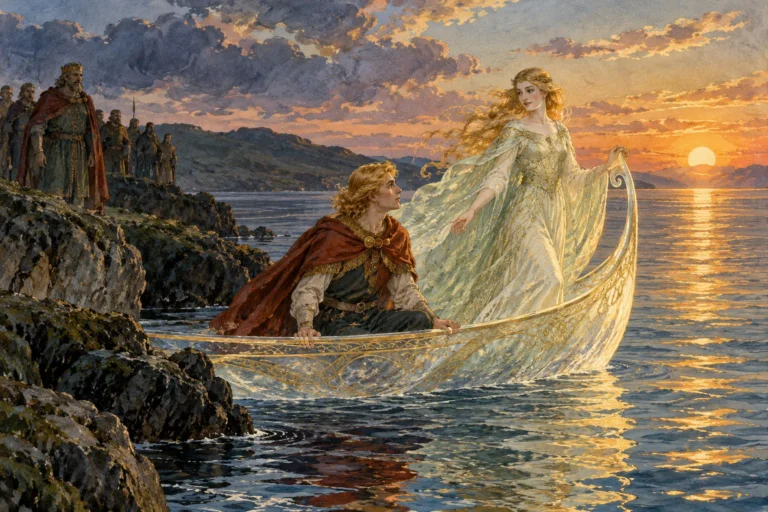
A year passed before the visitor returned. His first request was Ailbe, Cormac’s daughter. When he took her away, the women of Tara cried aloud. Cormac shook the branch and quieted their grief. A month later the warrior claimed his son, Cairbre Lifechair. Again the king used the music against the sorrow filling his household.
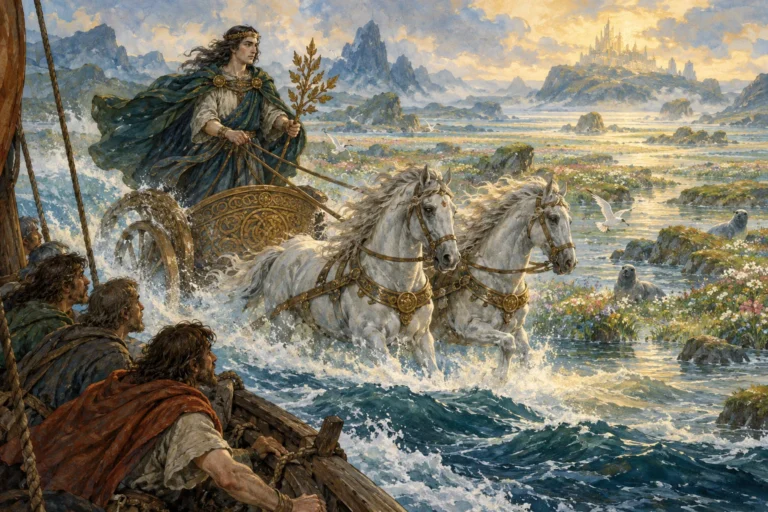
On the third visit, the stranger asked for Cormac’s wife, Ethne. This time Cormac followed. His people went after him, but a thick mist swallowed the company. When it cleared, the king stood alone on an unfamiliar plain.
He found a house within a bronze wall. Riders brought white birds’ wings to thatch its roof, but every fresh covering blew away. Nearby, a man fed an oak tree into a fire; by the time he returned with another, the first had vanished into the flames.
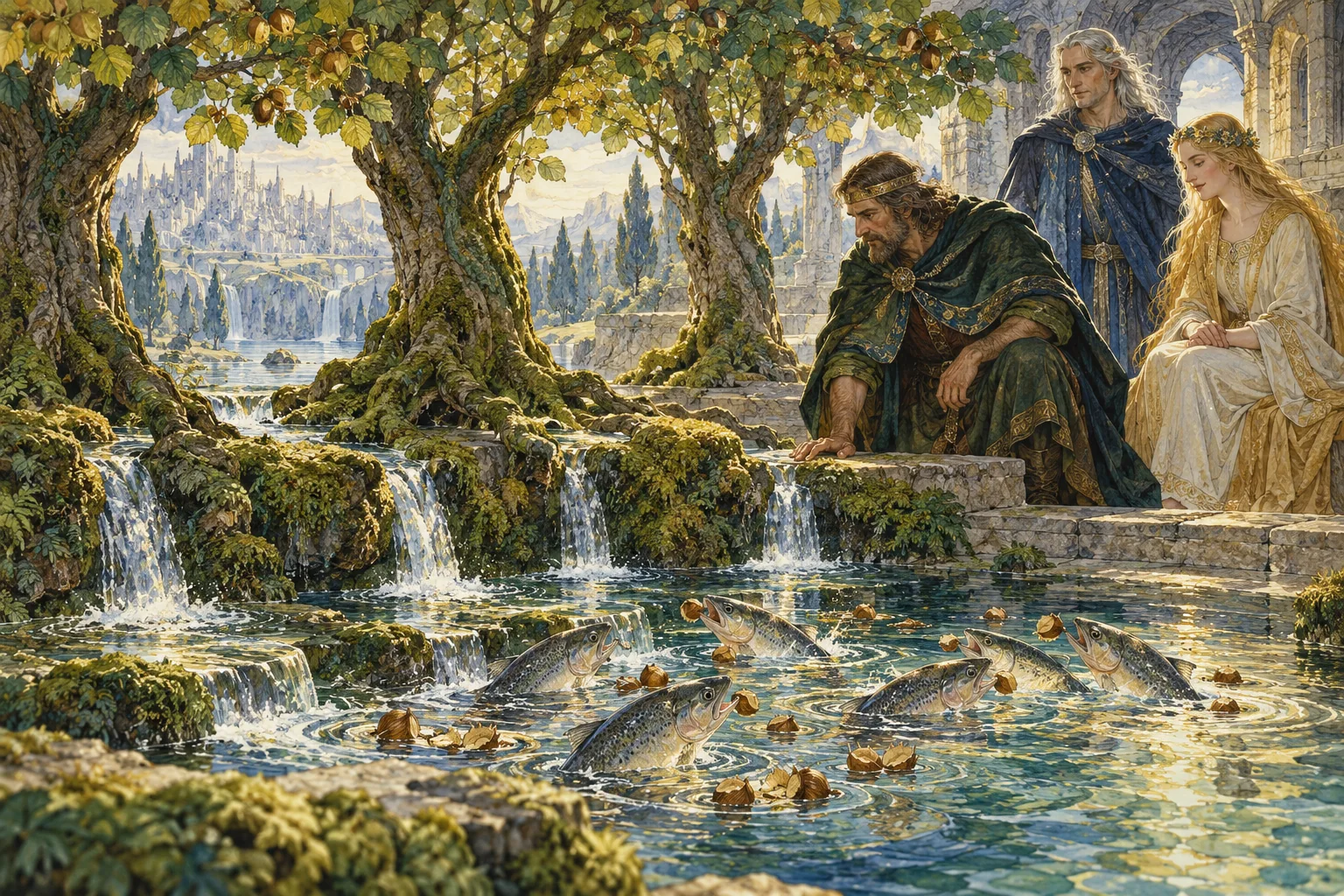
Cormac passed on to a greater stronghold. There a fountain sent out five streams beneath nine hazel trees. Nuts fell into the water, five salmon broke them open, and the husks drifted away. The music of the flowing water was more beautiful than any human song.
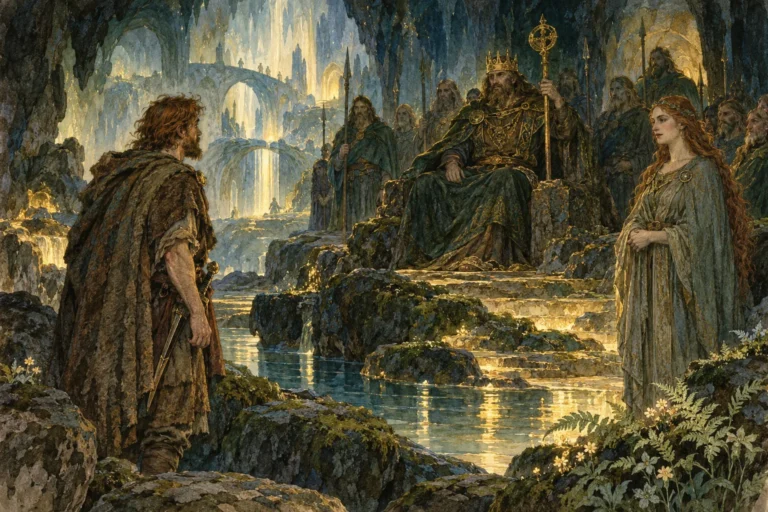
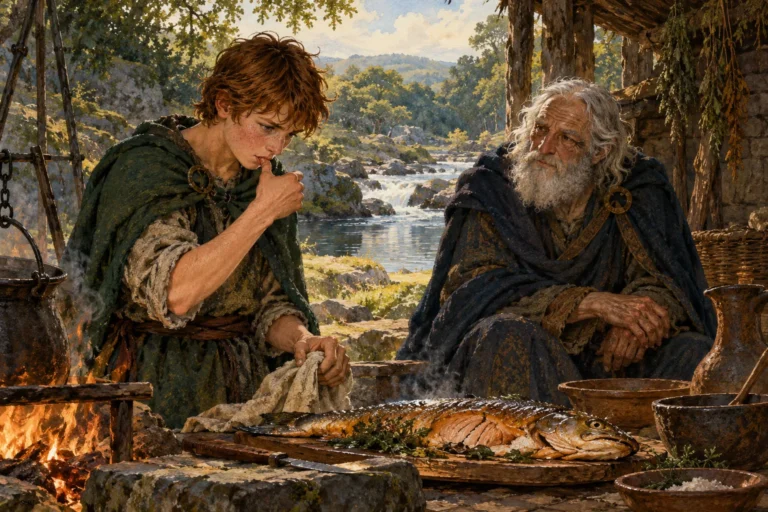
A handsome warrior and a golden-haired woman received him inside. A man brought a pig, an axe and a log to prepare a meal. But the pig would cook only when a true account was told for each quarter. The cook described how he had received the pig and the log as a reward: each morning both became whole again. His host told of a field that cultivated and harvested itself. The woman spoke of seven cows and seven sheep whose milk and wool supplied the people of that country.
For the final quarter, Cormac told the truth of his own journey. The food was ready, but he would not eat without his accustomed company of fifty. His host sang him asleep. When he woke, the company was there, with Ethne and their children.
The host now displayed a golden cup. Three false statements broke it apart; truthful declarations restored it. He revealed himself as Manannán son of Ler and explained that he had brought Cormac to see the Land of Promise. The unfinished roof and the hungry fire showed forms of human striving and expenditure. The fountain represented knowledge, and its streams the senses.
Manannán gave Cormac the cup for distinguishing truth from falsehood, and left him the branch for pleasure and music. At morning, Cormac found himself back on Tara’s green with his family and both treasures. The gifts remained with him during his life, but were not to outlast his death.
Versions and variations
Three apples become nine
Stokes’s translation, §25, specifies a silver branch carrying three golden apples. Gregory’s “His Three Calls to Cormac” instead gives the branch nine red-gold apples. The surrounding plot remains recognisably the same: three promises, the removal of the children and wife, the journey, the feast and the return. The changed number is a documented difference between these tellings, not evidence by itself of an independent local tradition.
Company at the feast and the meaning of knowledge
In Stokes (§52), Cormac says he never eats without fifty companions. Gregory recasts the objection as never having eaten with only two people present, although fifty warriors still appear when he wakes. Stokes’s explanation of the fountain (§53) explicitly identifies the five streams with the senses and requires drinking from the fountain and the streams. Gregory calls them the streams through which knowledge travels and initially uses or. These small wording changes affect how confidently a reader can build a precise philosophical system from a modern retelling.
What counts as a separate witness?
Gregory’s authorities name Stokes’s Irische Texte; her chapter must therefore be treated as a later adaptation, not independent confirmation. Stokes’s introduction identifies the Book of Ballymote and Yellow Book of Lecan, notes their shared errors, and points to a corresponding Book of Fermoy story and a modern recension in the Ossianic Society’s transactions. Those are valuable research leads. Their readings have not been independently collated for this entry, so no invented manuscript-by-manuscript variant list is offered.
Context and evidence
Stokes prints this adventure within a larger collection about judgments and ordeals. Its magical cup is therefore part of a sustained interest in how truth can be recognised, rather than just another wonder in an enchanted country. His introduction dates the two main manuscript witnesses to the later fourteenth century; that dates surviving copies, not Cormac’s journey. The story begins and ends at Tara, but supplies no route by which its Land of Promise can be plotted as an ordinary destination. Compare the knowledge-giving water and salmon with Fionn’s wisdom story, while keeping each text’s distinct plot.
Sources for this entry
- Anonymous; edited and translated by Whitley Stokes, The Irish Ordeals, Cormac’s Adventure in the Land of Promise, and the Decision as to Cormac’s Sword. Irische Texte, third series, part I (Leipzig, 1891), pp. 183–229; CELT T302000. Introduction; English translation §§25–54, pp. 211–216. Read source — Principal narrative; edition’s manuscript description and surrounding ordeals consulted.
- Lady Gregory, Gods and Fighting Men. First published 1904; consulted 1905 edition via Project Gutenberg. Part I, Book IV, chapter XI, His Three Calls to Cormac; Notes III. Read source — Directly compared later adaptation; bibliography names Stokes. About this book
Research coverage
The Stokes translation and Gregory adaptation have been examined. The separate Book of Fermoy and Ossianic Society recensions are identified by Stokes but not yet collated here. This entry does not claim to recover one original or every known version.
The Myths · Irish collection · Editorial approach
Further Reading