Place · County Kildare, Ireland
Hill of Allen
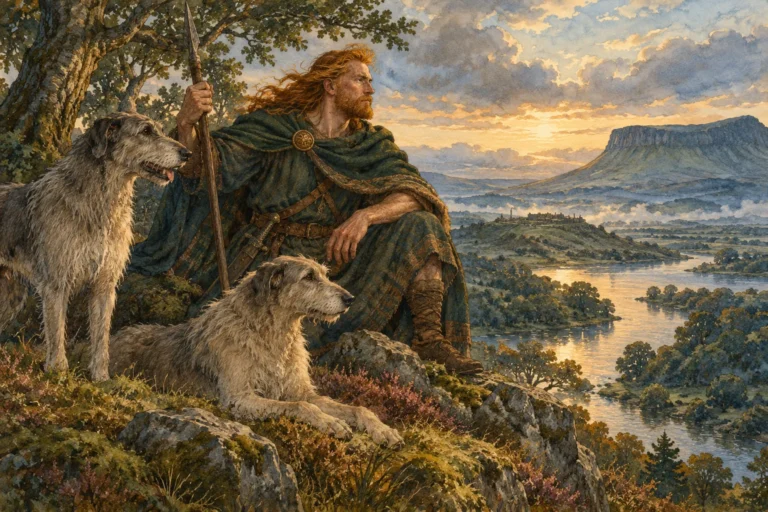
Fionn’s home in many Fenian stories: a place of welcome, hunting, family bonds and dangerous returns.
Also found as: Almu · Almhuin · Almain · Cnoc Alúine · Allen Hill
The home to which the Fianna return
Adventures carry the Fianna across Ireland and into strange countries, but many tellings bring them home to Almhuin. Lady Gregory describes it as Fionn’s residence in Leinster. Her stories repeatedly begin with a visitor arriving there, a feast being held, or the hunters setting out. The place gives the roaming company a household: people wait there, news arrives there, and relationships established there shape what happens far away. Gregory, Gods and Fighting Men, Part Two, Books One and Two.
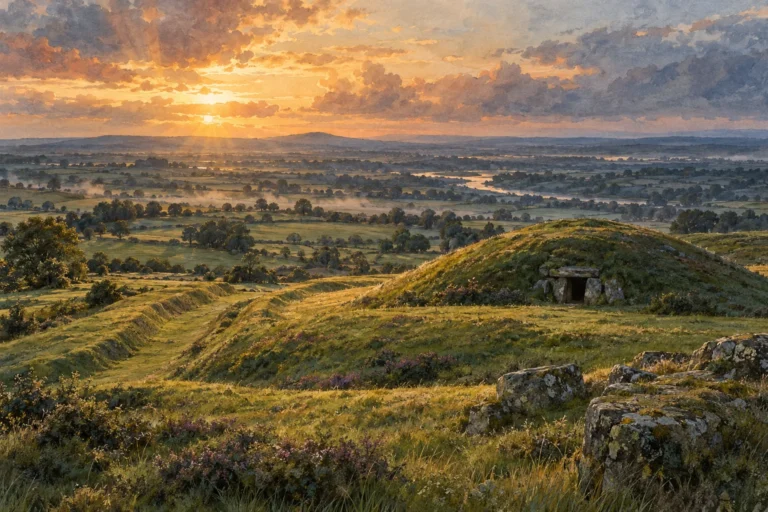
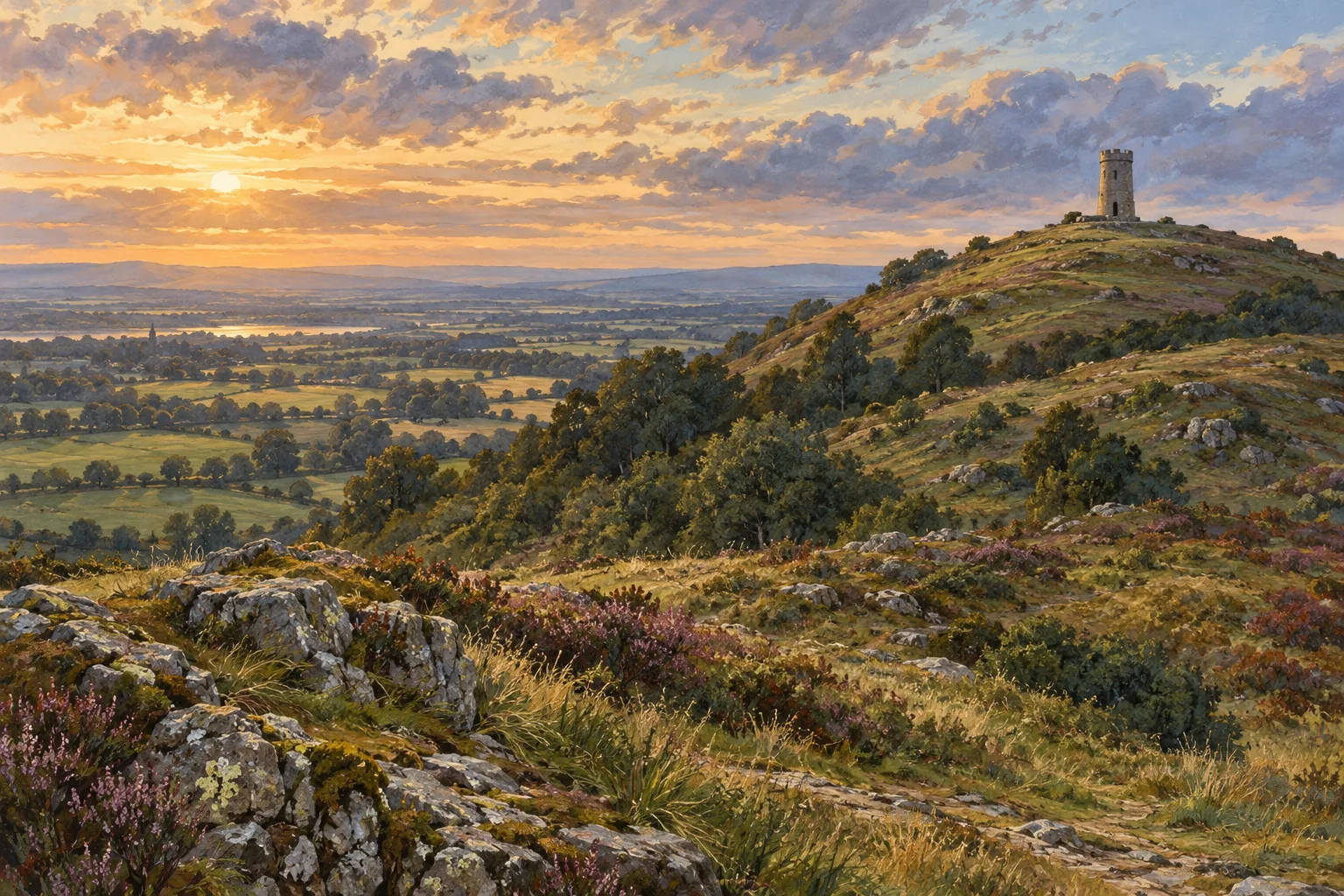
The Hill of Allen stands near Kildare. In his introduction to Gregory’s book, W. B. Yeats explicitly connects the hill he visited with the Almhuin of the stories. His account is valuable as a record of literary engagement with the landscape, rather than a survey establishing the site of Fionn’s buildings.
Three ways into the stories
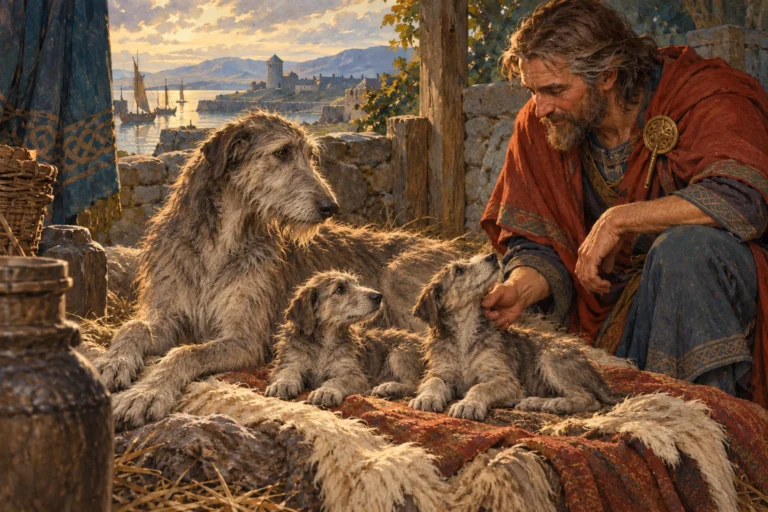
In Sadhbh’s story, the household offers protection. A hunted deer follows Fionn and his hounds home, and a woman emerges from the transformation. That safety depends on remaining within the enclosure. A false appearance of Fionn subsequently draws her out, turning the familiar gateway into the point of greatest danger.
In the birth of Bran and Sceólang, Fionn’s mother brings her sister Tuiren to Almhuin. A marriage arranged from that household creates obligations that Fionn must later enforce. The hounds’ human origin then helps explain their behaviour towards Sadhbh. Reading the two stories together reveals a connection that is easy to miss when each is treated as an isolated animal tale.
The pursuit of Diarmuid and Gráinne also starts from this social world: discussions at Almhuin lead towards a proposed marriage at Tara. Across these episodes, home can offer refuge, place people under obligations, or prepare the conditions for a quarrel. These associations follow Gregory’s chapters, whose source histories are examined on the linked story pages.
The tower and the older association
The conspicuous tower on the hill is a nineteenth-century building. Eileen Ryan’s 1963 newspaper account, preserved by Kildare Libraries, records construction beginning in 1859 and describes the masons and inscriptions. It also repeats a local belief that a skeleton found during construction belonged to Fionn. The article is evidence that this identification was reported; it supplies no scientific authentication of that belief. Read Ryan’s account.
A useful visit begins with that separation: the tower has a building history, the hill has a continuing life in tradition, and the literary residence has its own descriptions. None needs to be reduced to the other for the place to be worth exploring.
Sources for this place
- Lady Gregory; introduction by W. B. Yeats, Gods and Fighting Men. Digital text bearing 1905; first published 1904. Yeats’s introduction, section I; Part Two, Book One: The Coming of Finn, Birth of Bran, Oisin’s Mother; Diarmuid and Grania. Read source — Explicit identification of Hill of Allen with literary Almhuin and named narrative associations. About this book
- Eileen Ryan, preserved by Kildare County Archives and Local Studies, The tower on the Hill of Allen. Leinster Leader, 3 August 1963; digital republication 29 August 2007. Construction account and reported skeleton tradition. Read source — Local building history and a record of a later belief, not authentication of Fionn’s remains.
Research coverage
This entry examines the hill’s identification in Yeats’s introduction, selected Gregory stories and one documented local-history account. A complete archaeological site history and individual oral records remain to be added. Reviewed 17 October 2026.
The Myths · Irish collection · Editorial approach
Further Reading