Mythological Cycle; also a fore-tale to the Táin · story
The Dream of Aengus
A woman visits Aengus in dreams and disappears. Finding her draws his family and the rulers of Connacht into a search that ends among the swans of a mysterious lake.
Also found as: Aislinge Óenguso · The Dream of Óengus · The Dream of Angus · Aisling Aonghasa · Aengus and Caer
Research reviewed 17 October 2026.
Read the story
Version followed: this original retelling follows Lady Gregory’s “Dream of Angus” (1902), pp. 143–147. Her seasonal wording is retained; the medieval account’s Samhain setting is compared below.
The first time Aengus saw her, she stood beside his bed. He reached for her hand, but she vanished before he could speak. All the next day he thought of the stranger. When night came, she returned carrying a small harp. Its music sent him into a sleep from which he woke alone.
For a year the visits continued. Aengus knew the music and the face, but neither the woman’s name nor the place from which she came. Then she stopped appearing. He lay without appetite, growing weaker while the physicians searched for a bodily illness that they could not name.
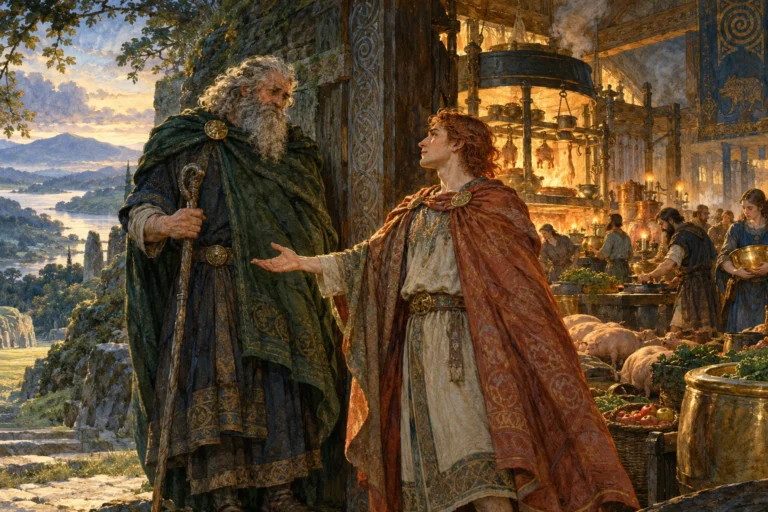
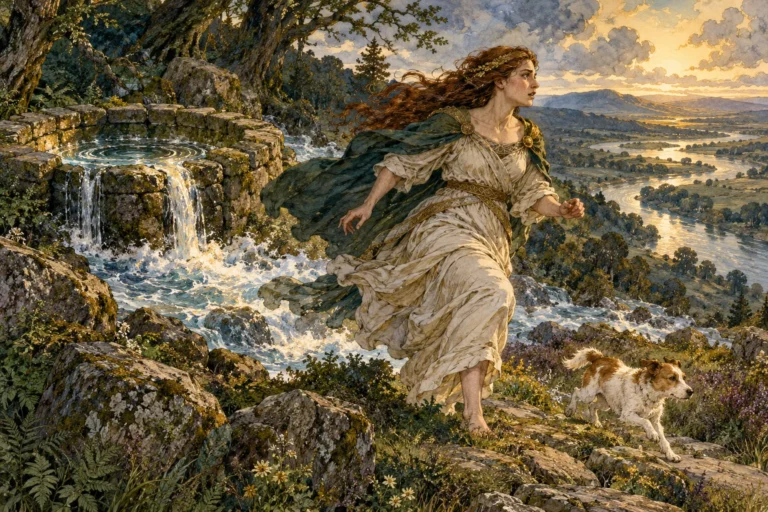
At last Fergne asked to speak to him alone. He recognised a suffering of the mind and persuaded Aengus to tell his dream. Fergne carried the account to Boann, Aengus’s mother. She sent people throughout Ireland to look for a woman matching his description. Another year passed without an answer.
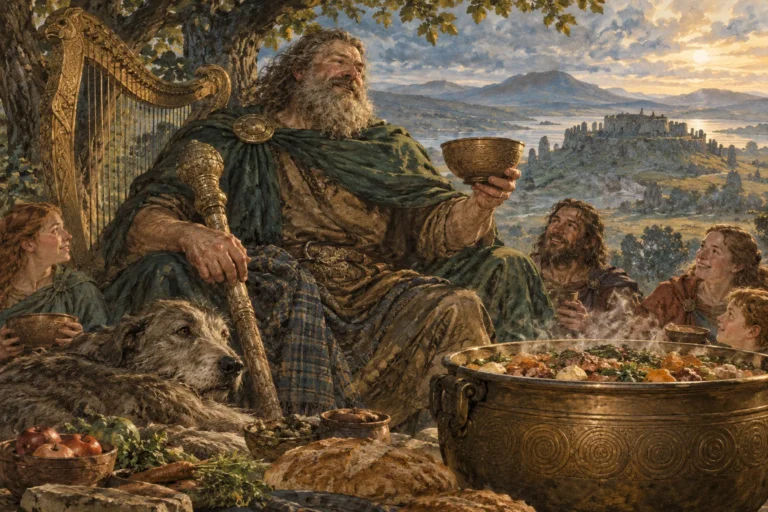
The Dagda was called to help his son. He protested that he knew no more than the physician, but Fergne reminded him of Bodb, whose knowledge might reach where their search had failed. Bodb undertook the task. After a further year, his messengers reported that he had found the woman at Loch Bél Dracon.
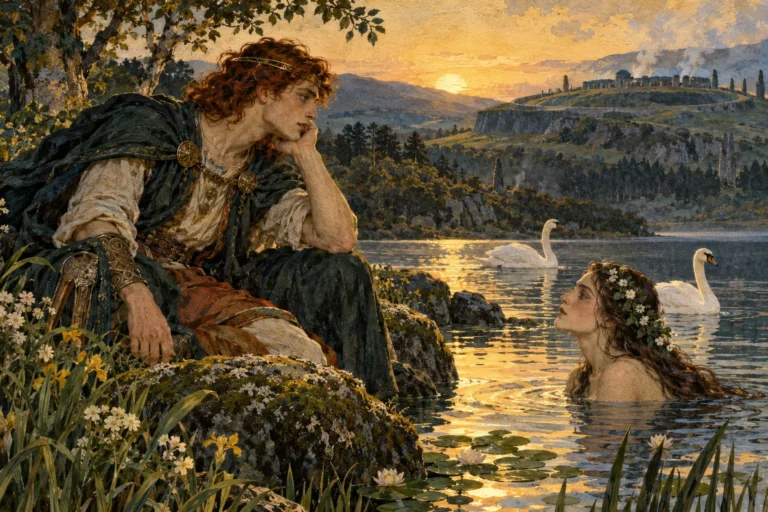
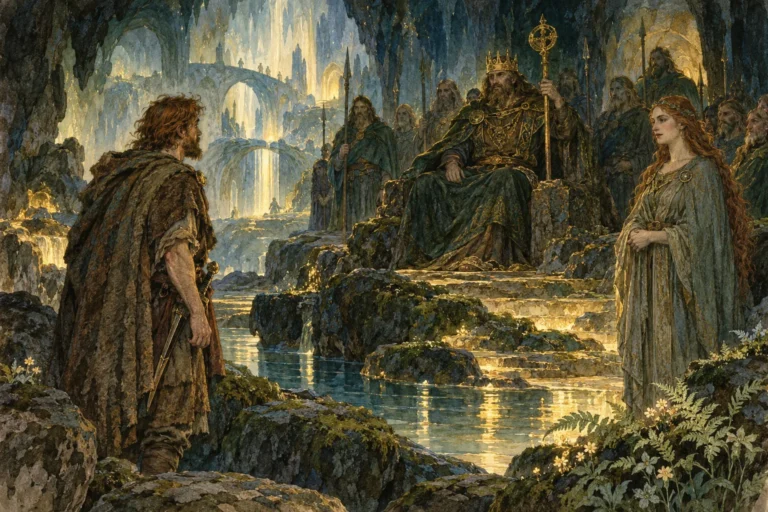
Aengus travelled to Bodb’s dwelling and was welcomed with a feast. Afterwards they went to see the women gathered by the water. There were a hundred and fifty, linked in pairs by silver chains. One wore a brilliant golden necklace. Aengus recognised her immediately. Bodb named her Caer, daughter of Ethal Anbuail, but warned that recognising her did not mean he could take her away.
Bodb advised the Dagda to approach Ailill and Medb, the rulers of the country where Ethal lived. The rulers said they could not simply give Caer to Aengus. They summoned her father, who refused to come. Their answer was force: the Dagda’s men and Ailill’s men attacked Ethal’s dwelling and brought him before them.
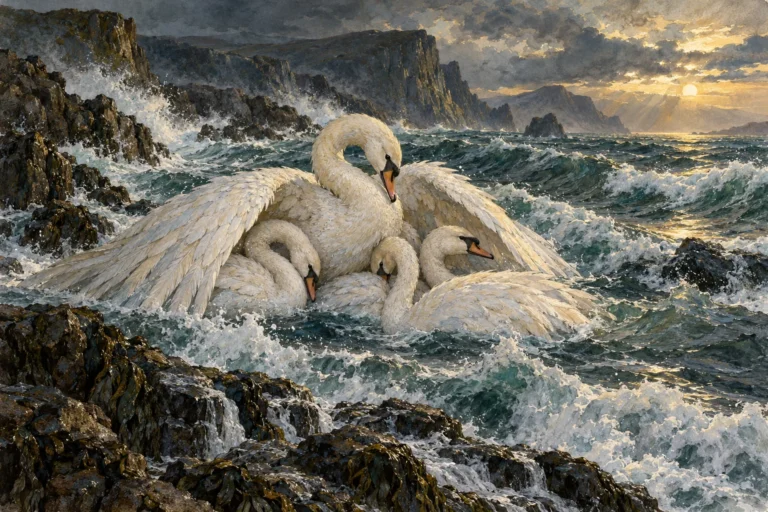
Even then Ethal said he could not grant their demand. Caer spent one year as a bird and the next in human shape. Threatened with death, he revealed where she could be found among a company of swans. Peace was made, Ethal was released, and the Dagda returned to his son. In Gregory’s telling, he tells Aengus to go to the lake the following summer.
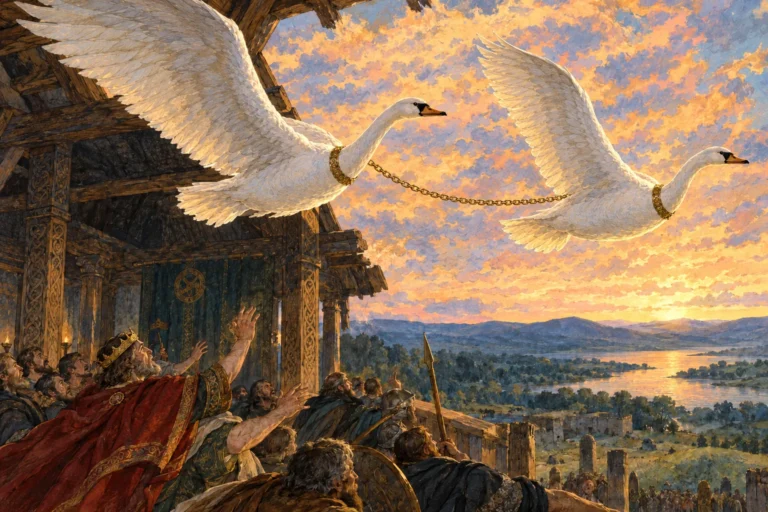
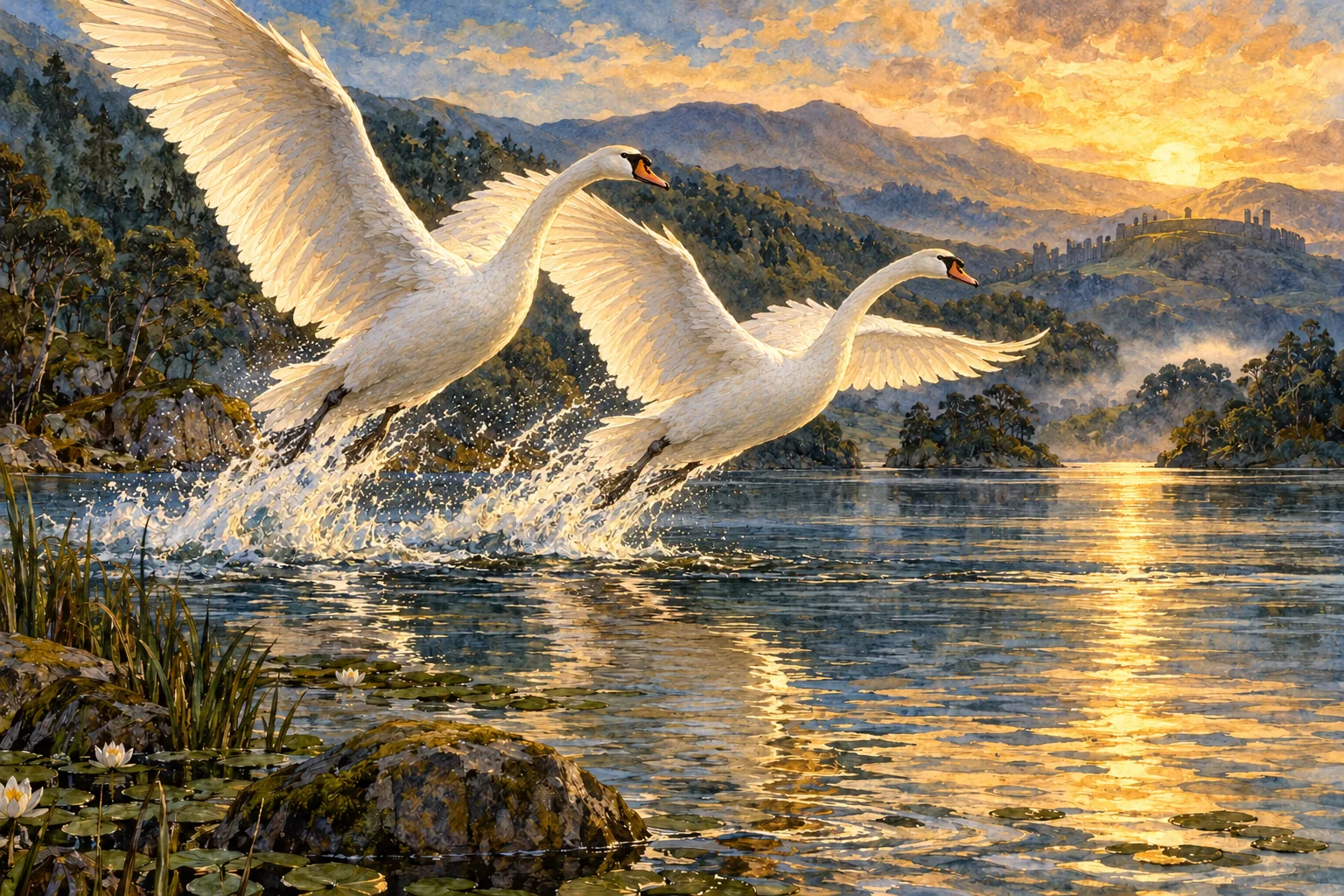
Aengus stood on the shore in human form and called Caer’s name. She answered and agreed to approach on his promise that he would not prevent her returning to the water. When she came, he put his hands upon her and became a swan himself. Together they circled the lake three times.
Then the two white birds rose and flew towards the Brú. Their music sent everyone who heard it into a sleep of three days and nights. Caer stayed with Aengus, and his friendship with Ailill and Medb endured: Gregory closes by linking it to his later help in their war for the Brown Bull of Cooley.
Versions and variations
The season changes
In Kevin Murray’s translation of Aislinge Óenguso, Ethal names the coming Samhain, and the Dagda repeats that date to Aengus. Gregory instead has Ethal say “next month” and the Dagda say “next summer”. The discrepancy should stay visible rather than be repaired without explanation. Murray, §§12–13; Gregory, p. 147.
Caer’s power and the violence of the search
Murray’s Ethal says that Caer’s own power exceeds his. Gregory describes a greater power over her and calls it an enchantment. Murray also specifies sixty heads taken in the raid; Gregory tells of the destroyed dwelling and captive father without that count. Both keep Caer’s condition that she may return to the lake. Murray, §§11–14; Gregory, pp. 146–147.
What kind of comparison is this?
These are two presentations of the same tale tradition, not two separately collected oral performances. Gregory identifies Müller’s Revue Celtique publication as her authority. Irish Sagas Online prints the medieval text from Francis Shaw’s edition alongside Murray’s English translation. The comparison can show what Gregory retained or changed; it cannot by itself tell us whether a difference originated with her, Müller or a manuscript reading. Gregory’s Notes, p. 360; Irish Sagas Online, edition credits.
The final connection to Ailill and Medb also matters. The romance has a place in the wider cattle-raid story, rather than existing only as a self-contained account of two lovers. Both presentations preserve that link.
Context and evidence
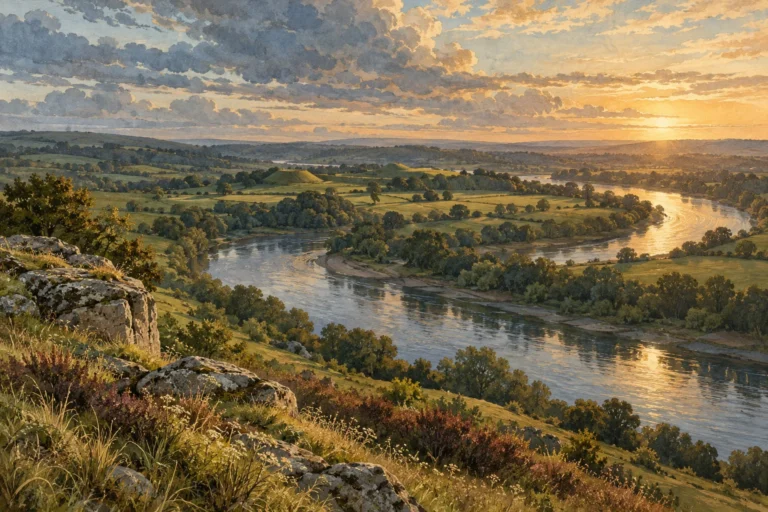
The supernatural lovers return to a real landscape around the Boyne, but the narrative does not document the construction or original purpose of its monuments. The Brú na Bóinne place guide separates that archaeological history from the stories attached to it.
The dream, the search and the swan transformation invite comparison with the Children of Lir and Étaín. Shared birds or transformations do not by themselves prove that one tale descended from another. Here the comparison is a reading route, not a demonstrated genealogy of stories.
Sources for this entry
- Lady Gregory, Cuchulain of Muirthemne. London: John Murray, 1902; online transcription checked against the first edition, with the archive’s edition note. VIII, Dream of Angus, pp. 143–147. Read source — Named basis of the original dream retelling.. About this book
- Lady Gregory, Cuchulain of Muirthemne: Notes. 1902. pp. 356–360; Dream of Angus and Cruachan source lists. Read source — Documents Gregory’s dependence on earlier editions and her practice of rearranging passages.. About this book
- Anonymous; English translation by Kevin Murray, Aislinge Óenguso / The Dream of Óengus. Irish Sagas Online; Irish text edited by Francis Shaw, 1934, pp. 43–64. §§11–15. Read source — Brief comparison of the medieval narrative as translated: Samhain, Caer’s power, the raid and the return to the Brú. Not the prose basis for the retelling..
Research coverage
Gregory’s complete chapter and Murray’s relevant passages have been examined. Müller’s original printing and Shaw’s manuscript apparatus have not yet been collated; modern literary versions, local lake identifications and oral-archive records remain to be added.
The Myths · Irish collection · Editorial approach
Further Reading