Fenian Cycle · story
Oisín in Tír na nÓg
Oisín follows Niamh across the sea to a country where youth lasts. When he returns to Ireland, the friends he remembers have become figures in old stories.
Also found as: Oisin in Tirnanoge · Oisin in the Land of Youth · Ossian · Niamh of the Golden Hair · Niamh Chinn Óir · The Last of the Fena
Research reviewed 17 October 2026.
Read the story
This retelling follows P. W. Joyce’s “Oisin in Tirnanoge”, including its stone-lifting ending. Gregory and Curtin tell the return differently.
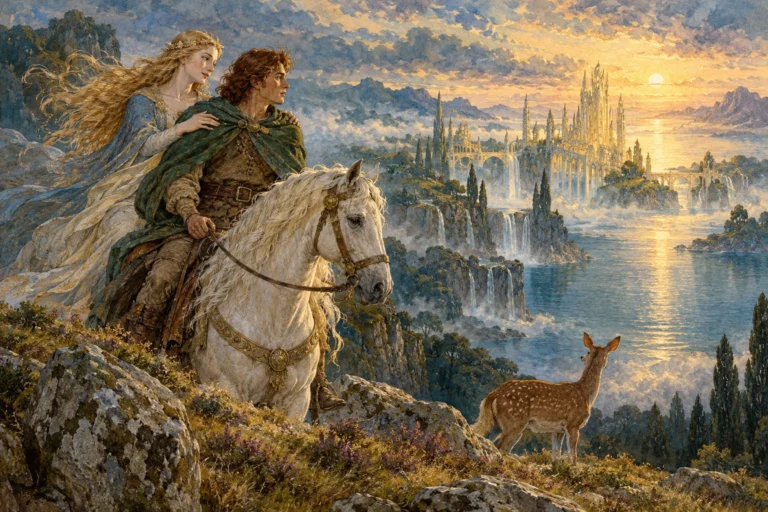
The Fianna were hunting beside Lough Leane when a woman approached on a white horse. She wore a golden diadem, and her hair shone against her cloak. Fionn stopped the hunt and asked where she had come from.
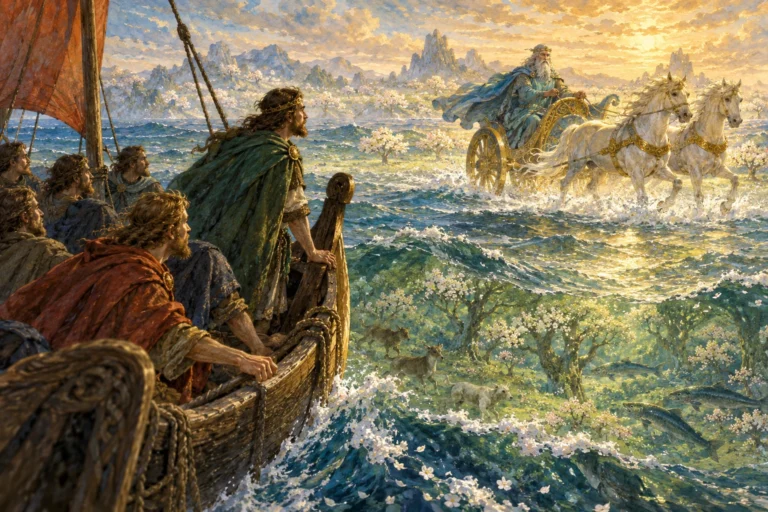
She was Niamh, daughter of the king of Tír na nÓg. Reports of Oisín’s courage and gentleness had reached her own country, and she had crossed the sea to seek him. She offered a land of music, feasting and abundance, where time would never wear away his strength. Oisín loved her as soon as they spoke. He agreed to ride with her.
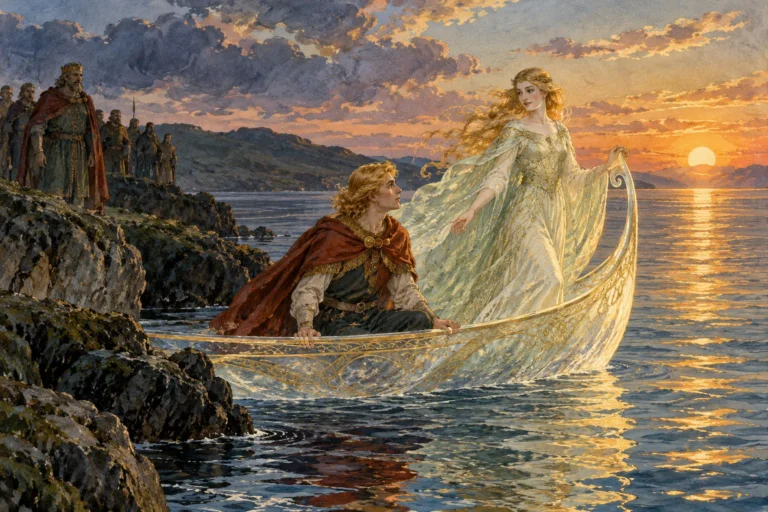
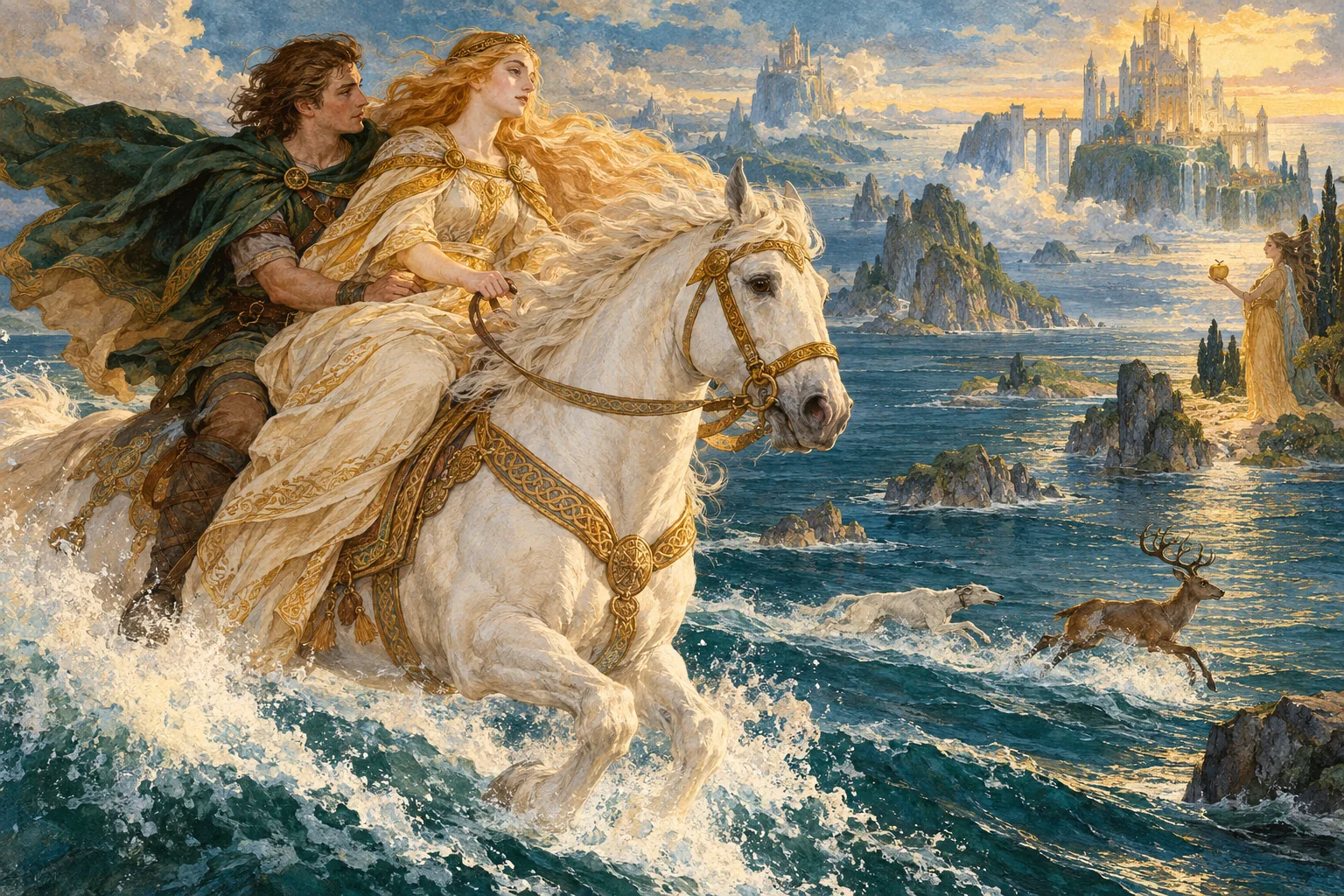
Fionn took his son’s hand before he left. Oisín promised to return, but his father’s grief was already the grief of farewell. Then Oisín mounted behind Niamh, and the white horse carried them out over the waves.
Strange sights passed on the sea: a deer pursued by a hound, a woman carrying a golden apple, distant palaces and islands. At one palace they found a captive princess. Oisín fought the giant who held her, defeated him after a long struggle, and continued the journey once his wounds were healed.
Tír na nÓg was everything Niamh had promised. Her parents welcomed him, a feast lasted ten days, and he married her. More than three hundred years passed, although Oisín felt that only three had gone by.
Then he began to miss Ireland. He wanted to see Fionn and his companions, and he asked permission to visit. Niamh consented with grief. Ireland had changed, she warned. The Fianna were gone. If he left the horse and put his feet upon Irish ground, he could never return to her.
He promised to remain mounted. But the Ireland he reached was filled with strangers. When he asked for Fionn, people spoke of a hero from the distant past. They even knew a story about that hero’s son, who had vanished with a woman from another world. At Allen, Oisín found ruins and weeds where his father’s hall should have stood.
At Glenasmole he came upon men trapped beneath a great stone. Leaning from the saddle, he seized it and threw it aside. The effort broke the saddle-girth. He fell to the ground.
At once his youth and strength deserted him. The white horse fled, and Oisín lay blind, wrinkled and helpless. He survived to tell Patrick what had happened, remembering Niamh and the companions he could no longer reach. He had returned to his own country, but not to his own time. Read Joyce, pp. 385–399.
Versions and variations
Three different reasons for touching the ground
P. W. Joyce: the named Niam leads Oisín overseas; he rescues a captive princess on the way. On returning, he helps men lift a stone at Glenasmole. His saddle-girth breaks, and he falls. Joyce identifies the Irish verse tale printed and translated by O’Looney as a source; his English is a literary rendering. Preface, p. xvi; story, pp. 385–399.
Lady Gregory: Niamh brings Oisín away, but the return turns on memory rather than an accident while helping strangers. At Almhuin he recognises the Fianna’s stone washing trough, forgets the warning and gets down. Gregory also reports uncertainty about the duration of his absence, rather than imposing one universal number. Her arrangement draws on printed authorities, including Ossianic Society material. Part II, Book XI, chapter I; Notes III.
Jeremiah Curtin: the princess is unnamed and has been given a pig’s head by her father to prevent her marrying. Oisín’s marriage releases her, and he wins her kingdom in a race. On his return to Knock Patrick he uncovers the Fianna’s horn beneath a stone, then touches earth while reaching for it. He becomes old and blind. The chapter continues with further adventures involving Patrick. These are substantial differences, not alternative spellings of Joyce’s version. pp. 230–242.
Context and evidence
Oisín telling his own past to Patrick is a storytelling frame, not an eyewitness interview that can be dated as ordinary history. Joyce’s preface distinguishes the verse source from his English rendering. Gregory openly explains that she sometimes moves material between accounts, so her narrative should not be used as a transparent transcript of one original. The comparison here shows why a place directory needs source-specific associations: Glenasmole, Almhuin and Knock Patrick belong to different returns. Tír na nÓg itself is an Otherworld setting. Giving it a pin on a modern map would imply a geographical certainty these narratives do not provide. Joyce’s preface; Gregory’s Authorities.
Sources for this entry
- P. W. Joyce, Old Celtic Romances. 1920 edition displayed by Project Gutenberg; work first published 1879. Oisin in Tirnanoge; or, The Last of the Fena, pp. 385–399; preface p. xvi; notes CLI and CLIV. Read source — Principal retelling, stone-lifting ending and declared literary source; directly consulted. About this book
- Lady Gregory, Gods and Fighting Men. 1905 edition displayed by Project Gutenberg; work first published 1904. Part II, Book X, chapter II, The Call of Oisin; Book XI, chapter I, Oisin’s Story; Notes III, The Authorities. Read source — Trough ending and composite literary arrangement; directly consulted. About this book
- Jeremiah Curtin, Myths and Folk Tales of Ireland. Project Gutenberg text no. 36540, with printed page markers; collection first published 1890. Oisin in Tir na n-Og, pp. 230–242; otherworld journey and return pp. 230–235. Read source — Different printed folktale: transformed princess, race for kingship and horn ending; directly consulted. About this book
Research coverage
Three published accounts compared. Still to examine directly: the Irish lay and O’Looney/Flannery editions, the evidence for its attribution to Mícheál Coimín, and individually catalogued Irish and Scottish oral versions. Joyce and Gregory share printed source traditions and are not counted as independent oral attestations. The familiar modern claim that Oisín dies immediately on touching earth is not used: these examined accounts continue with his old age.
The Myths · Irish collection · Editorial approach
Further Reading