Local folklore · figure
The Bwbach and Welsh household spirits
Welsh domestic spirits can churn butter, disrupt a household or travel with its possessions. Collectors’ categories overlap, and the individual stories matter.
Also found as: Bwbachod · Boobach · Welsh household spirits
Research reviewed 17 October 2026.
A helper at the hearth
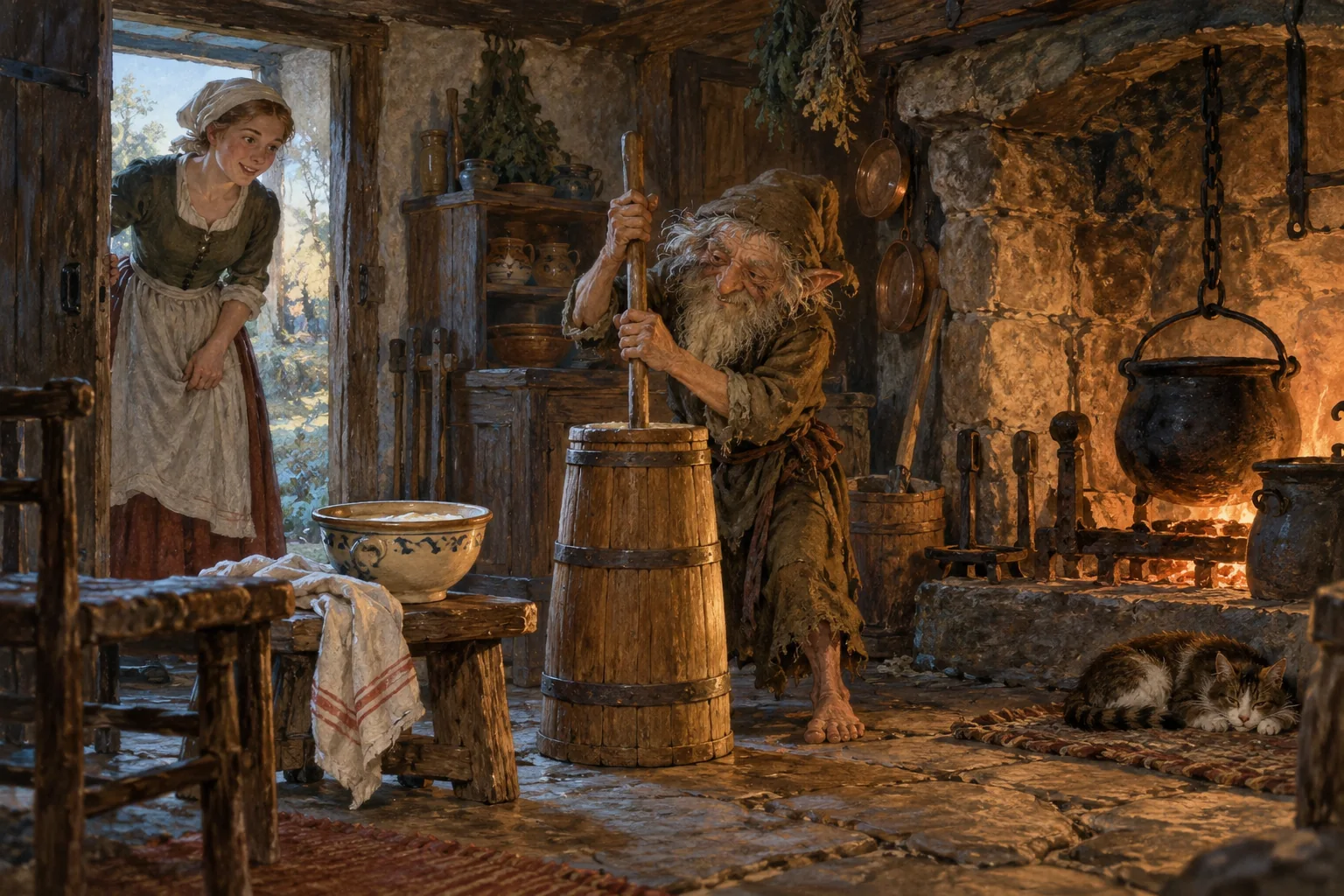
In British Goblins, Sikes describes a bwbach rewarding a tidy household. A maid leaves cream beside the hearth and a filled churn ready for work. In the morning the cream offering is gone and the butter is almost made. This is an arrangement involving preparation and hospitality, not simply magic performed on demand.
The same book gives less comfortable encounters. A bwbach in Cardiganshire torments a visiting Baptist preacher, interrupts prayers and appears as his double. Sikes tells the episode with humour at the preacher’s expense. That sectarian attitude belongs to the collector’s presentation, not to a universal Welsh view of religion.
At Hendrefawr in Merionethshire, a farmer called Dewi tries to rid himself of a troublesome bwbach. A wise woman tells him to pretend to move to England, circle Arenig and return another way. The spirit instead travels inside a churn on the cart and announces that it too is moving. Dewi turns back: changing the household’s address has not ended the relationship.
Versions and variations
Different named beings, overlapping jobs
Sikes calls Rowli Pugh’s workers ellyllon while noting their similarity to his bwbach category. With the Pwca of Trwyn, he hesitates between household fairy and familiar spirit. These are visible uncertainties in an author’s scheme, not errors to erase by imposing a fixed creature list.
Hendrefawr and Trwyn
Hendrefawr’s churn episode and Trwyn’s journeys in barm or yarn share a travelling-spirit idea. Their names, routes and circumstances differ. Keep the episodes attached to their own places rather than producing a combined “Welsh goblin” biography.
Comparisons beyond Wales
Brownies and the Manx Fynoderee also bring supernatural labour into domestic life. The Cauld Lad can be classed as a helper or a ghost. These parallels show recurrent narrative possibilities; they do not establish that all the names denote one creature.
Context and evidence
The value of a source such as Sikes lies both in the stories it preserves and in the opportunity to examine how a nineteenth-century writer arranged them. His broad theories of etymology and ancient religion require separate assessment and are not adopted here.
The episodes examined are accounts of beliefs and storytelling. They do not establish the physical existence of a household spirit or provide proof of the historical identities of every person mentioned.
Sources for this entry
- Wirt Sikes, British Goblins: Welsh Folk-Lore, Fairy Mythology, Legends and Traditions. London: Sampson Low, Marston, Searle & Rivington, 1880. Book I, chapter II, sections I, III and XI–XII; chapter IX, sections III–IV; Book II, chapter V, section I. Read source — Definitions, domestic work, Hendrefawr, Trwyn and the author’s classification difficulties. About this book
Research coverage
This initial guide is anchored in the specified Sikes passages. It is not a complete catalogue of Welsh-language bwbach traditions. The Welsh names and the collector’s uncertainty are retained rather than converted into a fixed taxonomy.
The Myths · Welsh collection · Editorial approach
Further Reading