Local folklore · story
The Cauld Lad of Hylton
An unpredictable kitchen spirit leaves when given clothes. Another strand of the same local tradition identifies him as a boy killed by the castle’s owner.
Also found as: Cauld Lad of Hilton · Cold Lad of Hylton
Research reviewed 17 October 2026.
Read the story
This account follows Henderson’s 1879 description of the household spirit. The murdered-boy explanation is kept distinct below.
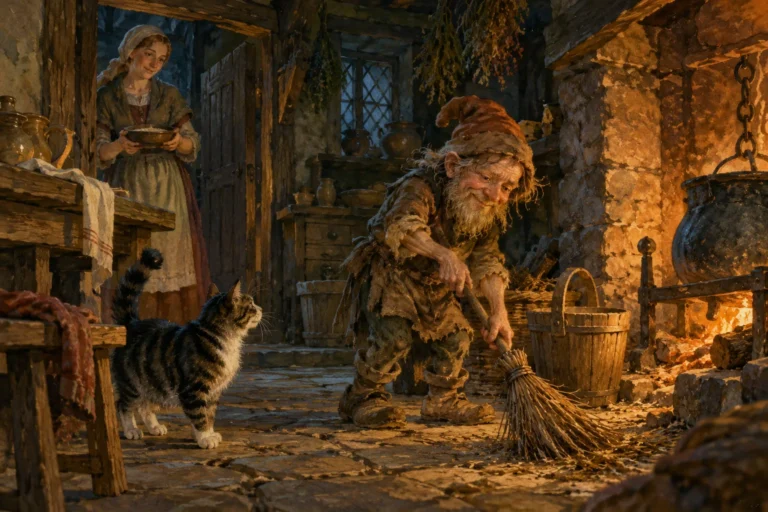
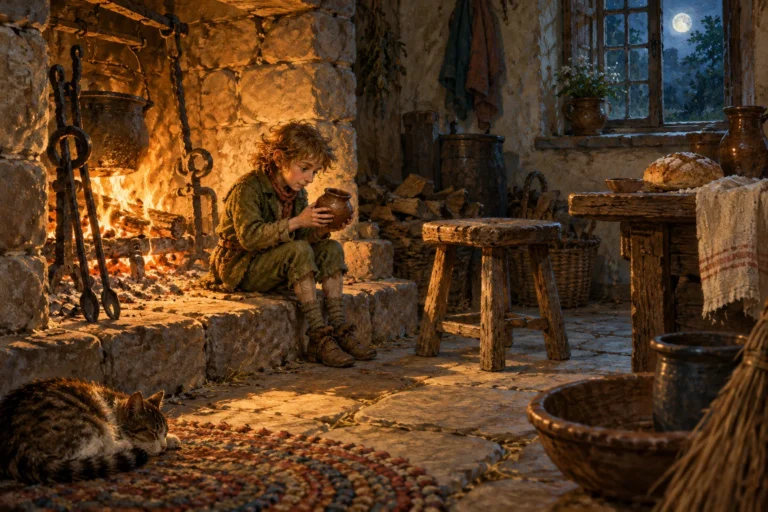
The servants at Hilton Castle rarely saw the visitor who came to the kitchen at night, but they knew where he had been. If they had left everything in order, he hurled it about. If they left the room in confusion, he put it carefully to rights. His work was as contrary as his presence was unsettling.
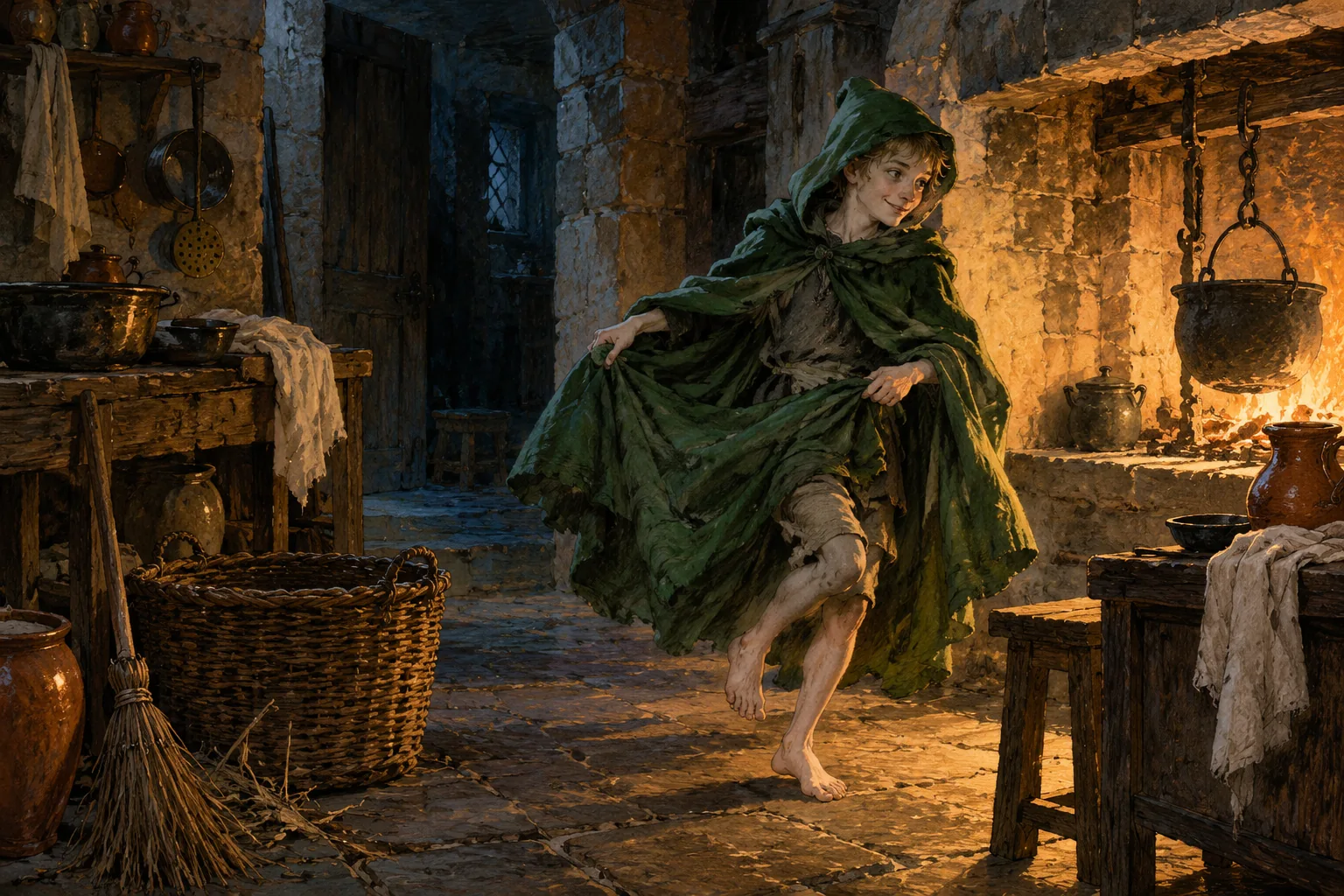
Eventually the household grew tired of the disturbance. The servants placed a green cloak and hood beside the kitchen fire and waited to see what would happen. At midnight the Cauld Lad appeared. He examined the clothes, put them on and frisked about in them.
At cockcrow he disappeared. His parting words announced that, now he had a cloak and hood, the Cauld Lad of Hilton would do no more good. The gift which might have clothed an ordinary servant instead brought this strange domestic service to an end.
There was also a darker way of explaining him. Local people, Henderson says, considered him the ghost of a servant-boy. Ordered to have a horse ready, the boy had fallen asleep. An angry baron struck him with a hay-fork and killed him, concealed the body under straw and later put it in a pond. A reported later discovery of bones formed part of that account.
Henderson preserves a lament in which the spirit waits for the future person who will lay him to rest. Even the tree that will supply wood for that person’s cradle has yet to grow. This gives the apparently comic kitchen visitor a very different emotional setting: a dead child waiting beyond any ordinary human lifetime.
Versions and variations
Henderson: helper and ghost
Henderson does not make a final choice between categories. The household behaviour resembles a brownie, while local explanation makes the visitor a murdered servant. His text records the reported bones within the legend; it does not supply an excavation record establishing their identity.
Jacobs: a shaped fairy tale
Jacobs turns the material into “The Cauld Lad of Hilton”. He gives the servants a henwife adviser and develops the behaviour of a brownie. In his note XXXVIII he names Henderson, second edition, pp.266–267, and says that his introductory paragraph uses broader material from pp.246–253. Jacobs is therefore a dependent adaptation, not a second independent local witness.
A modern local ending
Hylton Castle Trust names the boy Roger Skelton and tells a version in which the clothed spirit continues doing good. That differs from the departure in Henderson and Jacobs; it is recorded here as modern interpretation, not silently substituted for their endings.
Context and evidence
The Trust also cites J. B. Taylor’s report of an inquest dated 3 July 1609 concerning Roger Skelton, allegedly killed accidentally with a scythe by Robert Hylton. That is an indirect archival lead: neither the original inquest nor pardon has been inspected for this entry. It cannot authenticate the haunting.
The clothing gift connects the tale with Aiken-drum and the Fynoderee. Its meaning depends on the telling: dismissal, release, offence and continuing service should not be treated as one universal explanation. Hylton Castle’s documented building history belongs in the associated place guide, separately from these supernatural accounts.
Sources for this entry
- William Henderson, Notes on the Folk-Lore of the Northern Counties of England and the Borders. New edition, London: Folk-Lore Society, 1879. Chapter VII, Cauld Lad of Hilton passage; pp.266–267 as cited by Jacobs. Read source — Main account and explicitly preserved ghost explanation. About this book
- Joseph Jacobs, English Fairy Tales. First published London: David Nutt, 1890; Project Gutenberg eBook 7439, print impression not specified. “The Cauld Lad of Hilton”, and Notes and References, XXXVIII. Read source — Adaptation of Henderson; Jacobs identifies his added introductory material. About this book
- Hylton Castle Trust, The History of Hylton Castle. Web interpretation, consulted 17 October 2026. “The Cauld Lad of Hylton”. Read source — A modern local telling and an indirect historical lead; the cited inquest has not been independently inspected here.
Research coverage
Henderson’s complete Cauld Lad passage, Jacobs’s tale and source note, and the Castle Trust’s modern interpretation were examined. The cited historical inquest and pardon remain unverified primary-document leads. No claim is made to have collated every local retelling.
The Myths · English collection · Editorial approach
Further Reading