Local folklore · story
The Pwca of Trwyn Farm
An unseen visitor knocks, talks and plays the fiddle at a Welsh farmhouse. Other accounts give it remarkably different ways of arriving.
Also found as: Pwca’r Trwyn · Puck of Trwyn
Research reviewed 17 October 2026.
Read the story
The main narrative follows Sikes, Book II, chapter V. His separate stories of the spirit’s arrival are compared below rather than joined into one continuous adventure.
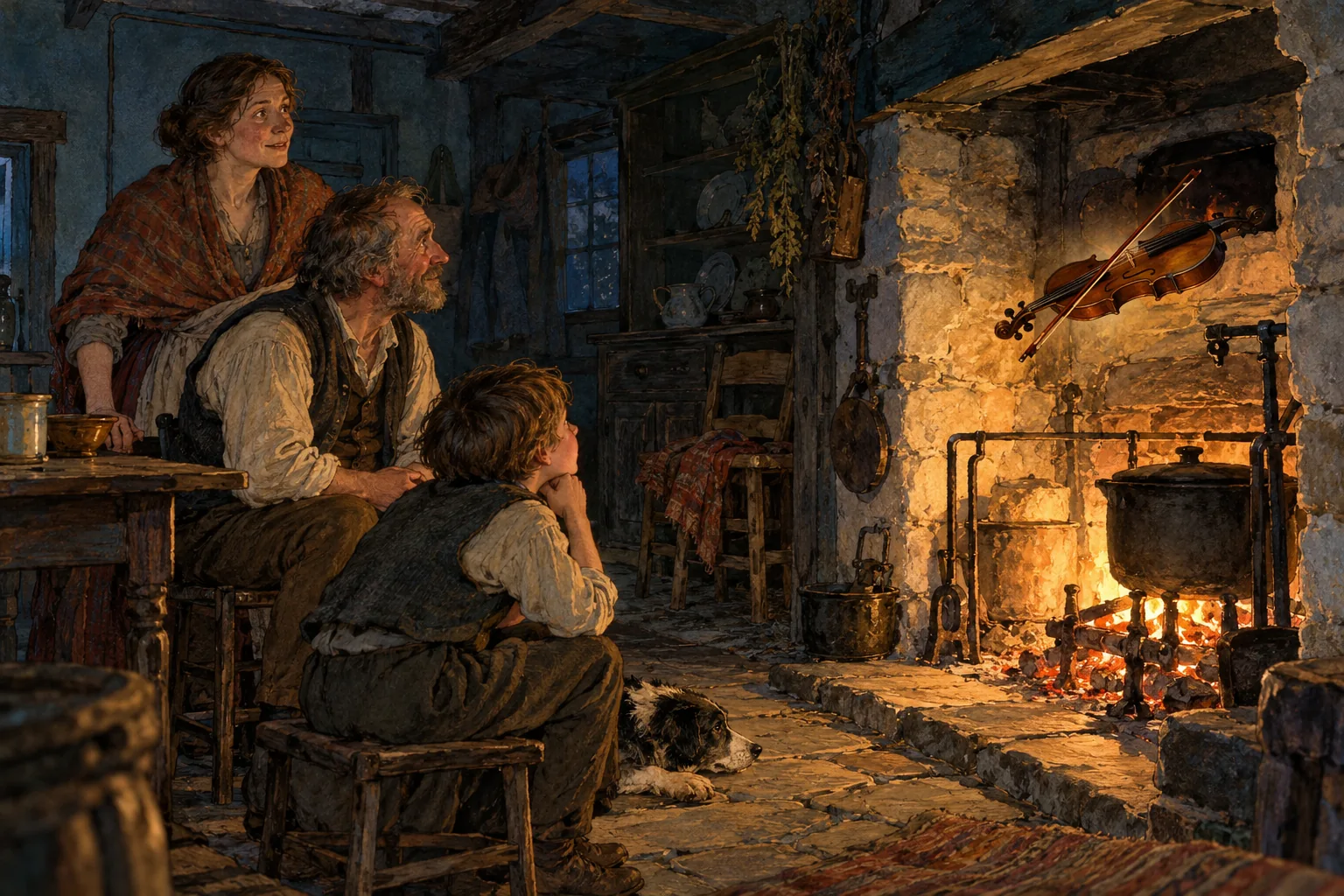
At Trwyn Farm, in the parish Sikes spells Mynyddyslwyn, Job John Harry and his household began to hear knocking at the outer door after dark. Whoever went to answer found nobody there. The repeated disturbance became more alarming when the invisible visitor spoke.
News spread, and neighbours came to keep watch. Thomas Evans brought a gun, intending to shoot the spirit. That evening Job was still on his way home when the voice met him in the lane. It knew about the gun and announced that it would punish the visitor who had brought it.
Inside the house, stones began striking Thomas. The other people tried to protect him, but the blows reached him and no one else. He fled with his weapon and did not return to attempt the experiment again.
As the household grew used to the visitor, it became more talkative. Its voice could be heard from the oven beside the hearth. It played Job’s fiddle at night and once touched his toe as he went to bed. A neighbour threatened it with a knife, only to be reminded that he could not see what he proposed to stab.
The family, finding that the spirit did not harm them, began to enjoy its conversation. Asked where it had come from, it named Pwll y Gasseg. It also recognised people who tried to put questions to it through intermediaries. The visitor appeared to know the household before the household knew anything about it.
Its stay ran from shortly before Christmas to the Wednesday after Easter. Then it said farewell to Job. Asked where it was going, it answered that it would go where God pleased. The voice that had first made the family afraid departed without giving them a fuller explanation.
Versions and variations
Two different arrival stories
In Book I, chapter IX, Sikes records a servant carrying the pwca from Pantygasseg in a jug of barm, the ferment used in brewing. He then gives another story: it announces that it will travel in a fallen ball of yarn, which rolls down a hillside, across a valley and up towards Trwyn. These are alternative accounts of its movement, not stages that the main narrative says happened in sequence.
Invisible, with an exception
Sikes’s longer account makes the spirit invisible. He also reports a tale of a white hand thrust through a floor to girls below. He acknowledges chronological disagreement between accounts. His decision to put the being among familiar spirits rather than fairies is an editorial classification, not a fact accepted by every teller.
A visitor that travels with a household
Sikes’s nearby account of the bwbach of Hendrefawr gives another moving-house trick: a farmer tries to escape his spirit by pretending to leave, only to hear it speak from a churn on his cart. That story is a parallel in travelling household spirits. It is not evidence that Hendrefawr and Trwyn are the same farm.
Context and evidence
Sikes says he gathered information in the neighbourhood of Trwyn, while the tenants then in residence were newcomers. His book provides a collecting context and multiple pieces of tradition, but not a transcript identifying each speaker and the date of every statement. The name Job John Harry should therefore be treated as part of the reported narrative unless separately documented.
The Welsh pwca and the Irish púca invite comparison, particularly when they interfere with travel or farm work. A resemblance of names and actions does not make any one Irish story a variant of the Trwyn haunting. The linked figure guides preserve those distinctions.
Sources for this entry
- Wirt Sikes, British Goblins: Welsh Folk-Lore, Fairy Mythology, Legends and Traditions. London: Sampson Low, Marston, Searle & Rivington, 1880. Book II, chapter V, section I, pp.187–190; Book I, chapter IX, sections III–IV, pp.116–118. Read source — Main household narrative, alternative journeys in barm and yarn, and the separately located Hendrefawr comparison. About this book
Research coverage
The complete passages cited in Sikes were examined. Their differences are preserved, but their underlying oral or printed transmission has not been fully reconstructed. Earlier accounts and modern identifications of the farm have not been independently collated.
The Myths · Welsh collection · Editorial approach
Further Reading