Collected folktales · story
The Piper and the Púca
A poor musician rides a horned púca to a feast inside Croagh Patrick. By morning, his gold has become leaves, but a more lasting gift remains.
Also found as: The Piper and the Puca · The Piper and the Pooka
Research reviewed 17 October 2026.
Read the story
This original retelling follows Douglas Hyde’s “The Piper and the Puca”, pp. 95–97, in W. B. Yeats’s Fairy and Folk Tales of the Irish Peasantry. The anthology labels it a literal translation from the Irish of Leabhar Sgeulaigheachta.
There was a piper in Dunmore, County Galway, who loved music much more than his music rewarded the listener. He could play only one tune, the Black Rogue. People with money sometimes paid him for the amusement he provided, but he had little reason to expect a great career.
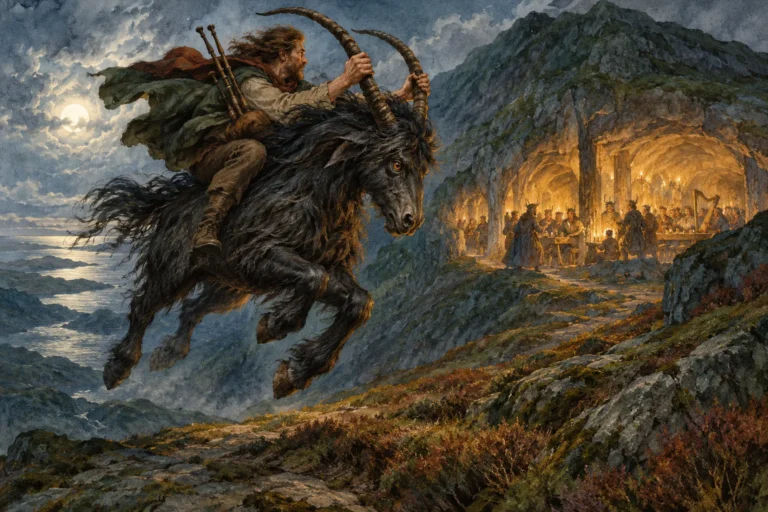
One night, returning from a dance with drink still in him, he stopped at the bridge near his mother’s house and began to play. A púca appeared, swept him onto its back and carried him off. The piper found himself clinging to the creature’s long horns, with his pipes in danger of being shaken to pieces.
He protested that he had to go home. His mother needed the tenpenny piece he was bringing her to buy snuff. The púca told him to hold tight if he valued his neck and his instrument. Then it ordered a tune: the Shan Van Vocht.
The piper could no more play that than any other tune besides his usual one. Nevertheless, when he tried, the music came out beautifully. His fingers suddenly knew their work. Before he could understand the change, he was playing with a skill he had never possessed.
The púca explained where they were going. The Banshee was giving a feast at the top of Croagh Patrick, and the company needed music. There would be payment for the player. That destination gave the piper an unexpected consolation. Father William had ordered him to go there as penance for stealing a white gander at Martinmas. At least this dreadful journey would save him the walk.
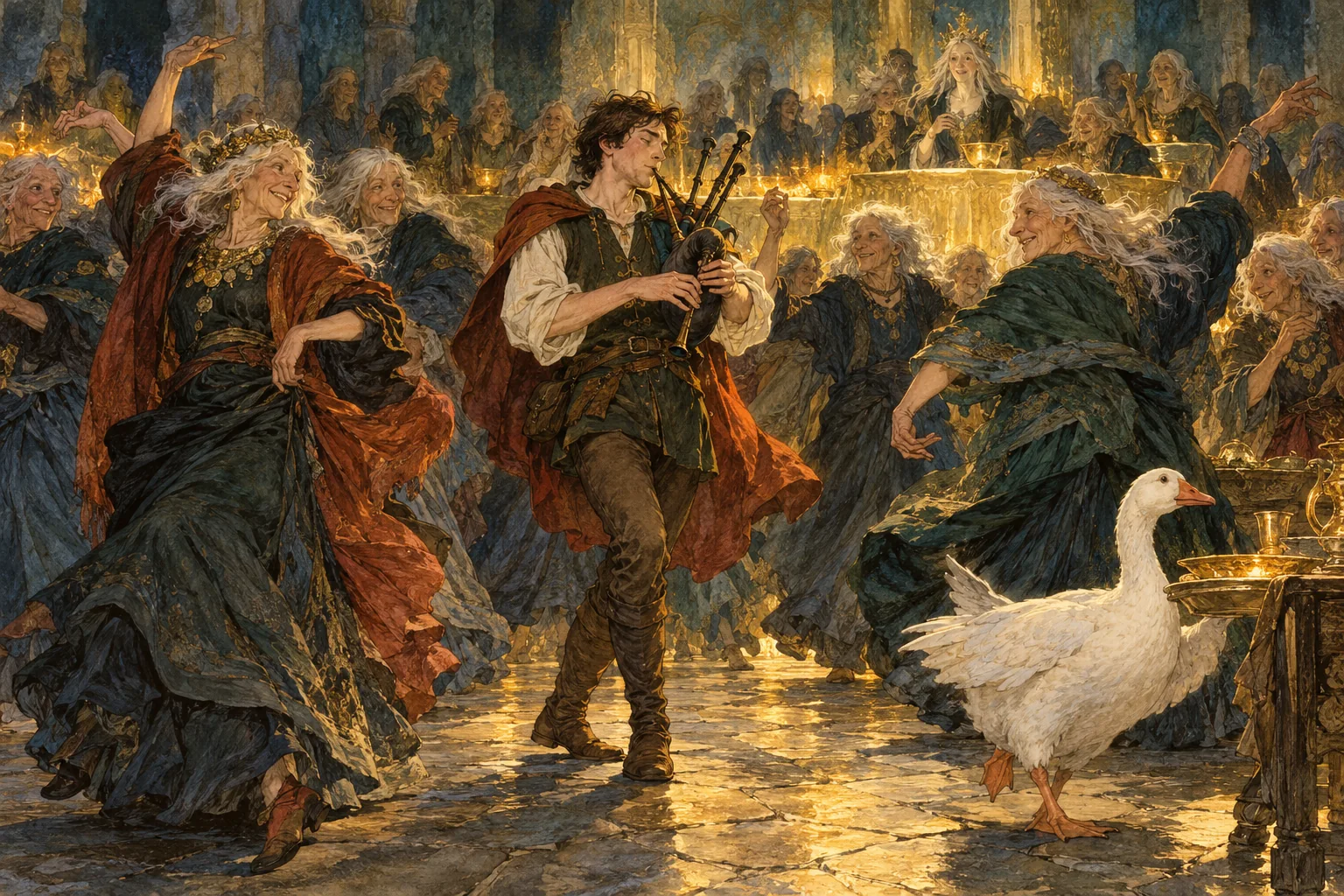
They crossed hills and rough ground until the mountain rose before them. At the summit the púca struck three blows, opening a door. Inside was a great hall, with a gold table and hundreds of old women waiting for their entertainment. They welcomed the púca of November.
One of the women struck the floor. Another opening appeared, and out came a white gander. The piper knew it at once. This was the bird he and his mother had eaten, except for one wing given to Red Mary. She had told the priest about the theft.
Now the stolen and eaten bird was alive before him, set to work clearing the tables. The piper had arrived to fulfil a penance and found the subject of his offence waiting at the feast. There was scarcely time to consider it. He had been brought to play.
The women danced while the new music poured from his pipes. He kept them dancing until they were tired, and each rewarded him with a gold piece. At last the púca was ready to take him home. Before they left, the gander presented him with another set of pipes.
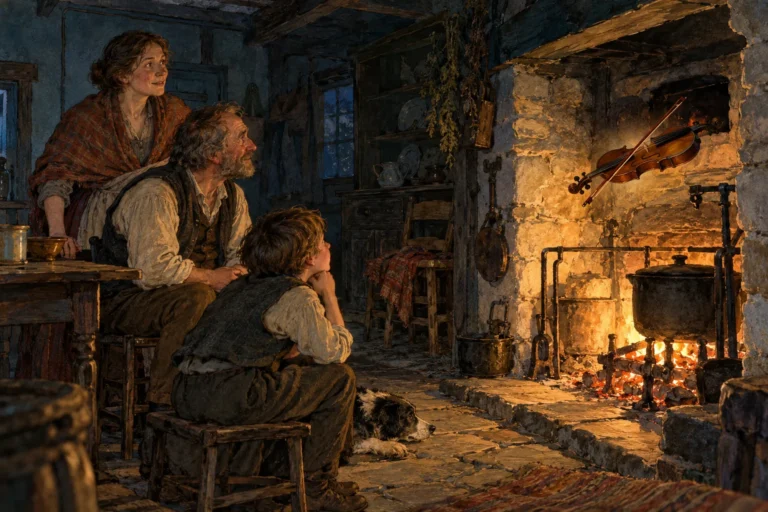
Back at the bridge, the piper was put down with his instruments and his earnings. He hurried to his mother, eager to show that he had brought home both wealth and talent. She thought he was drunk. He insisted that she listen.
He took up the gander’s gift. Instead of music, the pipes made the noise of geese, loudly enough to wake the neighbours and send them into laughter. He turned to his old instrument. From that came the wonderful playing he had discovered on the ride.
The morning brought another disappointment. All the gold he had received in the mountain hall had become leaves. The fortune he had carried home was gone, and the impressive new instrument was useless for anything but a racket.
He told Father William the whole adventure, including the gander. The priest did not believe him. When the new pipes produced their absurd cries, his account looked still worse. But then he played his own pipes, and the music answered for itself.
The piper had lost the gold and gained no sensible use for the strange gift. Yet the skill was real within the story, and it stayed with him. From that night until his death, he was the finest piper in Galway.
Versions and variations
The principal text is Hyde’s credited translation. This research has not established a separately collected Piper account with a substantially different plot. Reprinting the same translation does not create a new oral variant, and changes of spelling from puca to pooka do not demonstrate one either.
A Dún Mór Schools’ Collection copy, CBÉS 0037, p. 23, explicitly says its writer read the story in the Western People, where it was credited to Philomena Keelaghan of Shanahee National School, Belmullet. This is documented circulation through print into a school collection.
The Leitrim record, CBÉS 0205, pp. 337–339, closely follows Hyde’s wording and sequence in the examined pages. It names a local informant, but that metadata alone cannot establish an independent plot tradition. The distinction matters: a collected manuscript can preserve material already circulating in books or newspapers.
For a genuine comparison of different púca narratives, Patrick Kennedy’s “The Kildare Pooka”, pp. 105–108, offers a helpful household ass rather than the piper’s horned mount. This creature says that it is a dead servant undergoing penance. A gift of clothing releases it from work. In Lady Wilde’s “Fairy Help. The Phouka.”, a supernatural mill worker leaves after receiving fine clothes because it now regards itself as a gentleman. These are distinct stories, not alternative endings to the Piper.
Hyde’s ending also needs care. The two instruments have different results: the new gift makes goose noises, while the piper’s familiar instrument carries his new skill. The coins become leaves, but the ability to play remains. A retelling that makes every gift worthless, or lets him keep a fortune, changes that balance. Likewise Hyde gives the púca horns without specifying a black horse; choosing a particular animal for an illustration should be labelled an artistic interpretation.
Context and evidence
The feast gathers several kinds of supernatural and religious material in one adventure: a púca, the Banshee, dancing old women, an impossible return of a stolen bird, and a priest’s penance. These belong to the particular narrative; they do not supply a universal system of Irish belief. Hyde’s text preserves their conjunction without explaining every contradiction.
Croagh Patrick is a real mountain with a documented pilgrimage tradition. Its physical existence does not verify a hall inside it or establish where a fairy entrance might be. Dunmore is named, but no securely identified house, bridge or historical piper is supplied. The school records show that the tale circulated; they are evidence of storytelling, not confirmation of its supernatural events.
Sources for this entry
- Douglas Hyde; W. B. Yeats, editor, Fairy and Folk Tales of the Irish Peasantry. First published 1888; linked text is an undated Walter Scott Publishing Co. reprint, London and Felling-on-Tyne. Project Gutenberg ebook 33887.. The Piper and the Puca, pp. 95–97; translation headnote. Read source — Complete public-domain principal narrative; exact attribution retained. About this book
- Dúchas, National Folklore Collection, The Schools' Collection. CBÉS 0037. Dún Mór (cailíní), p. 23; newspaper headnote. Read source — Print-transmission evidence; opening and headnote examined.
- Dúchas, National Folklore Collection, The Schools' Collection. CBÉS 0205. Radharc na Sionainne (Canbeg), pp. 337–339; Proinnsias Mac Éoin; informant Bean Mhicil Mhic Eóin, 57, Mahanagh. Read source — Close textual parallel; examined pages do not establish independence from print.
- Patrick Kennedy; W. B. Yeats, editor, Fairy and Folk Tales of the Irish Peasantry. First published 1888; linked text is an undated Walter Scott Publishing Co. reprint, London and Felling-on-Tyne. Project Gutenberg ebook 33887.. The Kildare Pooka, pp. 105–108. Read source — Distinct household-helper story compared, not counted as a Piper variant. About this book
- Lady Wilde, Ancient Legends, Mystic Charms, and Superstitions of Ireland, with Sketches of the Irish Past. New edition, London: Chatto & Windus, 1919; first published 1887. Project Gutenberg ebook 61436.. Fairy Help. The Phouka., pp. 48–49. Read source — Distinct mill-helper narrative; fine clothing and departure compared. About this book
Research coverage
Complete Hyde tale examined. Dúchas comparison is limited to Dún Mór's headnote and opening, and Leitrim pp. 337–339; the entire archive has not been searched. No independent alternative Piper plot is claimed. Kennedy and Wilde supply related púca accounts, not witnesses to this same narrative.
The Myths · Irish collection · Editorial approach
Further Reading