Ulster Cycle · story
The Birth of Cú Chulainn
A wedding feast, a vanished company of women and a flock of enchanted birds lead Ulster’s king to the birth of its future defender. Other accounts tell a much stranger sequence of three conceptions.
Also found as: Compert Con Culainn · The Conception of Cú Chulainn · The Birth of Setanta · Feis Tige Becfholtaig
Research reviewed 17 October 2026.
Read the story
An original retelling following Lady Gregory’s “Birth of Cuchulain” (1902), with the spelling of names modernised. Gregory’s account combines earlier material; the different conception narrative is described below.
Deichtire’s marriage to Sualtaim should have been an occasion everyone at Emain Macha remembered for its feasting. Instead, they remembered the bride’s disappearance. During the celebration she lifted a cup of wine. A mayfly entered it, and she swallowed the insect with her drink. Later, in her room with her fifty attendants, she fell into a deep sleep.
Lugh appeared to her in a dream. The small creature in the cup, he told her, had been himself. She must come away with him, taking her companions. He changed their appearance into that of birds and led them south to Brú na Bóinne. At Emain, nobody could discover what had become of the women. The royal household had lost a sister, a bride and an entire company without finding a trail to follow.
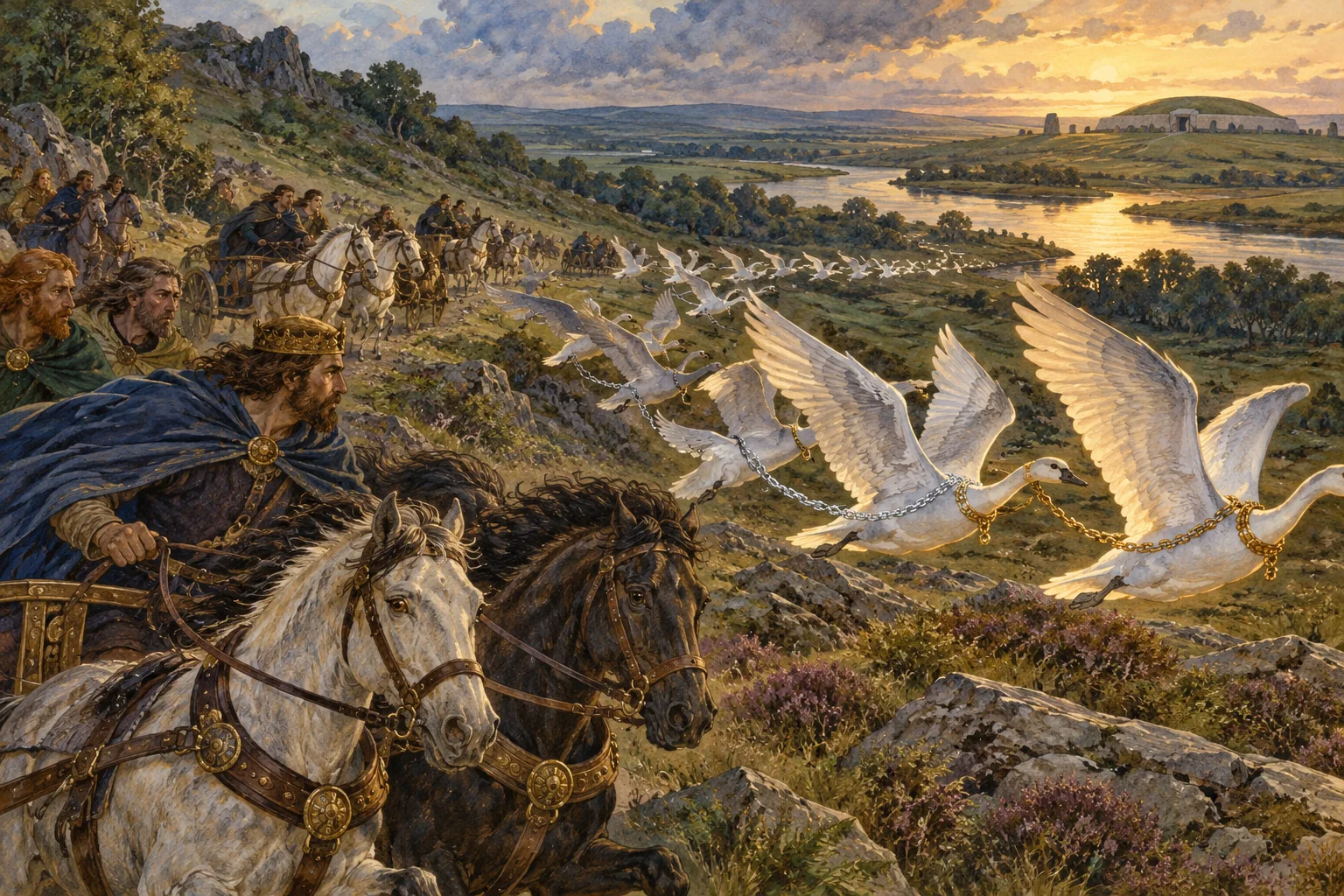
About a year later, another feast was interrupted by birds settling outside the king’s residence. They ate the ground bare. Conchobar and his companions harnessed nine chariots and set out after them. The birds kept ahead, drawing the hunters south across the country. Their beauty was as remarkable as the damage they had done: silver chains joined them in pairs, while the leading birds wore links of gold.
Night finally ended the chase. Fergus searched for shelter and found a small house whose occupants welcomed the entire company. Bricriu, always ready to find fault, doubted such a place could feed them. He went to inspect it himself and discovered a bright, spacious house, with a handsome young man and a woman who greeted him as someone she knew.
The host asked whether any women were missing from Emain. Here, he said, were the lost attendants; beside him stood Deichtire. They had become the birds that brought the hunters south. Deichtire gave Bricriu a fine cloak, but he decided to keep their identity to himself. Surely the king would pay handsomely for news of his missing sister. For the moment he reported only a splendid house and beautiful women.
The travellers entered and found food and drink in abundance. When Conchobar asked why their hostess had not joined them, he learned that she was giving birth. In the morning he heard a baby crying. He followed the sound and found his sister with her attendants and her newborn son. She had summoned them, she explained, to bring her and the child home.
The joy of reunion immediately became an argument about the baby’s upbringing. Conchobar proposed Finnchoem; Sencha claimed the child as his pupil; Blai, Fergus and Amergin each offered the advantages of his own household and accomplishments. Back at Emain, Morann settled the dispute by sharing the responsibility. The child would learn speech, judgement, poetry and the duties of a warrior from several teachers.
For now he remained with Deichtire and Sualtaim on the plain of Muirthemne. His name was Sétanta. The name Cú Chulainn, and the obligations it would carry, still lay ahead of him. Gregory, chapter I, pp. 2–6.
Versions and variations
A disappearance and a birth. Eleanor Hull’s “The Origin of Cuchullin” follows Louis Duvau’s French translation of an Egerton 1782 account, with additions marked in brackets. Deichtire and her attendants have been missing for three years, rather than Gregory’s roughly one. Conchobar asks Fergus to fetch the unidentified woman; her illness postpones the meeting. In the morning a baby is found in the hut, and Bricriu identifies its mother. Gregory instead has Conchobar discover Deichtire and her baby together. Hull’s introduction explicitly acknowledges editorial combination. Hull, pp. 14–20.
A threefold conception. The other major narrative makes Deichtire Conchobar’s daughter, accompanying the hunt, rather than his missing sister. She helps at another woman’s delivery and fosters the infant, who subsequently dies. A drink and a visitation from Lug bring a second conception. Under the pressure of scandal and an arranged marriage to Sualtaim, she ends that pregnancy; Sétanta is then conceived with her husband. This outline is documented in the University of Texas lesson accompanying the opening Old Irish text. It is a substantially different account of parentage and rebirth, not merely an alternative spelling of the same family tree. Old Irish Online, lesson 1, introduction and reading notes.
Gregory’s synthesis. Her wedding, swallowed mayfly and missing bird-women create a continuous route through material that other accounts arrange differently. Her notes name Duvau, Nutt, Windisch and other intermediaries, and admit transferring material between stories. Gregory therefore belongs in the comparison as an influential adaptation, not as an independent oral witness. Gregory, “Notes”, pp. 355–360.
Context and evidence
The story joins two important literary landscapes: the court at Emain Macha and the otherworldly dwelling at Brú na Bóinne. Their presence in the tale does not establish that its supernatural birth occurred at an excavated monument. Fosterage also matters: in Gregory and Hull the argument over Sétanta’s upbringing distributes knowledge and obligation across Ulster’s leading households. Read this beside the Cú Chulainn figure guide, Lugh and Sétanta and Culann’s hound; a single tidy genealogy conceals disagreements that these sources preserve.
Sources for this entry
- Lady Augusta Gregory, Cuchulain of Muirthemne. London: John Murray, 1902. Chapter I, “Birth of Cuchulain”, pp. 1–6; especially pp. 2–6. Read source — Principal retelling account; modern literary synthesis of older texts. About this book
- Eleanor Hull, adapting Louis Duvau, The Cuchullin Saga in Irish Literature. London: David Nutt, 1898. III, “The Origin of Cuchullin”, introduction p. 14 and narrative pp. 15–20; Egerton 1782 account with bracketed additions. Read source — Examined translation/adaptation of a medieval birth account; not an independent oral collection. About this book
- Patrizia de Bernardo Stempel, Caren Esser and Jonathan Slocum, Old Irish Online, Lesson 1: Compert Con Culainn. University of Texas Linguistics Research Center, online teaching edition. Introduction; Reading and Textual Analysis; opening Old Irish selection with translation. Read source — Examined opening text and scholarly synopsis of the threefold conception version; complete ending not translated on this lesson page.
- Lady Augusta Gregory, Cuchulain of Muirthemne: Notes. London: John Murray, 1902. pp. 355–360; source-list preamble and “Birth of Cuchulain”. Read source — Author’s explanation of combination and source dependencies. About this book
Research coverage
Compared Gregory’s complete birth chapter and Hull’s complete Egerton-based adaptation; checked the opening of the other conception narrative and its synopsis in the University of Texas teaching edition. A direct comparison of every manuscript, including all endings of the threefold-conception account and Feis Tige Becfholtaig, remains to be added. No exhaustive oral-variant claim.
The Myths · Irish collection · Editorial approach
Further Reading