Fenian Cycle · story
The Birth of Bran and Sceólang
Fionn’s aunt Tuiren is changed into a hound by a jealous woman of the Otherworld. Her children become Bran and Sceólang, the two hounds closest to Fionn.
Also found as: The Birth of Bran · Bran and Sceolan · Tuiren and Uchtdealb · Sceólan
Research reviewed 17 October 2026.
Read the story
This retelling follows Lady Gregory’s “Birth of Bran”, Part II, Book I, chapter III. It keeps the plot of that account rather than borrowing James Stephens’s later additions.
When Muirne visited her son Fionn at Almhuin, she brought her sister Tuiren with her. Among the company was Iollan Eachtach, a leading man of the Ulster Fianna. He loved Tuiren and asked to marry her. Before allowing the couple to leave, Fionn required a promise: if he ever called for his aunt’s return, Iollan must bring her back unharmed.
A promise of that importance needed witnesses who would answer for it. Caoilte, Goll and Lugaidh Lamha stood as sureties. Lugaidh placed Tuiren in Iollan’s keeping, and she went away to her husband’s house.
Iollan, however, had already been the lover of a woman of the sídhe, Uchtdealb of the Fair Breast. News of the marriage reached her, and she decided to strike at the new wife. She took the appearance of Fionn’s woman messenger and arrived with a friendly greeting. Fionn sent his good wishes, she said, and wanted Tuiren to prepare a feast. First, though, there was something she must tell her privately.
Tuiren followed the supposed messenger out of the house. Once they were away from it, Uchtdealb drew a dark rod from beneath her cloak and struck her. The woman vanished into the shape of a beautiful hound.
Uchtdealb led her to Fergus Fionnliath, the ruler at Galway harbour. Fergus was famous for disliking dogs. He would not allow one to share his house. Yet the visitor again used Fionn’s name: this was Fionn’s hound, she said, and Fergus must care for her until he came. She was carrying young and must not be hunted when her time drew near.
Fergus could not understand the choice. Surely Fionn knew how little he liked dogs. Nevertheless, he accepted the responsibility rather than refuse the first animal Fionn had entrusted to him.
Out hunting, the hound astonished him. No wild creature she pursued could escape her. Fergus’s dislike changed into admiration, and from admiration came affection for hounds. When the birth approached, he kept her from the chase as instructed. She bore two pups.
Meanwhile, Fionn learned that Tuiren was no longer living with Iollan. He called in the marriage pledge. Iollan asked for time to find her, promising that if he failed he would surrender himself to the Fianna in satisfaction.
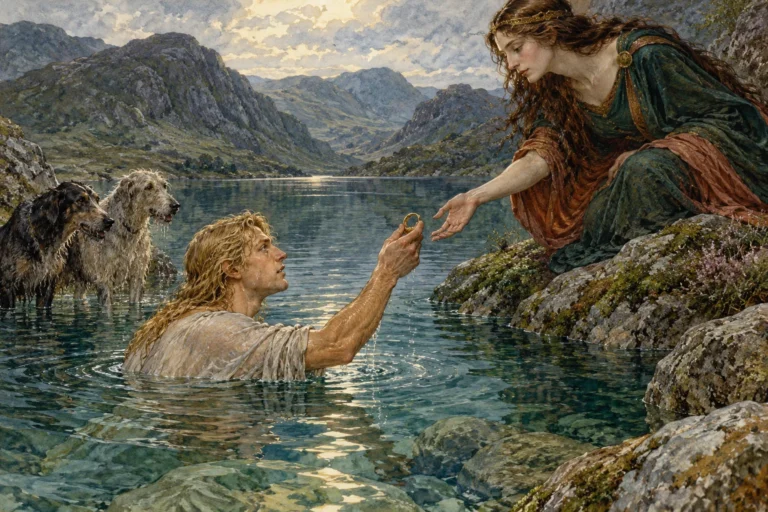
He went to Uchtdealb’s hill and told her the danger he faced. She offered to save him, but only if he promised to keep her as his sweetheart for the rest of his life. He agreed. Uchtdealb returned to Fergus, took Tuiren away and restored her human form. Tuiren was brought safely back to Fionn and afterwards married Lugaidh Lamha.
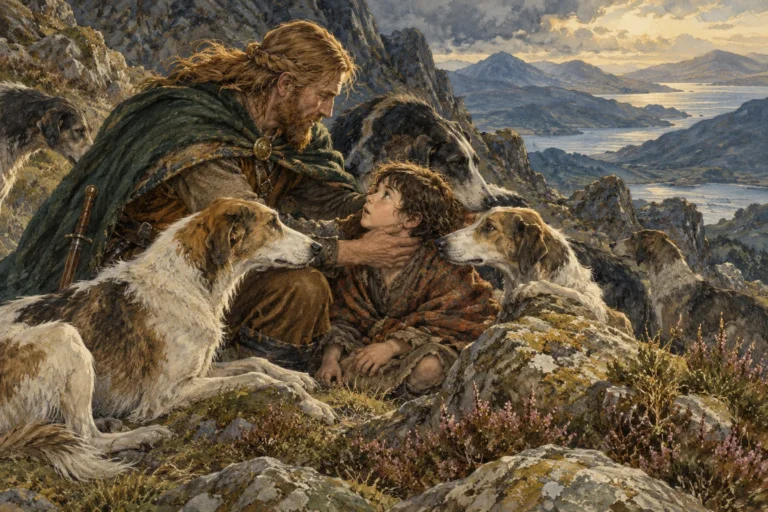
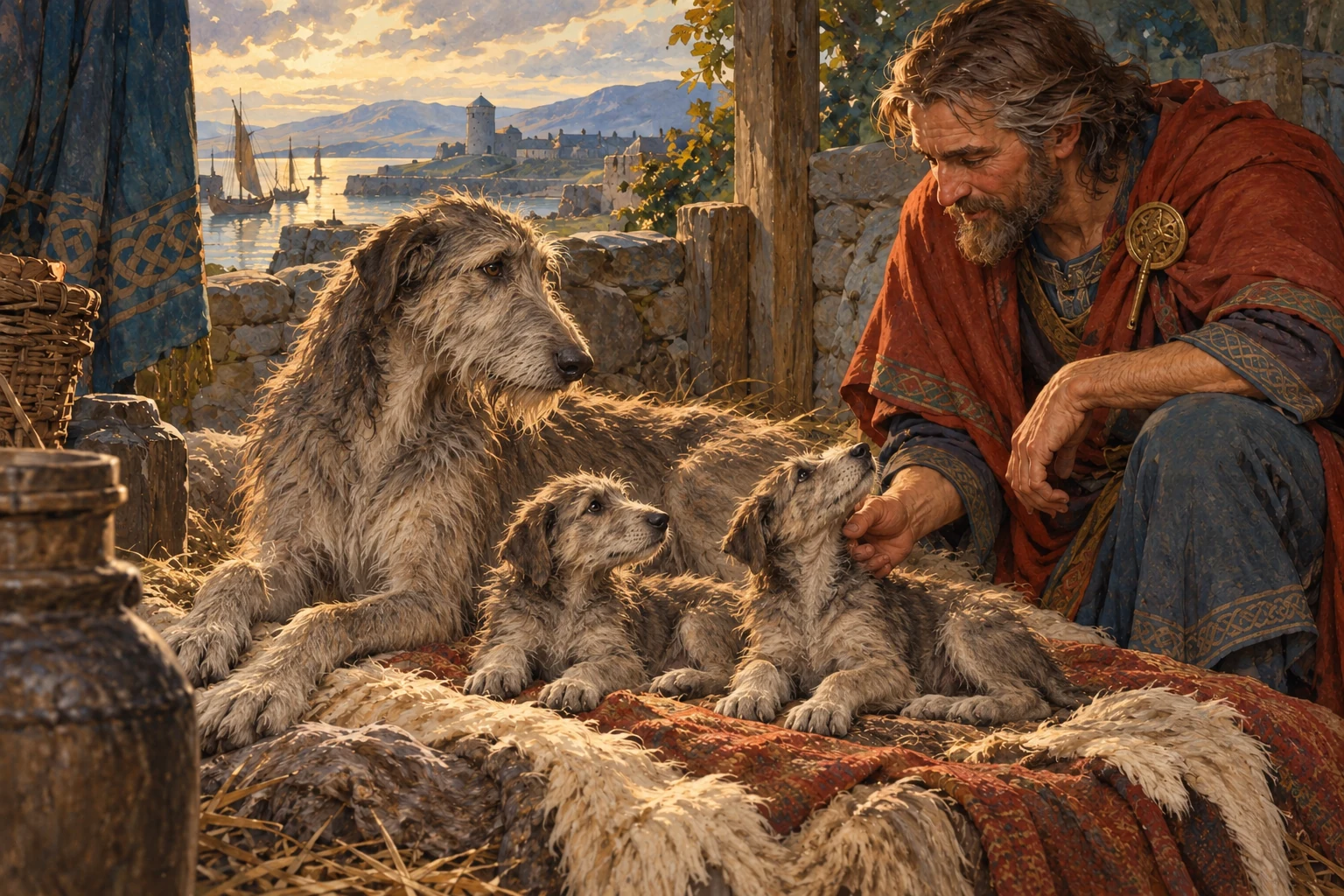
The two pups did not take human form when their mother was restored. They stayed with Fionn, who named them Bran and Sceólang. The leader’s most faithful hounds were also his own cousins: children of his mother’s sister, born during the enchantment.
Versions and variations
How Fergus learns to love a dog
In Gregory’s chapter, Fergus changes because Tuiren is an exceptional hunting hound. The narrator gives the transformation of his feelings in a few sentences. In James Stephens’s “The Birth of Bran”, chapters III–IV, the decisive scene happens indoors. The frightened dog cannot stop shaking; a servant advises embracing and kissing her. Fergus reluctantly comforts her, she responds with affection, and he becomes devoted to her. Stephens turns a brief incident about hunting skill into a sustained comedy about tenderness.
The marriage and the ending
Both writers retain the jealous Otherworld lover, the pledge demanded by Fionn, the two pups and Tuiren’s eventual marriage to Lugaidh. Stephens supplies a prior love for Tuiren on Lugaidh’s part, complete with mournful and happy poems. He also has Tuiren require proof that her new husband has no other sweetheart. His final addition returns to Fergus: losing the hound makes him ill for a year and a day until Fionn sends another puppy. None of those episodes appears in Gregory’s compact chapter.
What the two accounts establish
Stephens explicitly says the pups cannot have their enchantment undone; Gregory simply leaves them with Fionn as hounds. Both are early twentieth-century literary tellings, not two separately documented oral performances. Gregory names the Ossianic Society’s proceedings as her authority, but does not identify the item precisely in that chapter’s note. That earlier witness needs direct examination before its details can be confidently separated from the later writers’ handling.
Context and evidence
This story supplies a reason for Bran and Sceólang’s unusual understanding in the story of Sadhbh: their own mother had lived inside an animal’s form. It also binds the hunting world of the Fianna to marriage promises and responsibility for someone’s safety. Almhuin is the meeting place, Ulster the husband’s region and Galway harbour Fergus’s location in Gregory’s account. These are narrative associations; the passage does not identify a surviving house, burial or physical relic of the characters.
Sources for this entry
- Lady Gregory, Gods and Fighting Men. First published 1904; consulted Project Gutenberg transcription of 1905 edition. Part II, Book I, chapter III, Birth of Bran; chapter IV, Oisin’s Mother; Notes III. Read source — Principal retelling; relationship to the Sadhbh story; bibliography examined. About this book
- James Stephens, Irish Fairy Tales. London: Macmillan, 1920; Project Gutenberg text. The Birth of Bran, chapters I–V. Read source — Later literary account, directly read in full and compared; not labelled an independent oral witness. About this book
Research coverage
Gregory and Stephens have been compared directly. The Ossianic Society source named by Gregory, Irish manuscript versions and recorded Irish/Scottish oral accounts remain research leads. This entry does not claim that all traditions make Tuiren’s kinship, name or fate identical.
The Myths · Irish collection · Editorial approach
Further Reading