story · England
Robin Hood and Little John
Neither man will step aside on a narrow bridge. A staff fight ends with a soaking, a new friendship and a name turned upside down.
Also found as: John Little · The quarterstaff fight · The bridge fight. Research reviewed 18 October 2026.
Read the story
This retelling follows the ballad printed in A Collection of Old Ballads (1723), as edited by Child, no. 125. The familiar scene is a later account of how two much older legendary companions met. Read the ballad.
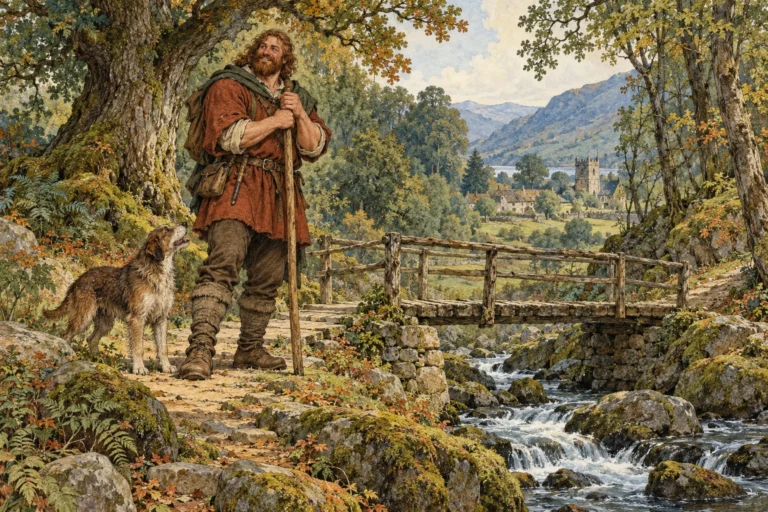
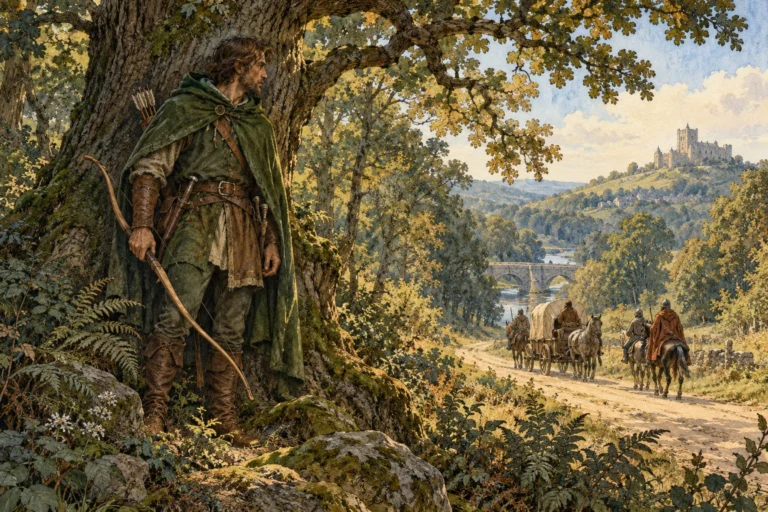
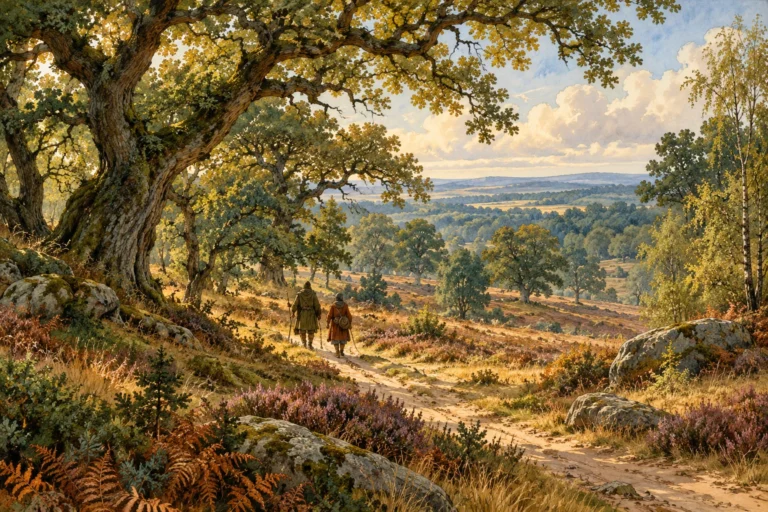
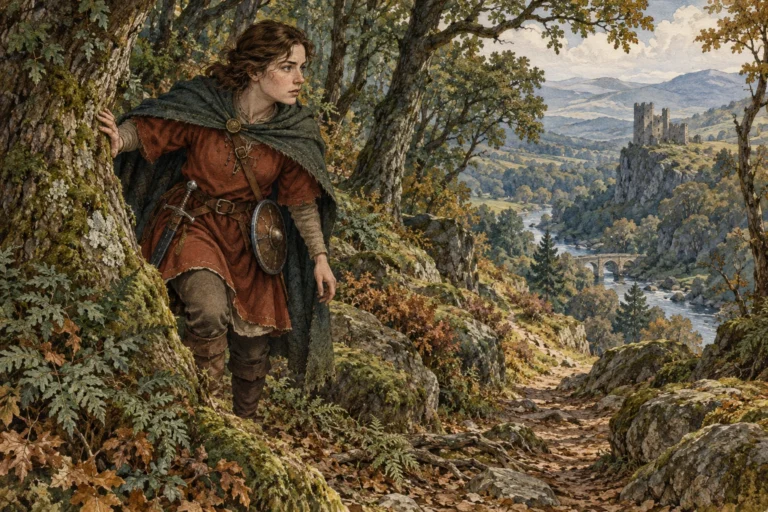
Robin left his men behind and went looking for sport. They were to come if they heard his horn. At a narrow bridge he met a stranger coming the other way. Neither would move aside.
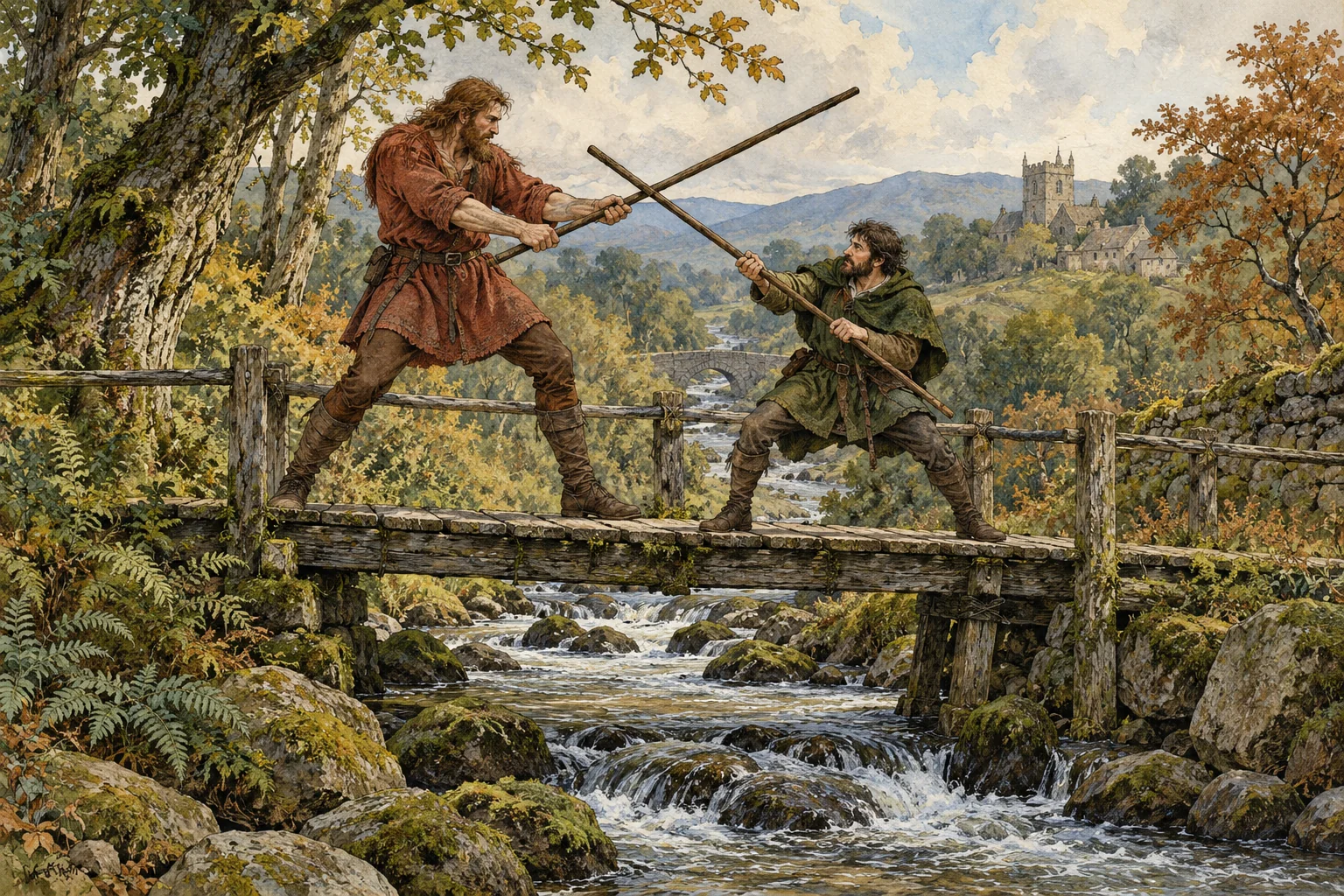
Robin reached for an arrow. The stranger called the threat cowardly: he had only a staff, while Robin could shoot him from a distance. Stung, Robin laid down his bow and cut an oak staff. They agreed that whoever knocked the other into the water would win.
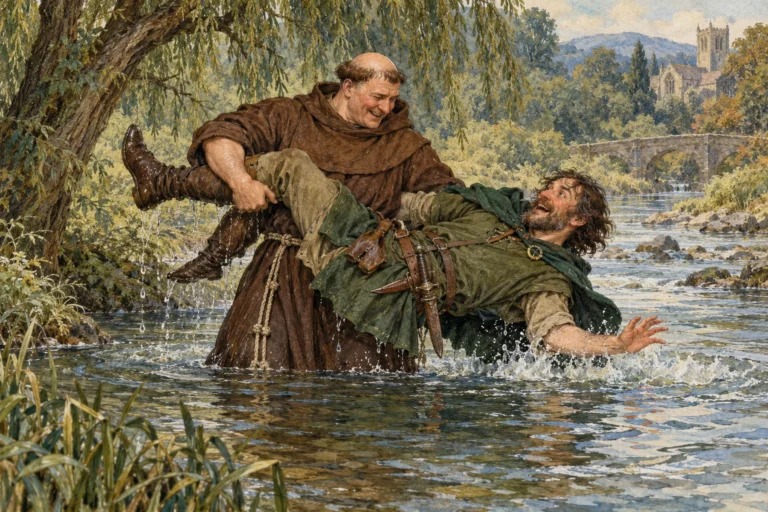
The blows came hard. Robin struck first, but the stranger answered him stroke for stroke. A blow to Robin’s head made him angrier and less willing to yield. Finally his opponent caught him with a stroke that sent him into the brook.
Asked where he was now, Robin could only answer from the water. He conceded the victory, scrambled ashore and blew his horn. When his men learned who had soaked their leader, they wanted to throw the stranger in after him. Robin stopped them. Here was a man worth having on their side.
The stranger accepted the offer of a place in the band and gave his name: John Little. Will Stutely proposed a new name for a new companion. Although John stood seven feet tall, they would call him Little John. Venison, drink, music and a mock christening followed, and Robin supplied him with green clothes and a bow. A defeat had brought the band a formidable friend.
Versions and variations
Child’s two printed witnesses
Child uses the 1723 collection as his main text and records an Aldermary garland version. His notes list many wording changes, while the bridge, defeat, recruitment and reversed name remain the central sequence. A mention in a seventeenth-century publisher’s list is not the same thing as a surviving medieval text. No. 125, headnote and a/b readings.
Pyle adds a second test
In Howard Pyle’s 1883 opening adventure, John does not immediately agree to join. He first demands proof of the outlaws’ archery. He hits a small white target; Robin improves on his shot. Pyle makes the new partnership answer both men’s pride. This is a novelist’s expansion, not another medieval manuscript witness. Pyle, opening chapter.
John was already there
In the Monk and the Gest, John is already Robin’s trusted but sometimes rebellious companion. Neither needs the bridge as an introduction. The later meeting tale should not be used to date those earlier stories.
Context and evidence
The bridge is a small stage on which rank counts for little: skill and the willingness to admit defeat determine the outcome. The tale also gives the nickname a memorable explanation. That explanation belongs to this ballad, not to a verified record of a historical John Little.
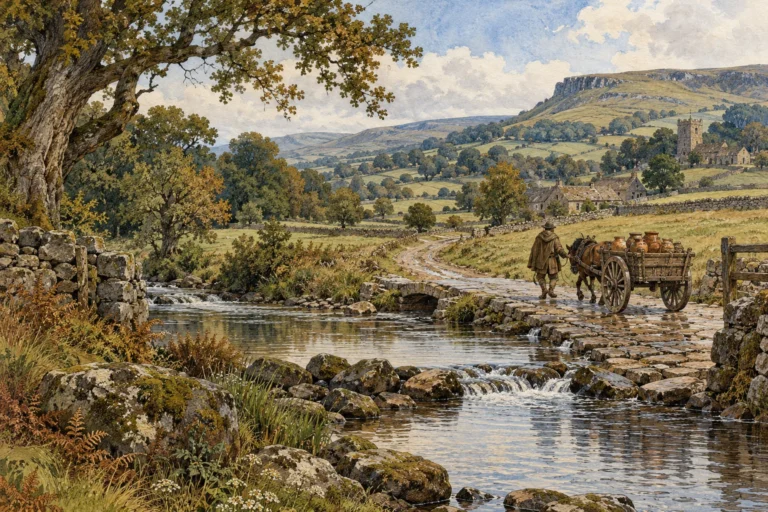
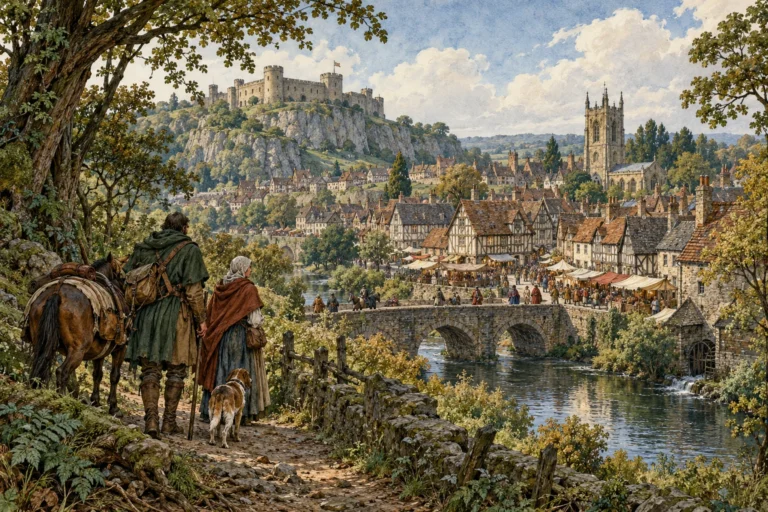
No identifiable bridge is named in this text. Its connection with Sherwood comes through the wider legend; an illustrated crossing or modern attraction cannot identify the exact place of the supposed fight.
Sources for this entry
- Francis James Child, editor, The English and Scottish Popular Ballads, volume III. Boston, Houghton, Mifflin, 1888. No. 125; headnote; stanzas 1–39; a/b variants. base account and surviving printed witnesses. Read source · About this book
- Howard Pyle, The Merry Adventures of Robin Hood. 1883; Project Gutenberg text. Opening chapter, “How Robin Hood Came to Be an Outlaw”: bridge encounter and archery test. later literary expansion. Read source · About this book
- Francis James Child, editor, The English and Scottish Popular Ballads, volume III. Boston, Houghton, Mifflin, 1888. No. 119; stanzas 8–25 and 77–80. earlier presentation of an established companionship. Read source · About this book
Research coverage
The named texts and selected editorial notes have been examined. This entry does not claim to collate every manuscript, broadside, oral performance or modern adaptation.
The Myths · Robin Hood collection · Editorial approach
Further Reading