figure · England
Maid Marian
A woodland companion, a page in disguise and a fighter who can match Robin: Marian’s history extends beyond the familiar role of his sweetheart.
Also found as: Marian · Marion · Matilda. Research reviewed 18 October 2026.
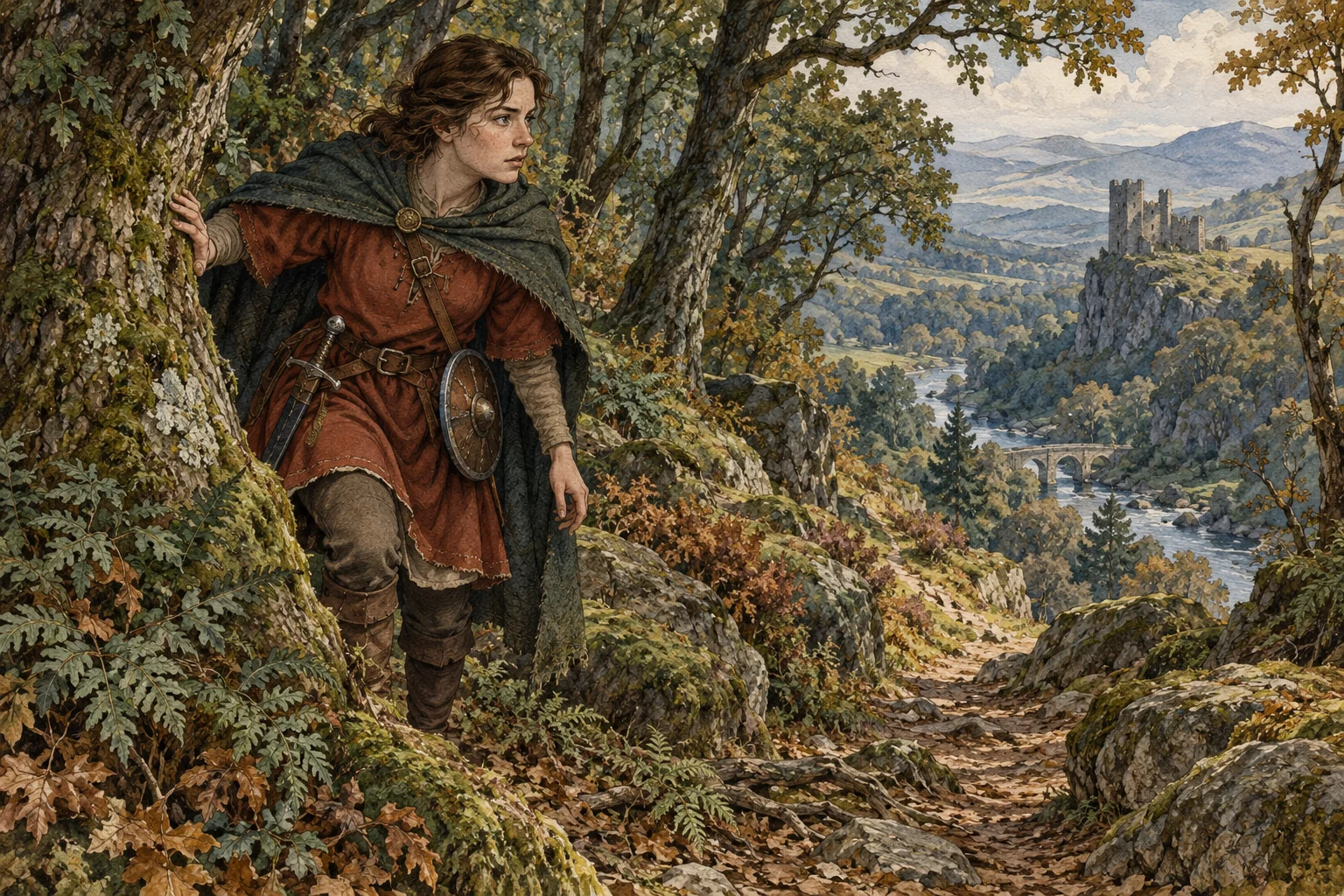
One ballad gives Marian an entrance of her own. Separated from Robin, she dresses as a page, equips herself with bow, sword and buckler, and searches the wood. Robin is disguised too. Neither recognises the other, and they fight until he offers the determined stranger a place in his band. Hearing his voice, Marian reveals herself. Read Child 150.
The reunion is affectionate, but Marian has not waited to be rescued. She has found Robin by travelling and fighting on her own account. Little John brings venison for the celebration, and the ballad ends with Marian living in the wood among the company.
This is not the only Marian, nor is it an episode preserved in the earliest surviving Robin Hood ballads. Her importance to the wider tradition should be considered alongside the particular kinds of evidence in which she appears: games, drama, printed song and later fiction.
Versions and variations
A named broadside, not an anonymous medieval consensus
Child’s no. 150 comes from a black-letter broadside in the Wood collection, signed “S. S.”, and was also printed by Ritson. Robin is an earl in this text. The fight and recognition belong to that witness; they should not be imported into every earlier Robin Hood account. Headnote and stanzas 4–21.
Marian, Matilda and the stage
Child discusses Marian’s connection with popular festivities and the Matilda/Marian of Munday’s Downfall of Robert Earl of Huntington. This guide has checked his account of that play, not completed an independent reading of the drama. Its family names and courtly framework therefore remain a separate line of research.
Reading past the collector’s judgement
Child dismisses the Marian ballad in strong aesthetic terms. His judgement is evidence of his editorial taste, not a reason to exclude Marian’s adventure from the library. The text is available to read and compare even when its editor dislikes it.
Context and evidence
Marian is absent from the Monk, Potter and knight episodes examined here. That absence does not prove that nobody told stories about her elsewhere; it defines what those particular witnesses contain.
A festival character, a dramatic heroine and a broadside sword-fighter may influence one another without supplying a single continuous biography. This entry makes no historical identification and does not treat a later wedding association as proof that Robin and Marian married in a particular church.
Sources for this entry
- Francis James Child, editor, The English and Scottish Popular Ballads, volume III. Boston, Houghton, Mifflin, 1888. No. 150; complete ballad, headnote and textual notes. base character account and editorial discussion of games and drama. Read source · About this book
- Francis James Child, editor, The English and Scottish Popular Ballads, volume III. Boston, Houghton, Mifflin, 1888. No. 117; introduction on the company and theatrical tradition. context for the difference between early ballads and later additions. Read source · About this book
Research coverage
The Marian broadside in Child 150 and selected editorial discussion have been examined. Munday’s plays, French Robin-and-Marion material, later novels and screen adaptations have not yet been independently compared in this guide.
The Myths · Robin Hood collection · Editorial approach
Further Reading