figure · England
Friar Tuck
A formidable opponent becomes a familiar companion, but the curtal friar, the festive Tuck and the later woodland chaplain do not enter every version together.
Also found as: The curtal friar · Fryer Tucke · The friar of Fountain Dale. Research reviewed 18 October 2026.

Friar Tuck is often imagined as a permanent member of Robin’s band. The sources show a more varied history. In the river-crossing ballad, the friar is first an adversary whom Robin cannot easily defeat. In drama and festivities, Tuck has a role of his own. In a later connected book, he can become the man who helps lovers marry.
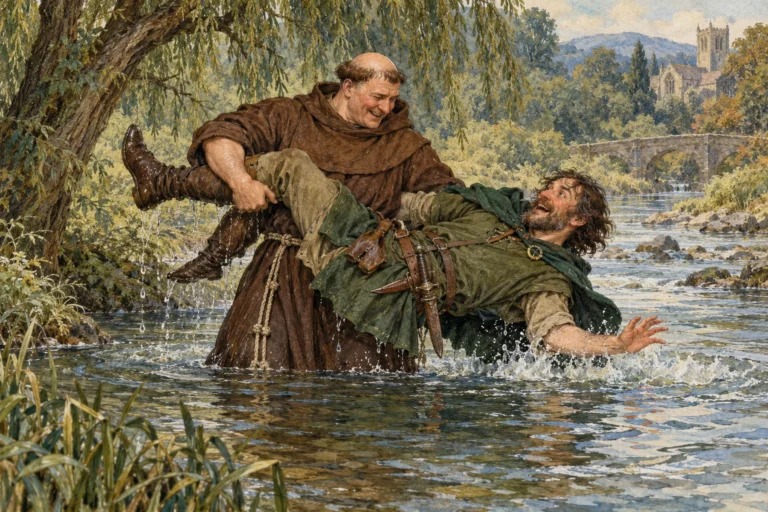
Read the Curtal Friar to see the encounter: the repeated crossings, the sudden soaking, a fight, and rival summonses to men and dogs. The joke depends on a religious figure who is far stronger and more resourceful than Robin expects.
The surviving Percy manuscript version is titled “Robine Hood and Ffryer Tucke”, although the body of the poem uses other descriptions for the friar. That title is evidence of an identification in the manuscript tradition. It does not make every detail of the later Tuck present in the ballad. Child 123, headnote and texts.
Versions and variations
Two endings to the encounter
In Child 123 A, Robin asks for friendship when confronted by the dogs. In B, John kills ten dogs before the friar calls a halt; Robin offers the friar clothing and a fee. B does not go on to narrate his life as the band’s chaplain.
The explicit Tuck of Pyle
Pyle’s friar calls himself Tuck and returns with Robin to Sherwood. Four named hounds replace the ballad’s much larger pack. His arrival leads into Allan a Dale’s wedding story, giving him a continuing purpose in the novel. Friar and marriage chapters.
Games and plays are another kind of evidence
Child’s introduction discusses Tuck in Robin Hood plays and popular festivities. These records belong in the history of the character, but they should not be described as independent reports of a real outlaw’s priest. We have not collated the surviving play scripts here.
Context and evidence
The ballad’s Fountains Abbey association is literary. Child notes the mismatch between a Cistercian monastery and a friar, and debates the meaning of “curtal”. The library preserves that uncertainty rather than assigning Tuck a securely documented order or office.
A priest or criminal who used a similar name would require separate documentary investigation. This page does not identify the legendary companion with a historical “Friar Tuck”, nor infer a biography from a title in an old manuscript.
Sources for this entry
- Francis James Child, editor, The English and Scottish Popular Ballads, volume III. Boston, Houghton, Mifflin, 1888. No. 123; headnote; A and B; discussion of plays and “curtal”. textual naming and distinct traditions. Read source · About this book
- Howard Pyle, The Merry Adventures of Robin Hood. 1883; Project Gutenberg text. “Robin Hood Seeks the Curtal Friar”; opening of “Robin Hood Compasses a Marriage”. later named companion and wedding connection. Read source · About this book
Research coverage
The named texts and selected editorial notes have been examined. This entry does not claim to collate every manuscript, broadside, oral performance or modern adaptation.
The Myths · Robin Hood collection · Editorial approach
Further Reading