story · England
Robin Hood and the Monk
A quarrel sends Robin into Nottingham alone. Little John must decide whether to rescue the master who has struck him.
Also found as: The Monk · Robin rescued by Little John. Research reviewed 18 October 2026.
Read the story
This retelling follows the surviving Cambridge text printed by Child as no. 119. It is a story of loyalty, devotion and lethal violence, rather than a harmless trick on the sheriff. Read the ballad and its textual notes.
The leaves were broad on the trees and the birds were singing when Robin decided he must hear mass. It had been more than a fortnight since he had been to church. Much urged him to take a dozen men into Nottingham, but Robin wanted only Little John beside him.
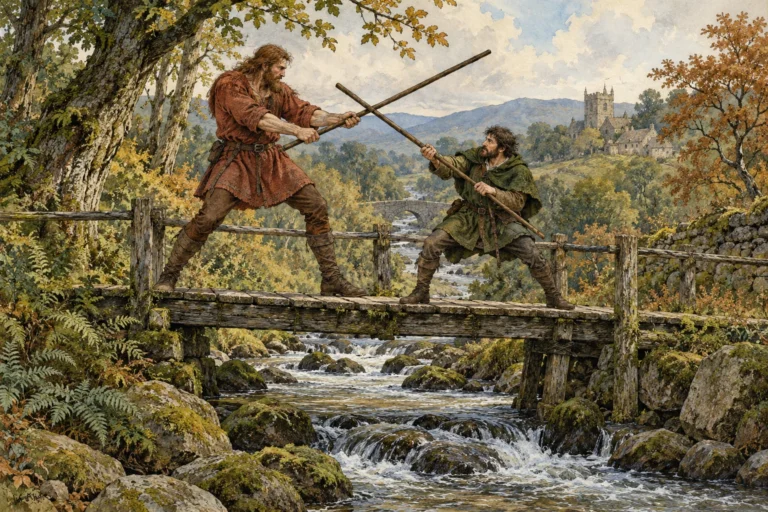
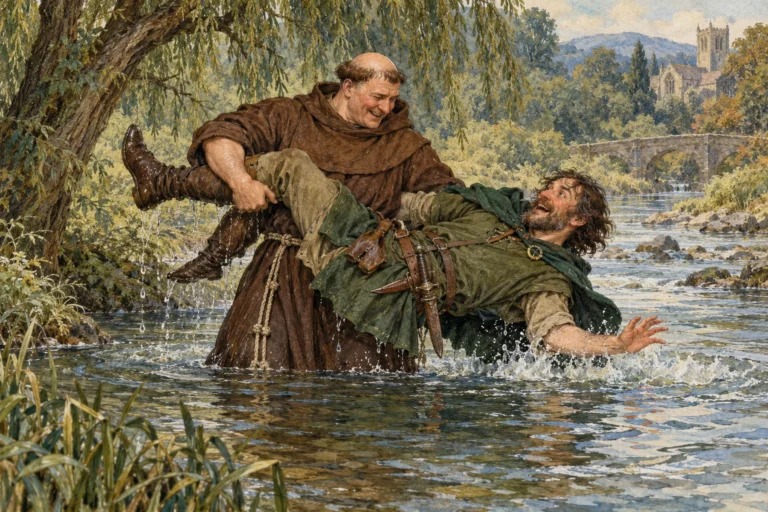
On the road they shot for a wager. John won, and Robin answered the defeat with anger and a blow. John would no longer serve a master who treated him so. He turned back, leaving Robin to enter the town alone.
At St Mary’s, a monk recognised the outlaw who had previously robbed him. He hurried to the sheriff. Armed men surrounded Robin; he fought until his sword broke, and he was taken. The surviving manuscript has a gap around this part of the action, so the retelling cannot recover every step between the fight and the news reaching the forest.
The outlaws despaired. John kept his head. Whatever Robin had done to him, he would not abandon him. With Much, he intercepted the monk carrying news of the capture to the king. John killed the monk, and Much killed the accompanying page so that no witness remained. Taking the letters, the two men presented themselves at court as the bearers of good news.
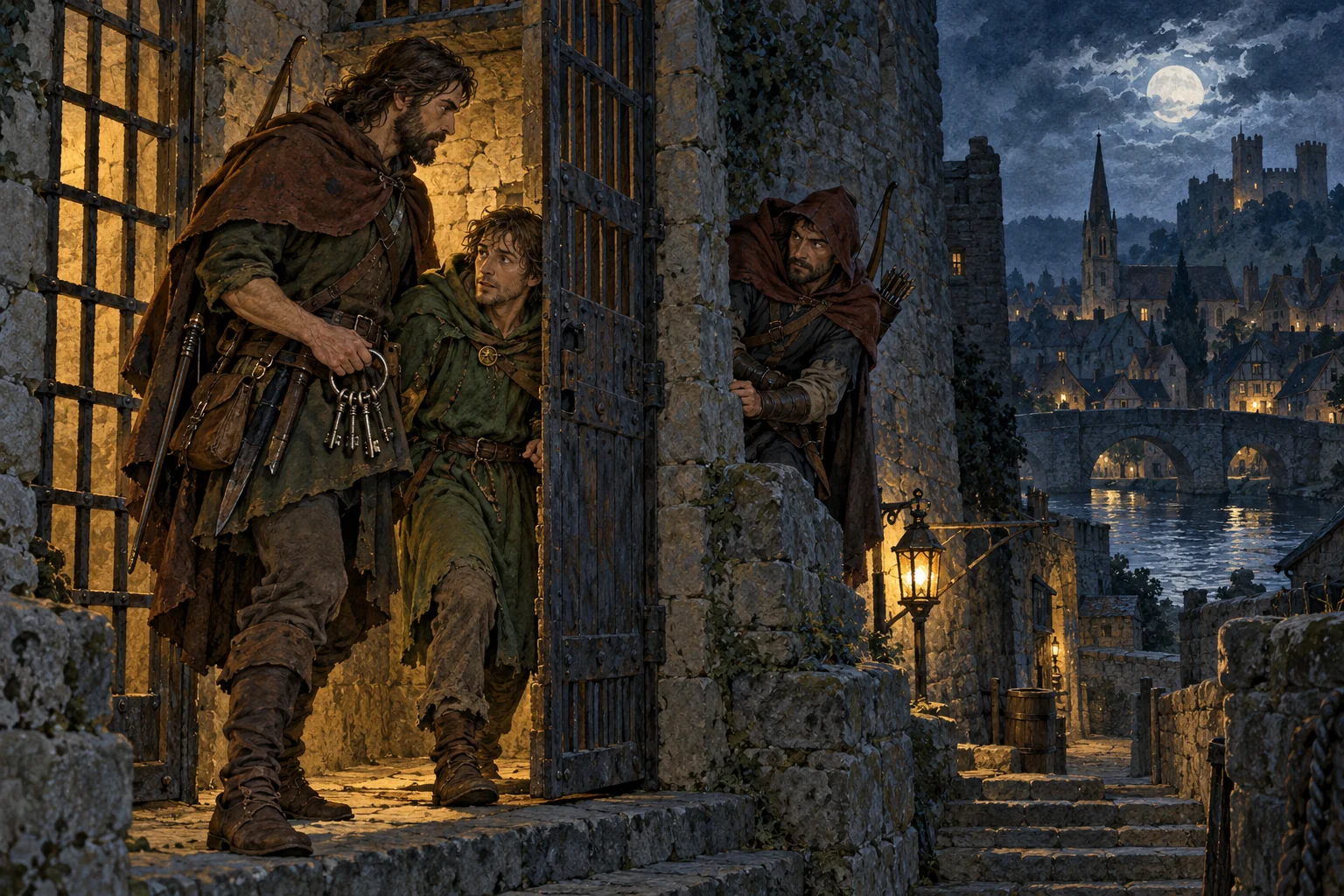
The king rewarded them and entrusted John with his seal, ordering the sheriff to send Robin to him unharmed. Back in Nottingham, that authority opened doors. The sheriff welcomed the supposed royal messengers, feasted them and drank deeply. While he slept, John and Much went to the prison. John killed the jailer, took his keys and released Robin. The fugitives escaped over the lowest part of the wall.
By morning Robin was in Sherwood. John reminded him that he had returned a good deed for an evil one and prepared to leave. Robin offered him command over the whole company. John wanted fellowship instead. The king, learning what had happened, recognised that John’s loyalty to Robin had defeated both himself and the sheriff.
Versions and variations
The complete witness and the fragment
Child prints the Cambridge manuscript, which he dates to about 1450, alongside readings from a surviving Bagford leaf. The fragment covers only part of the rescue. These are witnesses to the same ballad, not two complete adventures with different endings. Missing verses should remain missing. Child, headnote and variants.
Other rescues are related stories
Child compares the rescue with Adam Bell and the reversal of roles in Robin Hood and Guy of Gisborne. These are useful comparisons, but neither supplies a licence to fill the damaged manuscript with invented incidents. The present entry follows the Monk text.
Context and evidence
Robin’s devotion to the Virgin and his conflict with a monk coexist in the ballad. Opposition to a wealthy or hostile churchman is not equivalent to rejection of religion. John’s loyalty is also morally troubling: the monk, page and jailer die so that Robin may escape.
St Mary’s and Nottingham belong to the story’s geography. Their real existence does not establish that this arrest happened. The unnamed king should not automatically become Richard I, and this ballad gives no account of John first meeting Robin on a bridge.
Sources for this entry
- Francis James Child, editor, The English and Scottish Popular Ballads, volume III. Boston, Houghton, Mifflin, 1888. No. 119; headnote; text, especially stanzas 5–33, 45–80; fragment readings. base text, manuscript limits and comparisons. Read source · About this book
Research coverage
The named texts and selected editorial notes have been examined. This entry does not claim to collate every manuscript, broadside, oral performance or modern adaptation.
The Myths · Robin Hood collection · Editorial approach
Further Reading