story · England
The death of Robin Hood
Robin seeks treatment from his cousin and is betrayed. In a later ballad, one last arrow chooses the place of his grave.
Also found as: Robin Hood’s Death and Burial · The last arrow · Kirkley · Kirkly. Research reviewed 18 October 2026.
Read the story
The main retelling follows Child 120 B, “Robin Hood’s Death and Burial”, preserved in late eighteenth-century garlands. The more fragmentary Percy manuscript account and the Gest differ, as the comparison below explains. Read the death ballads.
Robin could no longer shoot as he once had. His arrows would not fly, and he told Little John that he would visit a cousin who could let him blood. He travelled to Kirkly, already feeling very ill.
His cousin welcomed him and offered beer. Robin asked instead for the treatment he had come to receive. She took him to a private room, opened a vein in his arm and locked the door. He was left bleeding through the day and into the next.
Robin looked towards the window. He thought of escaping but no longer had the strength to climb or leap down. He still had his horn. Three weak blasts brought John, who understood from their failing sound that his master was near death.
John broke through the locked doors and knelt beside him. He asked permission to burn the place down. Robin refused. He had not harmed women in his life, he said, and would not do so at its close.
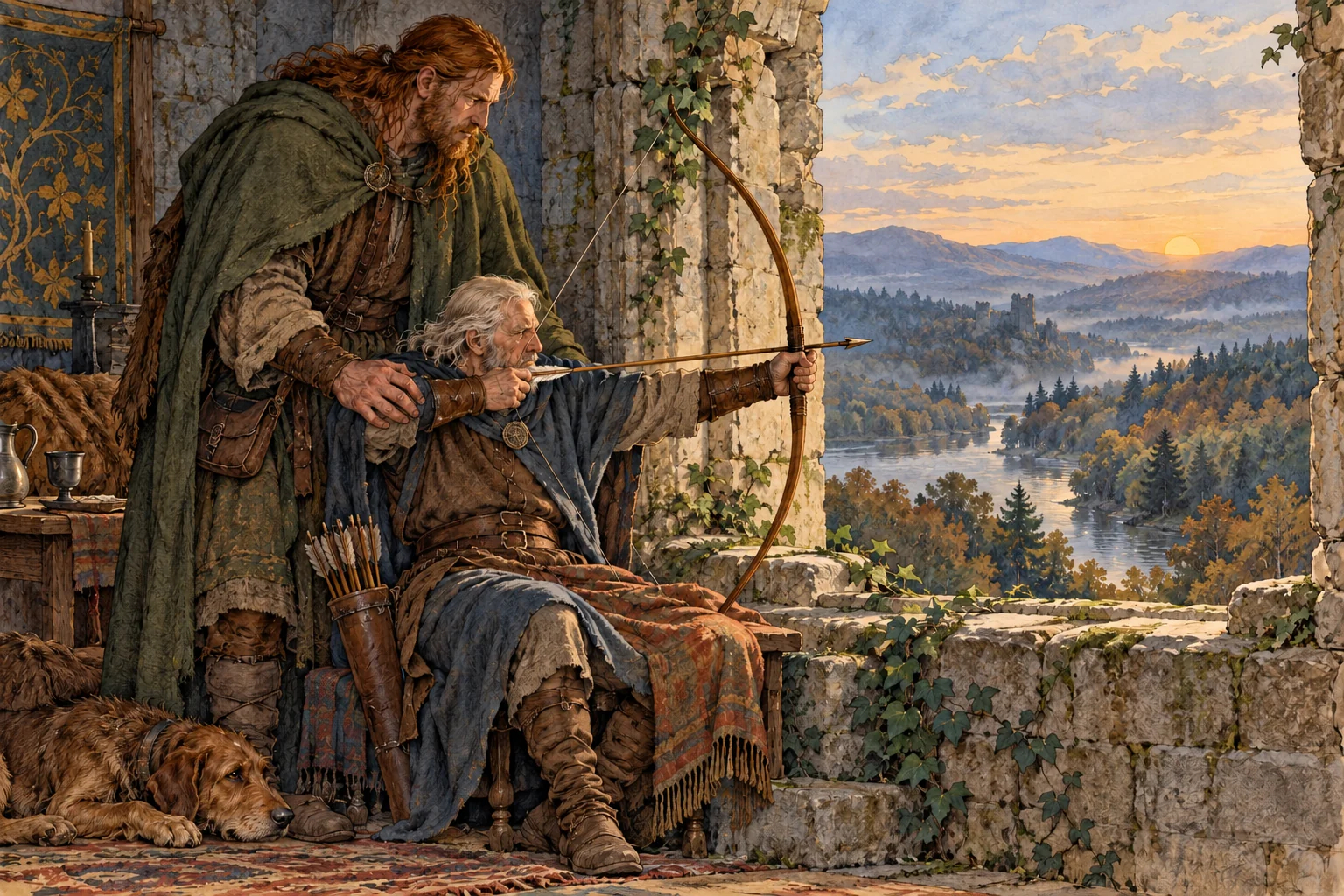
Instead he asked for his bow and an arrow. Where the arrow fell, his companions were to dig his grave. He asked for room enough, green turf beneath his head and feet, and the bow beside him. They granted his wishes and buried him within the grounds named in the ballad. The story closes with the outlaw remembered through the weapon that had accompanied him in life.
Versions and variations
Child 120 A: Red Roger and a damaged manuscript
The Percy manuscript account has large gaps. It includes a woman’s curse, betrayal during bloodletting, and a violent encounter with Red Roger. Robin kills Roger, refuses John’s proposed burning and gives directions for burial with his weapons. The surviving text does not contain B’s final arrow choosing the grave. It would be misleading to describe the lost passages as though their contents were known. Version A and editorial record of missing leaves.
The short ending of the Gest
The Gest closes with a brief account of the prioress of Kirkesly and Sir Roger of Doncaster plotting against Robin. It supplies no last-arrow scene. This is a related death tradition, not the full text of either ballad. Final stanzas, 451–456.
Pyle supplies a motive
Pyle’s epilogue places the death after service to Richard and a return to outlawry under John. His prioress fears the consequences of her connection with Robin and hopes to win favour with his enemies. That explanation belongs to the 1883 retelling; the B ballad does not give that political motive. Epilogue.
Context and evidence
The names Kirkly, Kirkley, Kirklees and Churchlees occur across the transmission of the story. A named religious house and a later claimed grave do not authenticate the death narrative. This entry has not established the identity of a historical Robin or verified a burial.
The different versions alter who betrays him, how much resistance he offers and how his grave is chosen. Keeping those changes separate gives a clearer view of the legend than treating every detail as part of one final day.
Sources for this entry
- Francis James Child, editor, The English and Scottish Popular Ballads, volume III. Boston, Houghton, Mifflin, 1888. No. 120; versions A and B; headnote, missing passages and printed variants. base narrative and comparison of death accounts. Read source · About this book
- Francis James Child, editor, The English and Scottish Popular Ballads, volume III. Boston, Houghton, Mifflin, 1888. No. 117; stanzas 451–456. brief death notice. Read source · About this book
- Howard Pyle, The Merry Adventures of Robin Hood. 1883; Project Gutenberg text. Epilogue, journey to Kirklees and the prioress’s motive. later narrative framework. Read source · About this book
Research coverage
The named texts and selected editorial notes have been examined. This entry does not claim to collate every manuscript, broadside, oral performance or modern adaptation.
The Myths · Robin Hood collection · Editorial approach
Further Reading