
Learning & activities / England
Compare versions
Little John joins: compare two tellings
Compare how Little John joins Robin Hood in the ballad and Howard Pyle’s retelling, with a two-page worksheet and adult answer guide.
EnglandAges 9+A4 · 2 pages
Download and print
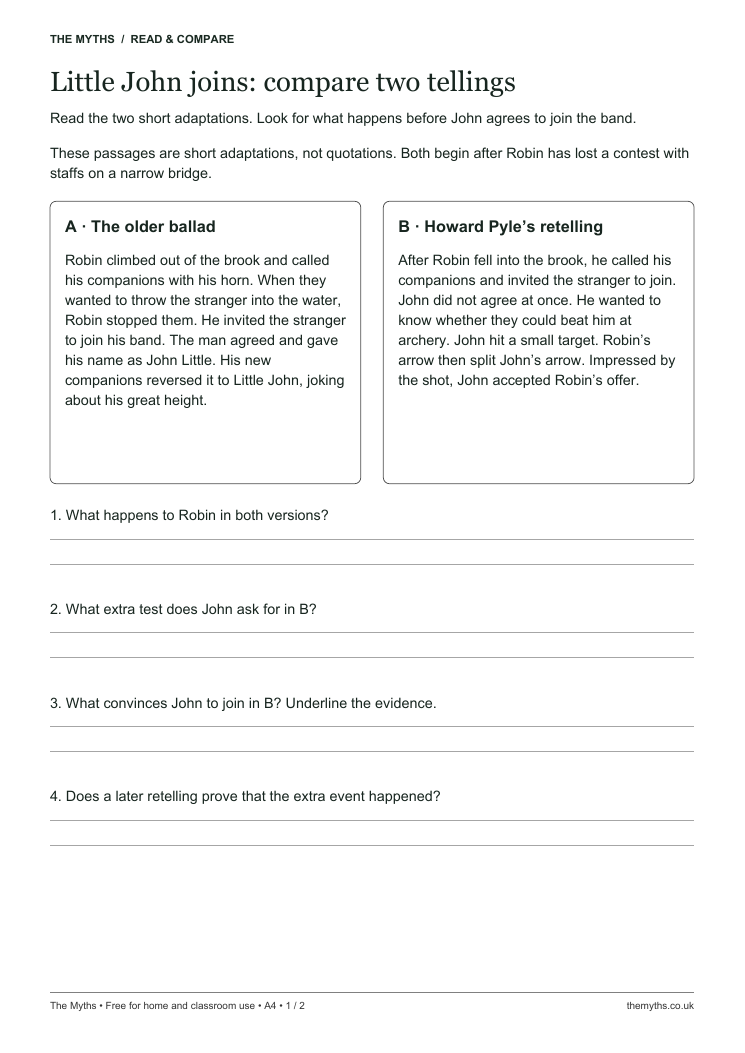
Read the two short adaptations. Look for what happens before John agrees to join the band.
Black-and-white printable. Select A4 and “Fit to page” when printing. Free for personal, home and classroom use. No sign-up needed.
Try this activity
Print page 1 for the learner and use page 2 for answers and discussion. Underline the detail that makes Pyle’s version different, then write a peaceful alternative to the bridge contest.
Suggested ages are a guide. Choose the reading and practical support that suits your learner.
More to try: Colour Robin Hood and Little John
The story behind the picture
Both versions make Robin lose the bridge contest and then welcome his opponent. The ballad lets John accept Robin’s invitation directly. Howard Pyle’s 1883 retelling adds another test: John wants to see whether the outlaws can beat him at archery.
About this version
Child’s main ballad text comes from a 1723 printed collection. Pyle’s book is a later literary retelling, not another medieval witness. The passages are original adaptations and omit blows, injuries and other details. A shared scene cannot by itself establish that these characters met in real life.
Follow the story
Sources for this activity
Source notes are for adults and older readers. Full texts may contain material beyond the selected activity.
- Child 125: the invitation to join
The English and Scottish Popular Ballads, volume III, no. 125. Compare the recruitment after the staff fight in the main 1723 text. - Howard Pyle: the extra archery test
The Merry Adventures of Robin Hood (1883), opening chapter, How Robin Hood Came to Be an Outlaw. John demands an archery trial before accepting the invitation.
How we use sources and illustrations · Browse all activities