Garth Dorwen fairy traditions · story
Eilian and the Fairy Midwife
A missing farm servant is recognised in a fairy dwelling. The ointment that reveals her also gives the visiting midwife a dangerous glimpse beyond appearances.
Also found as: Fairy Ointment · Eilian of Garth Dorwen
Research reviewed 18 October 2026.
Read the story
This retelling follows William Thomas Solomon’s account as printed and translated by John Rhŷs in 1901. Details added in W. Jenkyn Thomas’s later telling are kept in the comparison below.
An elderly couple from Garth Dorwen went to Caernarfon’s All Hallows’ hiring fair to find a servant. They engaged Eilian, a young woman with golden hair. She settled into the household, but had an unusual habit. On moonlit nights she took her spinning out into a meadow, where the Tylwyth Teg gathered to sing and dance.
In the spring she went away with them. The people of the farm lost their servant, while the meadow kept her name in the remembered landscape of the tale.
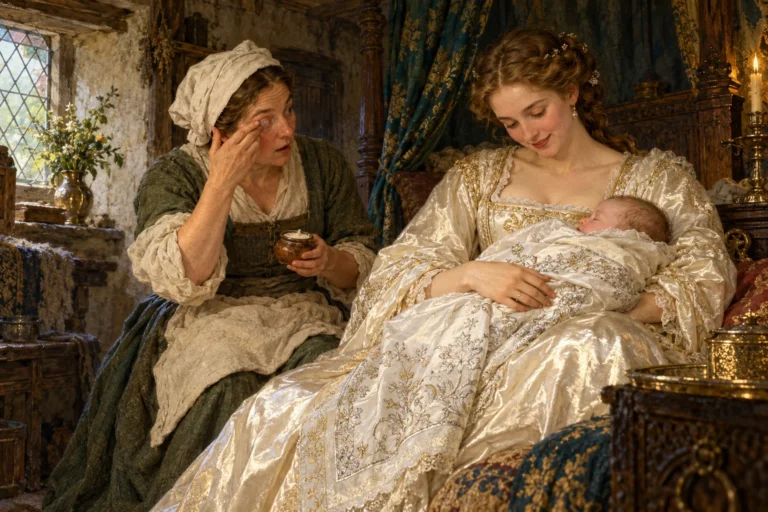
The mistress of Garth Dorwen was also a midwife. One night, when moonlight shone through rain and mist, a man arrived on horseback and asked her to attend his wife. She rode behind him to Rhos y Cowrt, where a low stony rise called Bryn y Pibion concealed the entrance to a cave.
Inside, everything appeared splendid. The visitor was taken to the woman who needed her help. Afterwards she was given ointment to put on the baby’s eyes, with a warning never to touch her own. An itch made her rub one eye with the finger she had used for the ointment.
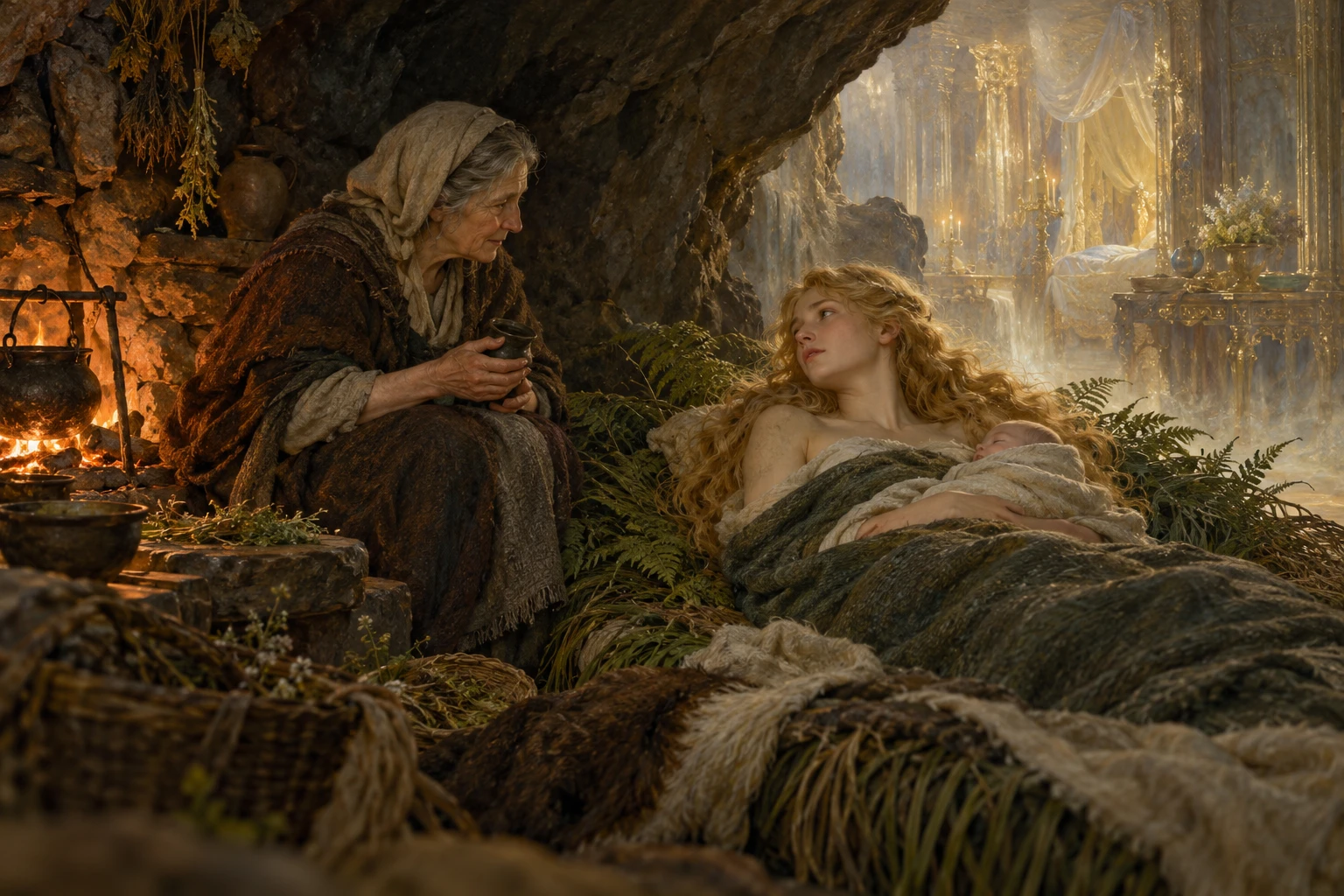
Through that eye the splendour disappeared. She saw a cave, large stones, a small fire and a bed of rushes and dry fern. On it lay Eilian, the servant who had vanished. Through her other eye the rich room remained.
Later, at Caernarfon market, the midwife recognised the man who had brought her there. She asked after Eilian. He wanted to know with which eye she could see him. When she indicated it, he struck it with a bulrush and destroyed its sight. The knowledge that had briefly exposed his household was taken away.
Versions and variations
Rhŷs and William Thomas Solomon
Rhŷs identifies Solomon, who worked as a gardener at Glynllifon, as his source. Solomon traced the story through his mother to an old woman at Garth Dorwen. Rhŷs prints a Welsh version and an English translation. He also notes that an earlier spoken telling mentioned Eilian’s extraordinary output of spun thread, a detail missing from Solomon’s written account. Even within this source record, the spoken and written tellings are not identical.
Thomas’s “Fairy Ointment”
The 1908 Welsh Fairy Book turns the implied relationship into a detailed bargain. Eilian says a fairy helped with her spinning on condition that she marry him. She tried to avoid the bargain by using a knife in the meadow and rowan above her bed, but forgot the protection after a tiring day’s sheep-shearing. Thomas also adds the fairy husband stealing at market and specifies that the midwife loses her left eye.
What can be inferred about those additions?
Rhŷs suggests a marriage bargain in his own commentary; it is not an explicit speech by Eilian in Solomon’s printed narrative. Thomas acknowledges using Rhŷs and other collections, and says some stories piece material together. His book is therefore a later literary witness. Its extra dialogue and charms must not be presented as words recorded from Solomon or as proof of a second independent local interview.
The English ointment tale
The English Fairy Ointment entry also has a human attendant gaining forbidden sight and losing it when a fairy notices. The Welsh account supplies its own servant, farm, meadow and route. Shared incidents make a comparison valuable without making the two stories interchangeable.
People, work and the evidence
The story connects two kinds of women’s work: spinning in a farming household and helping at a birth. Eilian crosses into fairy society, while the older woman crosses temporarily because her skill is needed. Sight turns the professional visit into a recognition scene.
Named fields and the farm make the account local, but they do not establish that an identifiable historical Eilian disappeared. Rhŷs’s suggestion that Bryn y Pibion deserved archaeological investigation is a suggestion, not a report of excavation. No fairy dwelling or corresponding birth record is established by the sources examined here.
Sources for this entry
- John Rhŷs, Celtic Folklore: Welsh and Manx, volume I. Oxford: Clarendon Press, 1901. Chapter III, William Thomas Solomon’s Eilian account, pp. 208–214. Read source — Welsh text, English translation, named transmission chain and Rhŷs’s separate comments. About this book
- W. Jenkyn Thomas, The Welsh Fairy Book. 1908 edition. “Fairy Ointment”, pp. 93–95. Read source — A later literary telling with a marriage bargain, protective objects and market theft. About this book
- W. Jenkyn Thomas, The Welsh Fairy Book. 1908 edition. Preface. Read source — Acknowledges Rhŷs and other collections, and explains that some stories combine material. About this book
Research coverage
Solomon’s account in Rhŷs, the surrounding collecting comments, Thomas’s complete “Fairy Ointment” and his preface were compared. Other Welsh midwife narratives await separate collation. No comprehensive claim about every oral variant is made.
The Myths · Welsh collection · Editorial approach
Further Reading