Manx fairy abductions · story
The lost wife of Ballaleece
A missing wife returns with instructions for her rescue. One hidden straw is enough to prevent it.
Also found as: Lost wife of Ballaleece · Ballaleece fairy procession
Research reviewed 18 October 2026.
Read the story
The wife who returned
This retelling follows Sophia Morrison’s 1911 version, in which the missing woman rides the last horse.
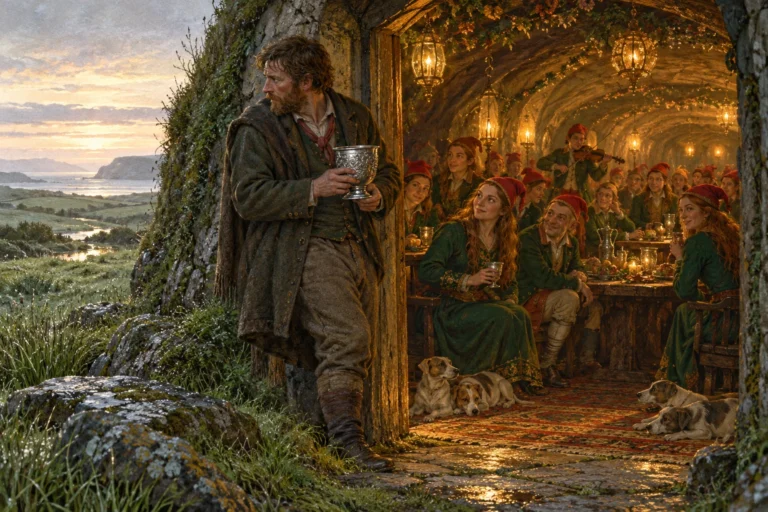
A man at Ballaleece lost his wife. No one could find her. Some thought she was dead; others said the Little People had taken her. He searched the island, but in time gave up and married again. His new wife had more money than the first.
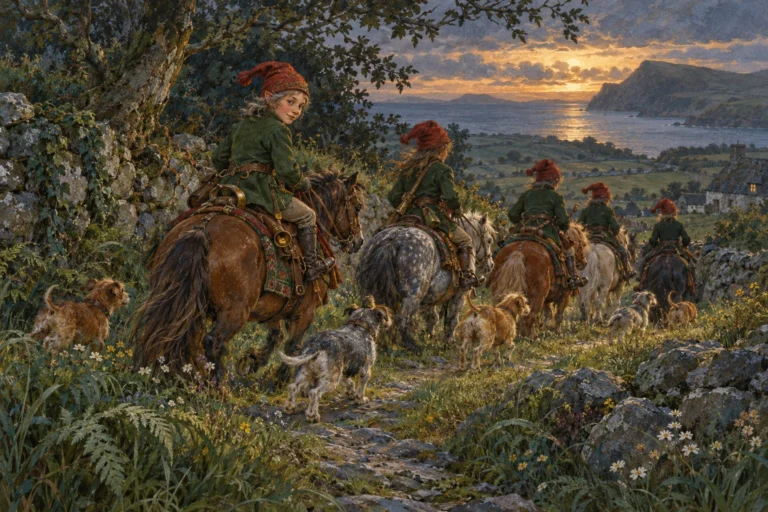
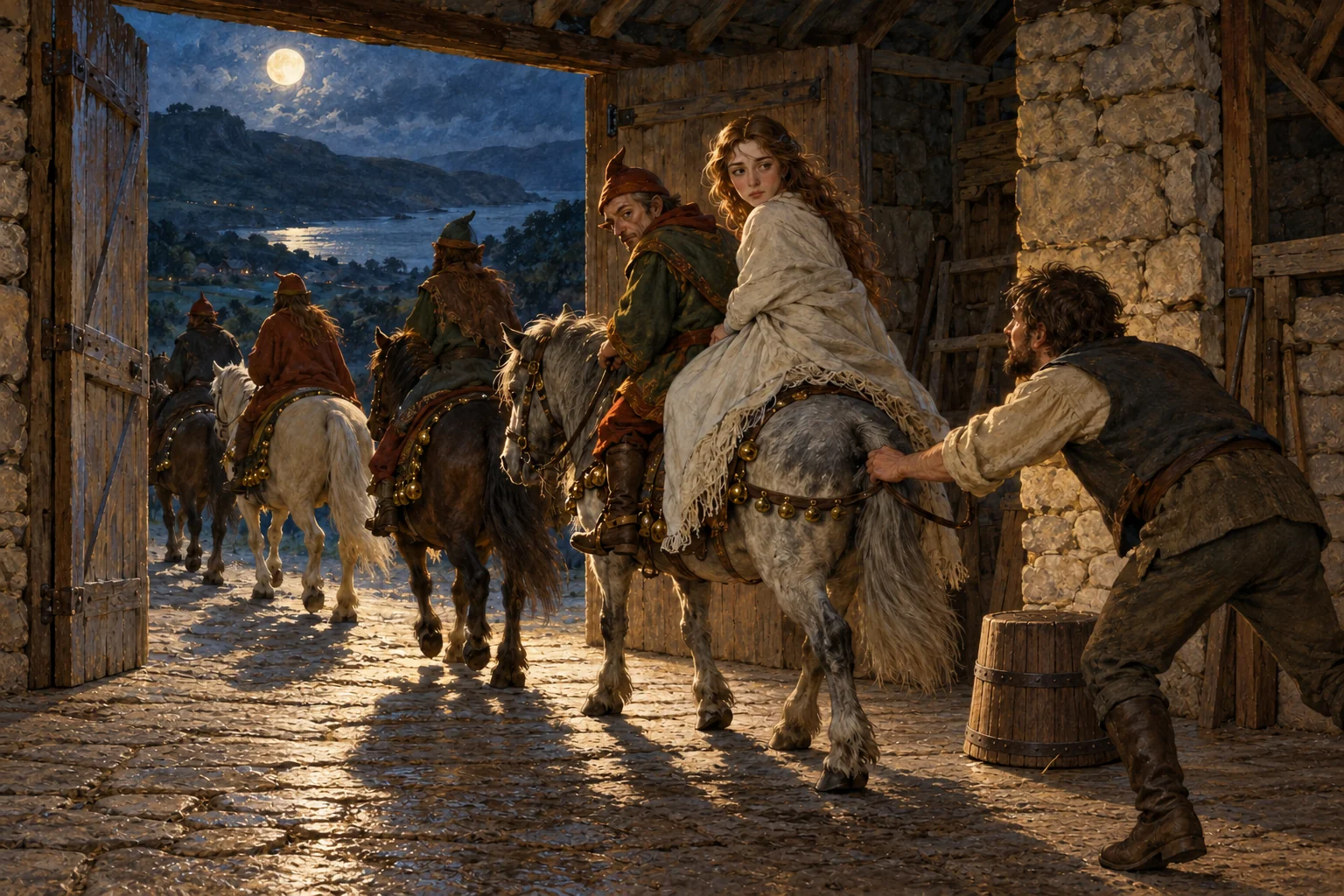
Then the missing woman appeared to him. She said that a company of riders would pass through his barn at midnight on Friday. He must sweep it perfectly clean, leaving not a single straw. She would be on the last horse, behind a little man. If he caught its bridle and held it, he could bring her home.
The second wife overheard the plan. While the barn was being prepared, she hid a straw beneath a bushel measure.
The last horse
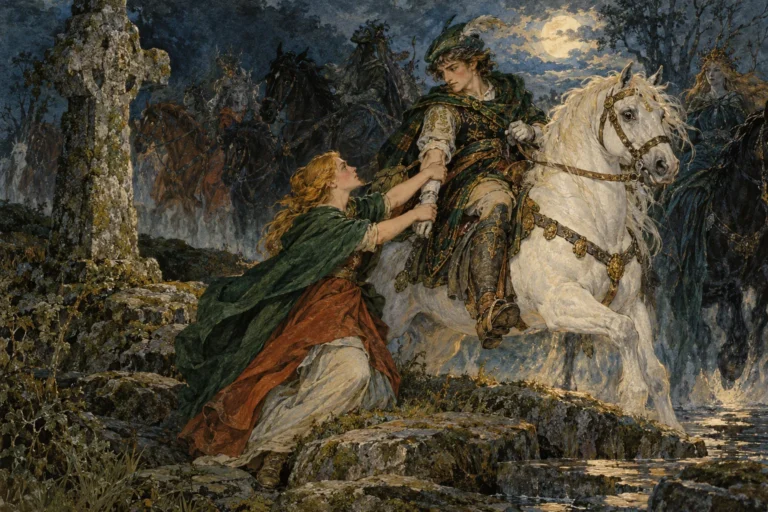
At the appointed hour, the riders came through. The husband waited until the last horse and seized its bridle. For a moment the rescue seemed possible, but he could not keep his hold.
The first wife pointed towards the hidden straw. The condition had not been met. She passed on with the riders, and he never saw her again.
The loss turns on an ordinary object, deliberately placed. The barn is almost clean, but almost is not enough.
Versions and variations
Morrison: the last horse and an overheard plan
The 1911 telling specifies Friday at midnight and the last horse. The second wife learns what is intended by listening. These are the details followed in the retelling above.
Moore, quoting Jenkinson: the second horse
Moore’s earlier collection prints an account credited to Jenkinson in which the first wife is to be on the second horse. The husband tells the second wife what is planned. The hidden straw and failed rescue remain, but the position in the procession and the means of discovery differ.
The same place does not mean the same text
Both accounts name Ballaleece. That common location is a reason to compare them, not permission to combine their instructions. A retelling that says “last horse” should identify Morrison; one following the “second horse” should identify Moore’s Jenkinson-derived passage.
Context and evidence
The jealousy of the second wife supplies the human obstruction in both versions. The narrative asks what happens when a return would undo a new household, but that is a reading of the plot, not evidence about a real marriage.
Ballaleece is documented as a place-name. The place guide distinguishes those records from the unverified barn and family. Compare Tam Lin for a successful retrieval from a supernatural procession and Rhys and Llewellyn for a rescue whose aftermath is still fatal.
Sources for this entry
- Sophia Morrison, Manx Fairy Tales. London: David Nutt, 1911. “The Lost Wife of Ballaleece”, pp.75–77. Read source — Complete last-horse narrative. About this book
- A. W. Moore, The Folk-Lore of the Isle of Man. Douglas and London, 1891. Chapter III, “The Kidnappers”, Ballaleece passage credited to Jenkinson. Read source — Earlier printed second-horse account; Jenkinson’s original edition has not been separately collated. About this book
- J. J. Kneen, The Place-Names of the Isle of Man. 1925–1929 work; German parish section in Manx Notebook transcription. Ballaleece and Balla Weene entries. Read source — Documentary name forms and Kneen’s interpretation of the place-name. About this book
Research coverage
The passages named below have been read and compared. This entry does not claim to include every oral performance, manuscript witness or modern adaptation; unexamined leads are identified separately.
The Myths · Manx collection · Editorial approach
Further Reading