Manx giant folklore · story
Finn MacCooilley and the Buggane
Finn’s wife outwits a Manx giant with a cradle and a griddle hidden in bread. But the trick does not settle their rivalry: a later battle sends Finn fleeing across the sea.
Also found as: Joe Moore’s story of Finn MacCooilley and the Buggane · Finn Mac Cooil · Finn and the Manx giant
Research reviewed 17 October 2026.
Read the story
A modern retelling of Joe Moore’s story as printed by Sophia Morrison in 1911, pp. 42–46. The ending includes violence. The account’s place-making is part of the legend.
From the Mountains of Mourne, Finn could see land across the water. He crossed to find out what sort of place it was and liked the Isle of Man well enough to stay. He settled near Cregneash, in the country above the Sound. Before long, word of the Irish giant reached another powerful inhabitant of the island.
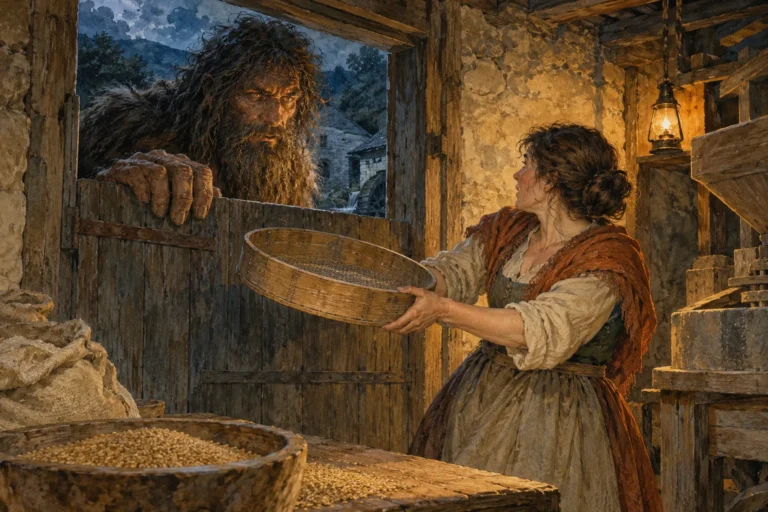
The Buggane lived on Barrule. He had heard enough about Finn to want a meeting, and Finn knew what such a visit meant. This would be a trial of strength. When the Buggane began coming down towards their home, Finn had no wish to meet him in a fight.
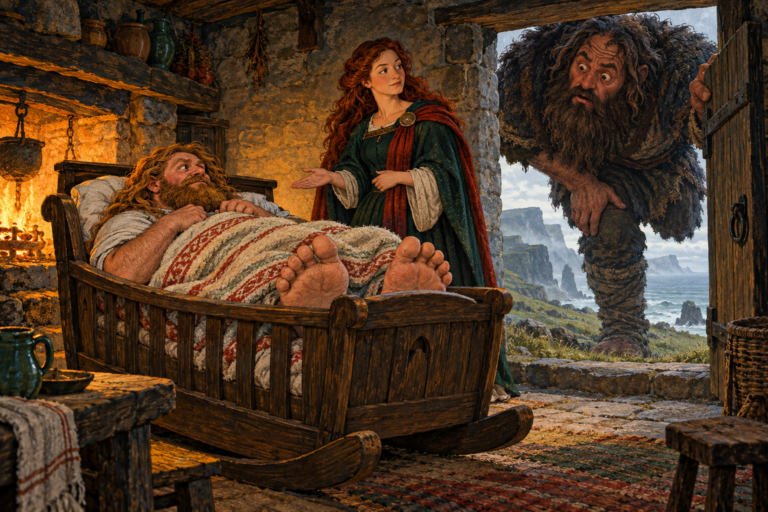
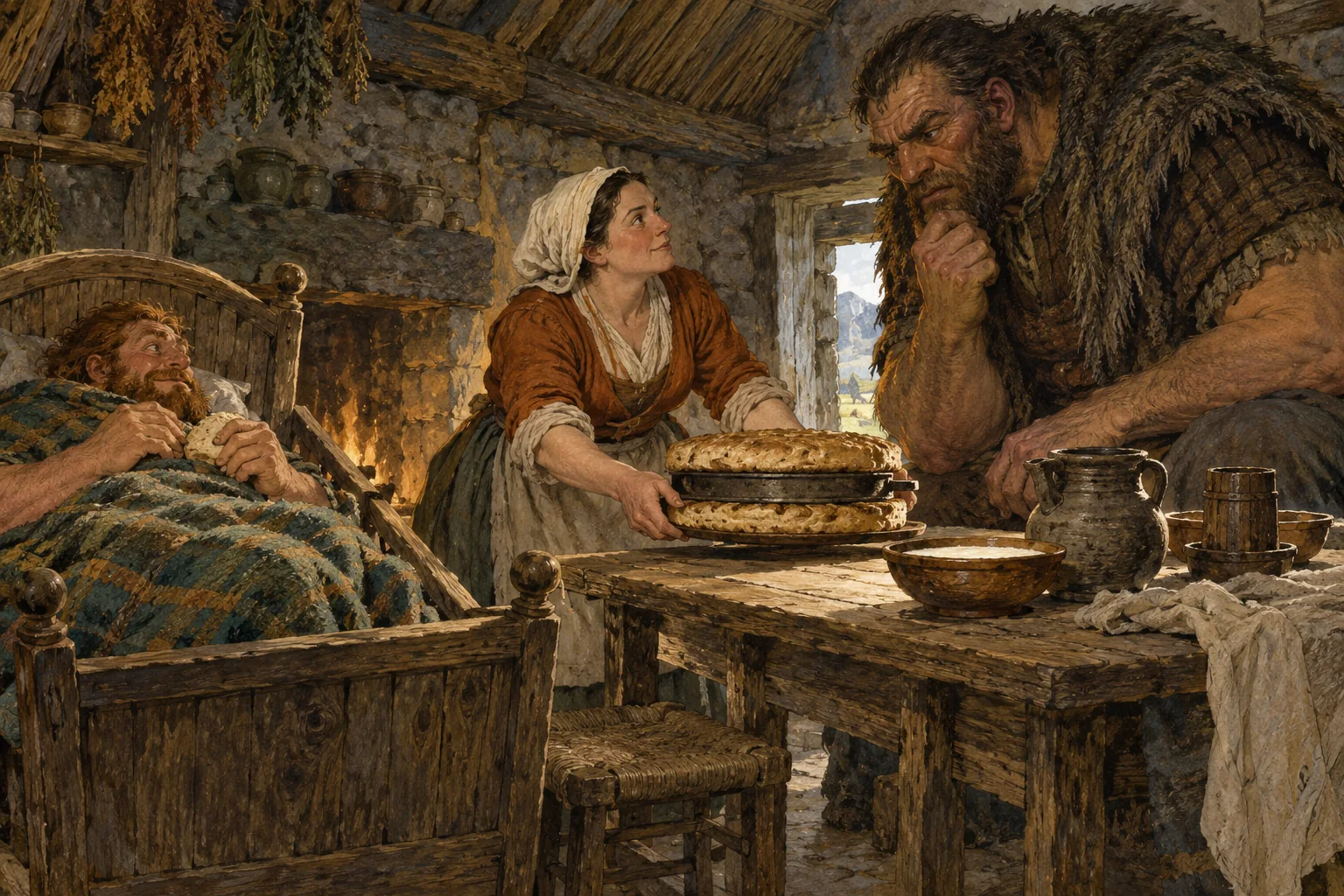
His wife had another way of handling the visitor. She told Finn to get into the cradle and leave the talking to her. By the time the Buggane reached the door, the great Irish giant was lying where a baby ought to be.
The visitor asked for the master of the house. Finn’s wife said he was away. The Buggane decided to come inside and wait, while she carried on with her baking. Then he noticed the occupant of the cradle. If that enormous creature was only the child, what must its father be like?
She encouraged that thought. Finn was indeed a powerful man, she explained, and the child took after him. To make the point more firmly, she finished her barley bread and put the iron griddle between two cakes. This formidable meal, with buttermilk to drink, she offered to the visitor.
The Buggane tried to eat and could not. He complained about the hardness of the bread. His hostess treated it as an ordinary household matter: that was the sort Finn liked. The guest was left to consider the teeth and jaws of a man who could eat such food.
Meanwhile, the supposed baby made a noisy demand for a share. His wife scolded him and handed over a buttercake. The Buggane protested that food so hard would break the child’s teeth. She assured him that the baby could manage it easily. Finn’s portion, of course, contained no griddle.
The visitor had seen enough. With a child of that size and a father of such alarming appetite, this was no household in which to force a quarrel. He slipped away. For the moment, the wife’s deception had succeeded.
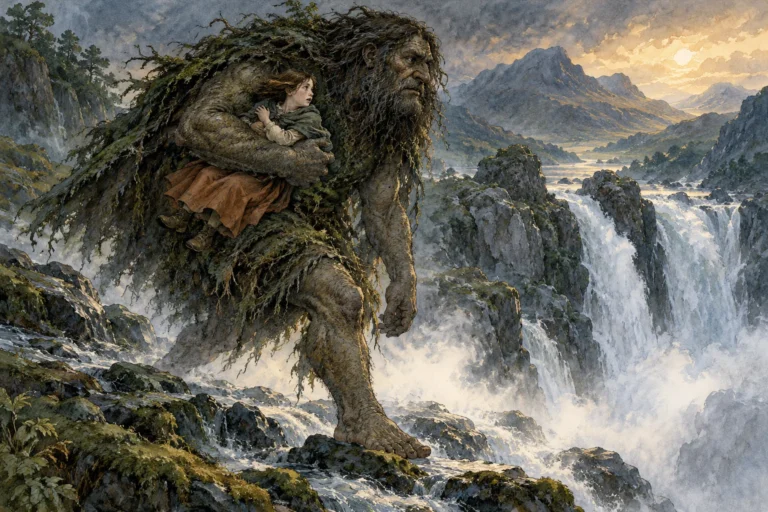
But Joe Moore’s story does not finish with Finn safe at home. Later, the giants met at Kirk Christ Rushen and fought from morning until sunset. Their feet broke the coastal rocks. Finn stood across the Sounds beside the Calf and Kitterland; the Buggane’s stance opened Port Erin. The struggle became an explanation for the shape of the southern shore.
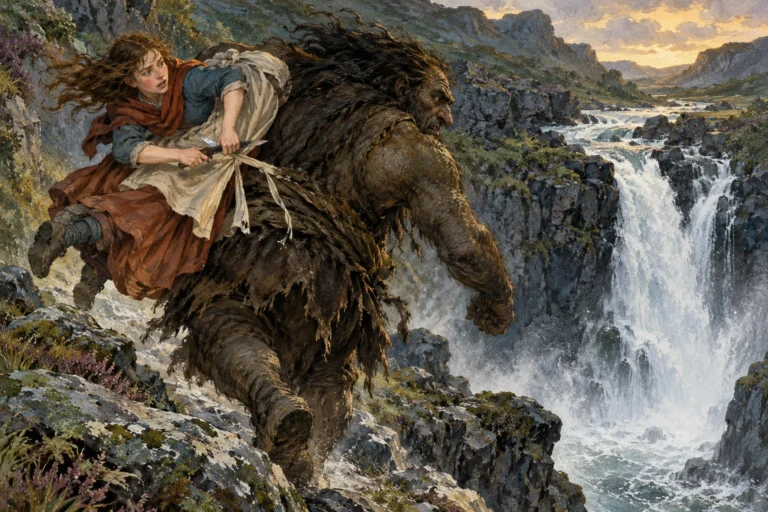
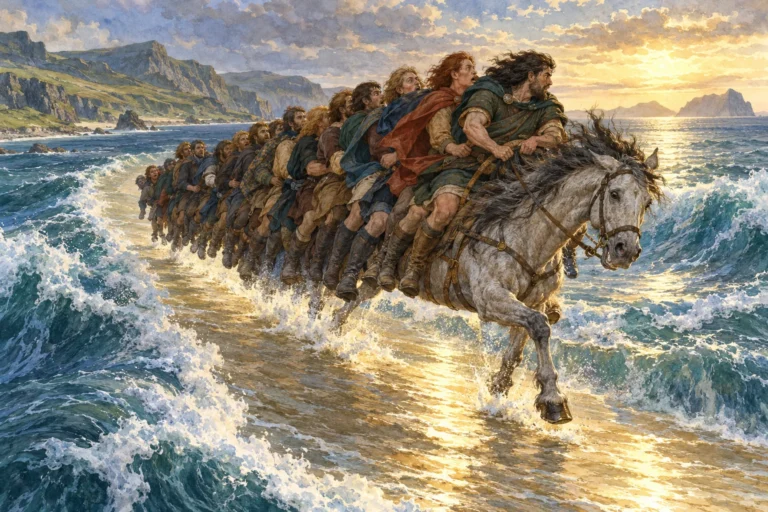
This time the Buggane won. Badly beaten, Finn escaped towards Ireland by walking over the sea, something his opponent could not do. The Buggane tore out a tooth and hurled it after him. It struck Finn’s head, fell into the water and became Chicken Rock.
Finn turned and cursed the rock to trouble people for as long as grass grew and water ran. The ending leaves the Manx giant victorious and the sea with a dangerous obstacle. The cradle trick had delayed the fight; it had never decided its outcome.
Versions and variations
A named Manx telling
Morrison’s title credits Joe Moore. The story makes Finn an incomer from the Mourne mountains and his rival a Manx Buggane from Barrule. Those details establish the narrative’s local loyalties. Finn is not automatically the winner simply because he is the more widely known figure.
The cradle trick across the water
The library’s Finn and the giant in the cradle compares Carleton’s Knockmany account with Greenwood’s Causeway telling. Morrison shares the device of a giant mistaken for a baby, and her iron griddle between cakes resembles Carleton’s hard-food test. Her text does not include Carleton’s curds disguised as a stone or the loss of Cucullin’s strength-bearing finger. Nor does it stop with a visitor’s retreat as Greenwood’s short account does. The subsequent Manx battle reverses Finn’s initial success.
These are comparisons of recorded plots, not a demonstrated route of borrowing. A shared episode could circulate through speech, reading and retelling; similarity alone cannot identify the direction or date of transmission.
Separate landscape stories
Morrison also prints “The Making of Mann”, in which Finn throws Irish earth into the sea. That is a separate narrative. It should not be inserted before this battle as though the two chapters form one continuous biography. Here the distinctive closing object is a tooth becoming Chicken Rock.
Context and evidence
The story is evidence of a recorded Manx telling about Finn. It does not establish that he lived at Cregneash, that giants cut the Sounds, or that Chicken Rock is a tooth. Its geographical precision gives listeners familiar places in which to imagine the contest.
Finn’s wife directs the successful deception. The giant’s defeat later does not undo her achievement; it changes what that achievement means. In this telling, cleverness avoids one encounter, while a direct contest has a different result. Keeping the second half matters: omitting it turns a Manx victory story into another uncomplicated triumph for Finn.
Follow Fionn’s figure guide for the much wider story cluster. The identity of a familiar hero can travel while the local setting, rival and outcome change.
Sources for this entry
- Sophia Morrison, Manx Fairy Tales. London: David Nutt, 1911. “Joe Moore’s Story of Finn MacCooilley and the Buggane”, pp. 42–46. Read source — Named printed telling; oral collection shaped for publication About this book
- Sophia Morrison, Manx Fairy Tales. London: David Nutt, 1911. “The Making of Mann”, pp. 16–19. Read source — Named printed telling; oral collection shaped for publication About this book
- William Carleton; W. B. Yeats, editor, Fairy and Folk Tales of the Irish Peasantry. 1888. “A Legend of Knockmany”, pp. 266–279. Read source — Cross-reference to the Irish entry’s already examined comparison About this book
Research coverage
Morrison’s complete Joe Moore narrative is examined here; the Irish cradle versions are compared through the linked entry. Other Manx Finn manuscripts and recordings have not yet been collated. The separate Making of Mann chapter is identified, not merged into this telling.
The Myths · Manx collection · Editorial approach
Further Reading