Irish tradition · Giants · Cunning
Irish book list · Irish source register
Finn and the giant
in the cradle
The Giant’s Causeway and A Legend of Knockmany: two recorded accounts of a clever wife, a frightened husband and an enormous deception.
A shared trick, different stories
Finn fears a rival giant. His wife hides him in a cradle and presents him as their baby, inviting the visitor to imagine the father’s size. That central trick connects the accounts below. Their names, extra episodes and endings do not all match.
These short modern retellings each follow a named source. They have not been blended into a single definitive version.
Research coverage: partial. This entry compares two passages. The wider survey of printed and oral accounts remains open; see the Irish source register. A listed collection is not evidence that it contains this episode.
Version A · William Carleton
A Legend of Knockmany
A short modern retelling following Carleton’s text in W. B. Yeats’s Fairy and Folk Tales of the Irish Peasantry, pp. 266–279. The collection was first published in 1888. This account includes violence.
Finn left his work at the Giant’s Causeway and returned to Oonagh on Knockmany Hill. The formidable Cucullin was hunting him, determined to prove himself the stronger giant.
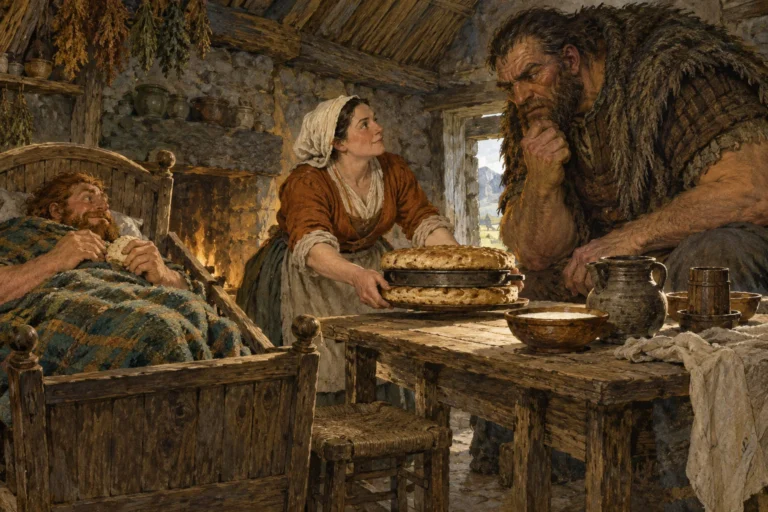
Oonagh prepared a different contest. She hid iron inside some bread, kept ordinary bread for Finn, and told him to lie in the cradle as their child.
When Cucullin arrived, she spoke as though Finn could easily defeat him. Her visitor broke his teeth on the iron-filled bread, while the supposed baby ate his portion without difficulty.
Then Finn challenged Cucullin to squeeze water from a stone. Cucullin failed. Finn secretly substituted curds and squeezed out the whey.
Alarmed at the child’s strength, Cucullin prepared to leave. First, he wanted to feel those extraordinary teeth. Finn bit off the finger in which Cucullin’s strength resided. With his rival powerless, Finn climbed out of the cradle and killed him.
Oonagh’s ingenuity had won the contest.
Read Carleton’s full text — look for “A Legend of Knockmany”, pp. 266–279.
Version B · Grace Greenwood
Benandonner at the Causeway
A short modern retelling following “Antrim—The Giant’s Causeway” in Stories and Legends of Travel and History, for Children. Edition consulted: 1885; copyright notice: 1857.
Finn had finished the Causeway when he shouted a challenge across the sea. Let the Scottish giant Benandonner come and fight him, if he dared.
Benandonner accepted. As he waded towards Ireland, Finn realised just how enormous his opponent was. Courage deserted him. He hurried into his house beside the cliff and told his wife that he did not feel well enough to fight.
She ordered him into the cradle, covered him up and began to rock him.
When Benandonner arrived demanding Finn, she asked him to mind the baby while she went to look for her husband.
The visitor looked down. The supposed infant was so large that his feet hung over the cradle’s end. If this was Finn’s child, how huge must Finn himself be?
Benandonner hurried home, abandoning the fight.
Read Greenwood’s account — in the chapter “Antrim—The Giant’s Causeway”. Greenwood says she heard the anecdote during her visit, but does not identify the teller or date that conversation.
What changes between them?
| Detail | Carleton | Greenwood |
|---|---|---|
| Opponent | Cucullin; the narrator leaves his Irish or Scottish identity uncertain | Benandonner, a Scottish giant |
| Finn’s wife | Oonagh | Unnamed |
| Main setting | Knockmany Hill | A house beside the Causeway cliffs |
| Tests | Iron-filled bread and curds presented as a stone | The baby’s size is enough |
| Ending | Cucullin loses his strength and is killed | Benandonner flees |
These are differences between two texts, not a demonstrated family tree of the oral tradition. We have not established whether their tellers drew on independent traditions, a shared source or earlier printed versions.
Later tellings and rearranged motifs
The Story Museum’s 2021 resource pack, credited to Amber Hsu and retold by Hannah McLean, calls the tale “Oonagh and Finn McCool”. Its synopsis puts Finn in a bathtub and combines the Causeway rivalry with an iron griddlecake test and impossible household tasks. This is a named modern adaptation: motifs can be rearranged, so a familiar detail should not automatically be assigned to every older account. Read the pack, p. 1.
The National Trust’s current Causeway history page gives a short fight version in which Benandonner tears up the crossing as he retreats. It also reports a different legend: Finn builds towards a Scottish lover, storms repeatedly destroy the route, and he dies after finally reaching her. The Trust associates that account with an 1830 poem attributed to “Mary Anne”. We have examined the Trust’s account, not independently collated the poem or its reported earlier guide tradition. Read the National Trust account.
These are additional published presentations, not evidence that the tradition has only four versions. The relationship between modern combinations and their earlier sources still needs tracing.
Evidence & connections
The landscape
UNESCO describes the Causeway’s basalt formations as the result of volcanic activity around 50–60 million years ago. That is evidence about the landscape’s formation. It does not date the story or establish a giant’s existence. Read UNESCO’s site description.
A later adaptation
Joseph Jacobs identifies Carleton as the source of his Knockmany tale in Celtic Fairy Tales. It is therefore a documented adaptation, rather than an additional independent oral witness. See Jacobs’s Notes and References, XVIII.
The figure behind the name
The giant in these accounts belongs to a larger field of Fionn stories. Follow the figure profile and the separate investigation, “Was Fionn a real person?”.
Sources for this entry
- William Carleton, “A Legend of Knockmany”, in W. B. Yeats (ed.), Fairy and Folk Tales of the Irish Peasantry, pp. 266–279. Collection first published 1888; digitised text consulted.
- Grace Greenwood, Stories and Legends of Travel and History, for Children, “Antrim—The Giant’s Causeway”, 1885 edition (copyright notice 1857). Read the source.
- Joseph Jacobs, Celtic Fairy Tales (1892), Notes and References, XVIII. Read the source.
- UNESCO World Heritage Centre, “Giant’s Causeway and Causeway Coast”. Read the site description.
The main retellings follow Carleton and Greenwood. The later-tellings section also examines the linked Story Museum pack and National Trust account. This is not a complete oral-variant inventory. Reviewed 17 October 2026.
The Myths · Irish collection · Sources & editorial approach
Further Reading