Irish coastal folklore · story
The Lady of Gollerus
At Smerwick harbour, Dick Fitzgerald steals a sea-woman’s enchanted cap and marries her. Years later, finding the hidden cap gives her a choice that he has kept from her.
Also found as: The Lady of Gallarus · Dick Fitzgerald and the Merrow · The Merrow of Gollerus
Research reviewed 17 October 2026.
Read the story
An original retelling of Thomas Crofton Croker’s published account, as printed in the 1906 edition. Its cheerful narrator praises the marriage, but the action begins with Dick deliberately preventing the woman from returning home.
Dick Fitzgerald stood smoking beside Smerwick harbour as daylight spread behind Mount Brandon. The sea was quiet, the mist lifting. It ought to have been a pleasant morning, but Dick had nobody with whom to share it. He talked aloud about the loneliness of a man without a wife, receiving only his own voice in return.
Then he noticed someone beside a rock. A young woman was combing hair the colour of the sea. Near her lay a little cap. Dick had heard enough stories to recognise what he was seeing: a merrow, with the enchanted headgear that allowed her to travel beneath the water.
He seized the cap. The woman turned and began to cry. Dick understood perfectly why she was distressed. Without it, she could not go home. Nevertheless, he kept it, wondering what advantage might come from the encounter.
He tried to comfort her and took her hand. A fine membrane joined her fingers. For a time she did not answer him, and he wondered whether she could speak. At last she asked whether he meant to eat her. Dick recoiled from the idea. He had something quite different in mind: he wanted to make her his wife.
The merrow agreed to marry him. Before they left, she arranged her hair, put away her comb and bent to whisper into the water. Dick watched a ripple run out across the surface. She explained that she was sending a message to her father so that he would not wait breakfast for her.
Her father, it emerged, was king of the waves. Dick immediately began thinking about the riches lying on the seabed. His intended wife did not understand money, although the fish brought whatever she asked for. When he mentioned buying a more comfortable bed, she assured him that she already possessed fourteen oyster-beds. The two of them were discovering that familiar words could mean quite different things.
Together they crossed the strand from Gollerus to Ballinrunnig, where Father Fitzgibbon happened to be. The priest refused to marry Dick to a sea-creature. Royal parentage did not persuade him; beauty did not persuade him either. Dick almost returned the cap. Then he mentioned the gold his bride might command, and suggested that performing the wedding could be profitable. The priest’s objections disappeared. Croker, courtship and marriage.
The couple returned to Gollerus. Their household prospered, and the merrow became a devoted mother. Within three years they had a daughter and two sons. Dick was content, and the story describes his wife as content too. Yet the cap remained hidden, and the sea from which she had come remained beyond her reach.
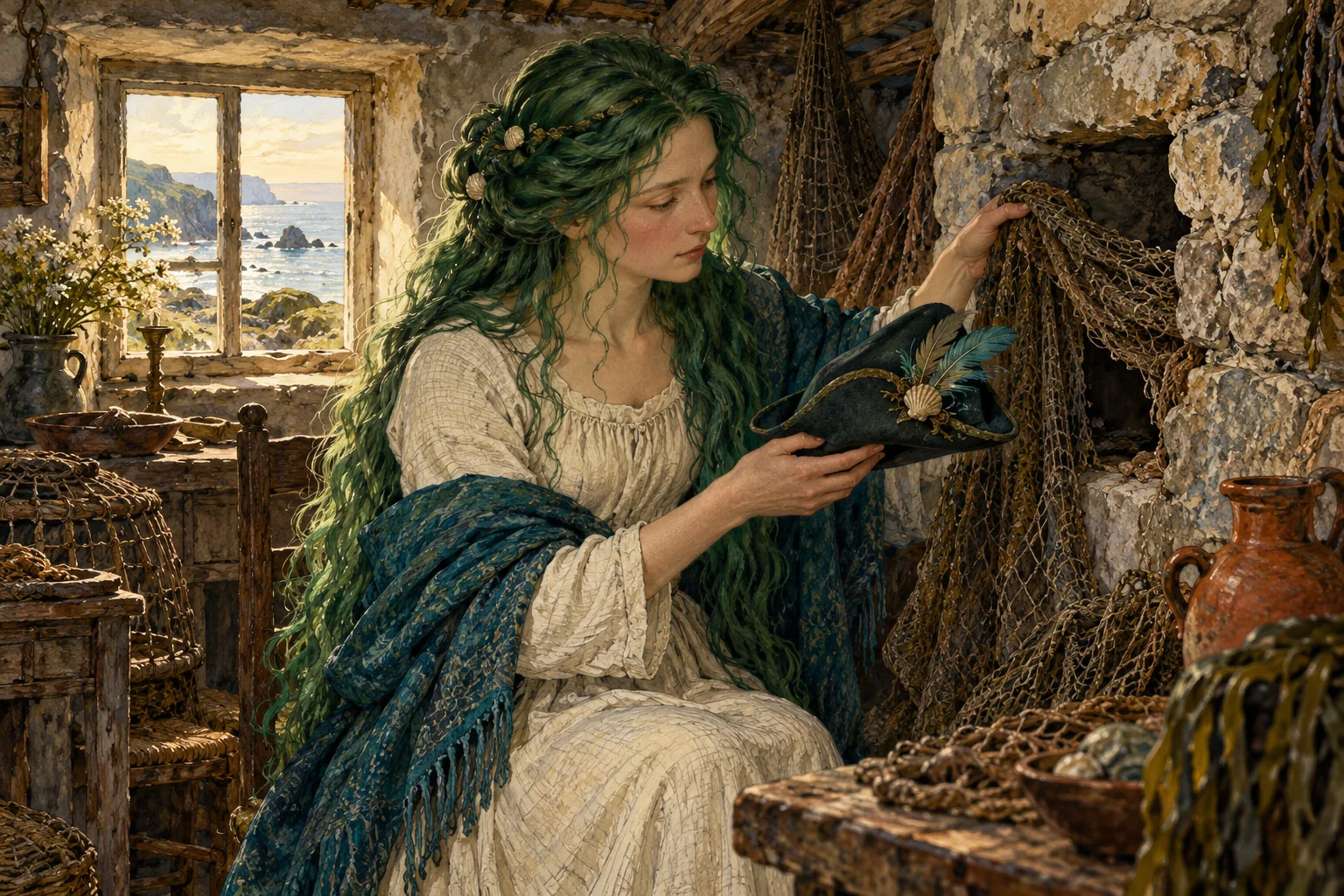
One day Dick went to Tralee. While cleaning the house, his wife pulled down a fishing-net and found a hole in the wall. Inside was her cap.
She held it and remembered another household: her father and mother, her brothers and sisters, and her life beneath the waves. Then she looked at her children and thought about Dick. Leaving would hurt him. But surely visiting her own family did not mean abandoning the family she had made on land. She told herself that she could come back.
At the door she turned again towards the cradle. She kissed the sleeping child, and a tear fell upon its face. She asked her daughter to be good and look after her brothers until she returned.
The strand was bright and the water calm. A faint sweetness seemed to call from the sea. Old feelings crowded into her mind. For that instant, Dick and the children vanished from her thoughts. She put on the cap and plunged beneath the surface.
That evening Dick asked his daughter Kathelin where her mother had gone. The neighbours had seen her walking towards the shore carrying something like a cocked hat. He searched the hiding-place, found it empty, and understood.
She never came back. Dick did not marry again. He believed her royal father must have detained her, and held to the hope that she would otherwise have returned. The story leaves him with that explanation; it never takes us under the water to discover whether he was right. Croker, discovery of the cap and ending.
Versions and variations
The same printed story is not a second witness. Croker’s 1844 edition and the 1906 transcription used here preserve the same central sequence: stolen cap, royal father, priest’s financial change of heart, three children, discovery behind a fishing-net, and departure. The earlier volume’s preface explains that it condenses and revises a larger collection. These publications document the circulation of Croker’s account; they do not establish two independently recorded performances. Croker, 1844, preface and chapter XXII; 1906 account.
Related seal-wife accounts change the escape. Keightley’s Shetland story, The Mermaid Wife, uses a sealskin, hidden behind a cornstack. A child finds it. The woman returns to a previous husband in the sea, and the children of her land marriage have webbed hands. Gollerus instead gives the wife her own discovery, a cap hidden indoors, and longing for parents and siblings. Dick’s belief that her father prevents a return is his conjecture, not the sea-wife’s explanation. Keightley himself compares the stories in his discussion of Irish merrows. These are related narratives from different settings, not alternative eyewitness accounts of one marriage. Keightley, pp. 169–171 and 370.
A different rescuer. Patrick Kennedy’s The Silkie Wife, credited to Captain F. W. L. Thomas, also explicitly concerns Shetland and Orkney. Here the couple have two children. The sea-woman’s intended companion finds her stolen skin and helps her leave; afterwards he addresses the human husband from a rock. That confrontation gives the sea-side relationship a voice absent from Dick’s ending. Kennedy’s Irish collection title must not turn this into an Irish field record. Kennedy, The Silkie Wife.
What remains open. These comparisons establish differences in objects, children and the route home. They do not establish which telling came first, prove direct borrowing between every account, or recover the unnamed woman’s perspective beyond what the published narrators supply.
Context and evidence
The tale places an unequal bargain inside a comic courtship. Its narrator sympathises with Dick, although Dick knowingly withholds the means of departure. The wife’s later intention to visit and return complicates any simple description of her as faithless. Wealth and the priest’s willingness to perform the wedding give the story another satirical edge. These are readings of Croker’s narrative, not claims about a recorded historical couple. Explore the merrow guide for other sea-people, and Smerwick and Gallarus for the distinction between the named coast and the actual monument.
Sources for this entry
- Thomas Crofton Croker, Fairy Legends and Traditions of the South of Ireland. Library Ireland transcription of the new and complete seventh edition, June 1906, edited by T. Wright. The Lady of Gollerus, complete story. Read source — Public-domain published account; main retelling, geography and cap motif About this book
- Thomas Crofton Croker, Fairy Legends and Traditions of the South of Ireland. A New Edition. Philadelphia: Lea and Blanchard, 1844; Faded Page transcription. Preface, pp. v–vi; XXII, The Lady of Gollerus, beginning p. 133. Read source — Earlier edition checked; a reprint of the same narrative, not a second oral witness About this book
- Thomas Keightley, The Fairy Mythology, Illustrative of the Romance and Superstition of Various Countries. New edition, revised and greatly enlarged. London: George Bell & Sons; New York, 1892; Project Gutenberg transcription. Shetland, The Mermaid Wife, pp. 169–171; Ireland, discussion of the merrow, p. 370. Read source — Public-domain comparative seal-wife account and Keightley’s explicit comparison with Gollerus About this book
- Patrick Kennedy; account credited to Captain F. W. L. Thomas, R.N., Legendary Fictions of the Irish Celts. Second edition, 1891; Library Ireland transcription. The Silkie Wife, complete story and opening attribution. Read source — Public-domain comparative account explicitly placed in Shetland and Orkney, not an Irish version merely because it appears in this book About this book
Research coverage
The full Croker account and two related northern-island seal-wife narratives were examined. The comparison distinguishes reprints from different tales. No independent Irish oral variant of the named Gollerus marriage has yet been fully examined, and no historical Dick Fitzgerald or merrow marriage is established. This is not an exhaustive survey of stolen-garment traditions.
The Myths · Irish collection · Editorial approach
Further Reading