Ulster Cycle · story
The Wooing of Emer
Emer answers a famous warrior with riddles and conditions of her own. Her father’s resistance sends Cú Chulainn on a dangerous journey to the teacher Scáthach.
Also found as: Tochmarc Emire · The Courtship of Emer · Courting of Emer · Cú Chulainn’s Training with Scáthach
Research reviewed 17 October 2026.
Read the story
An original condensed retelling of the long “Wooing of Emer” translated by Kuno Meyer in 1888. Its training episodes and return journey contain further adventures; the account here follows the courtship and its consequences.
The men of Ulster decided Cú Chulainn needed a wife. Their reasons were not entirely generous: too many of their own wives and daughters admired him. Yet the women their messengers found did not interest him. Eventually he chose to visit Emer, the daughter of Forgall, whom he already knew.
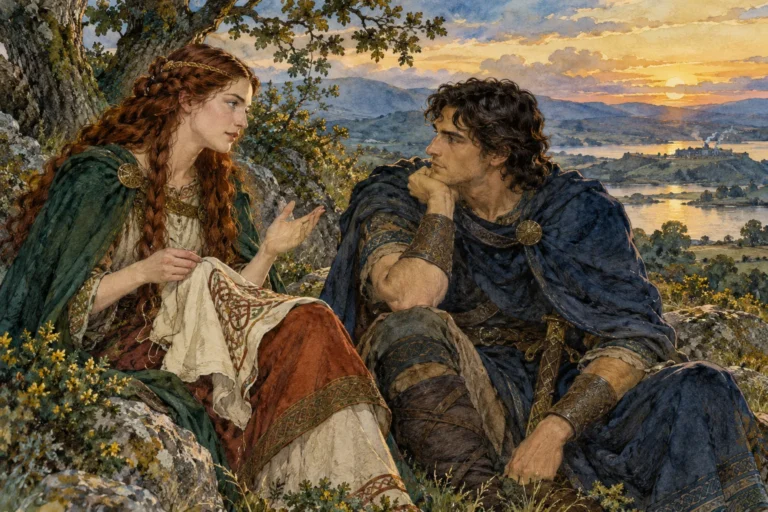
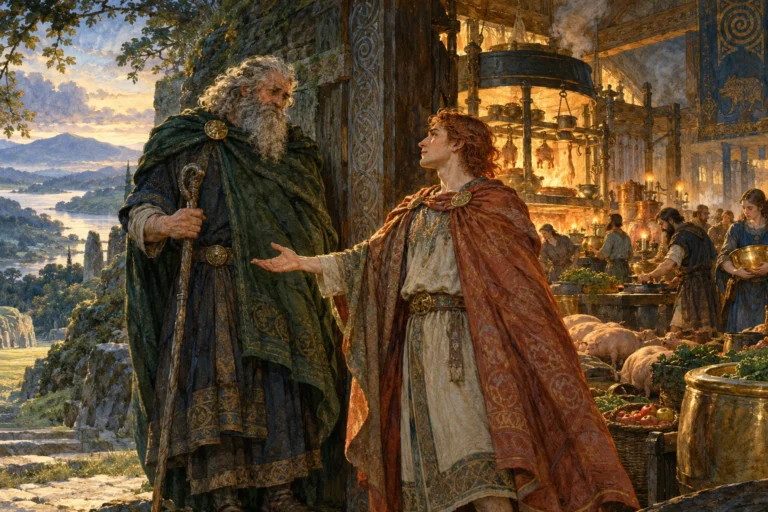
Emer sat with other young women, teaching them fine needlework, when his chariot arrived. She possessed the accomplishments he demanded in a partner, including wisdom and skilled speech. But his reputation did not end the conversation before it began. When he described his strength, she observed that impressive deeds for a boy were not necessarily those of a grown champion.
They spoke in riddles, describing roads, rivers and their own identities through stories hidden inside names. The women nearby could hear the words without understanding the courtship. Emer also set conditions. To carry her away, he would have to cross her father’s defences and overcome the guards while sparing her brothers. She was interested, but neither ignorant of the danger nor willing simply to submit to his boasts. Meyer, pp. 70–75, 150–155 and 231–233.
Forgall discovered what was happening. Disguised as a foreign visitor at Emain Macha, he praised Cú Chulainn and suggested that training abroad would make him greater still. His hope was that the journey would kill him. Emer recognised the scheme and warned her suitor before they parted.
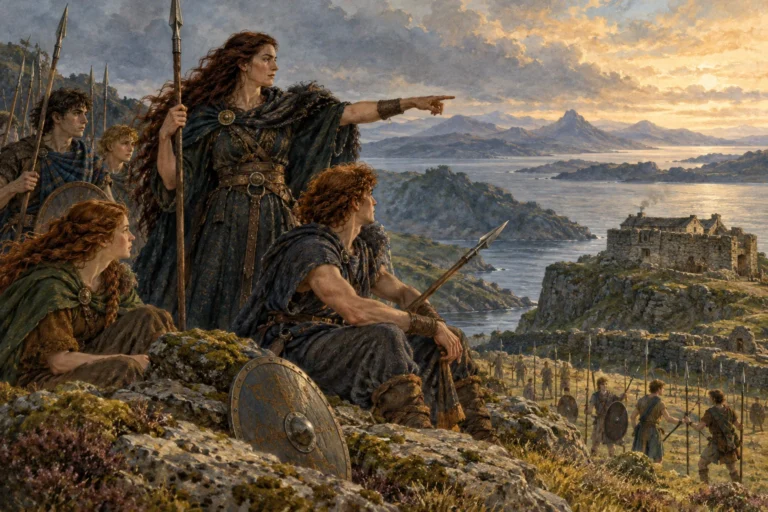
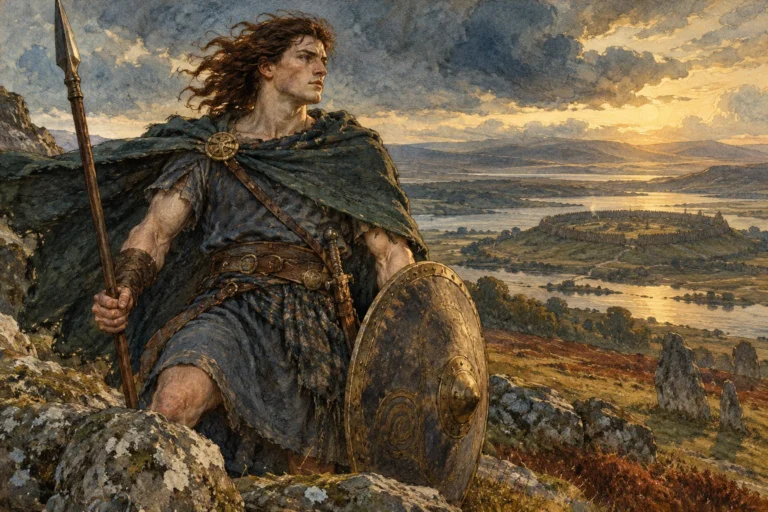
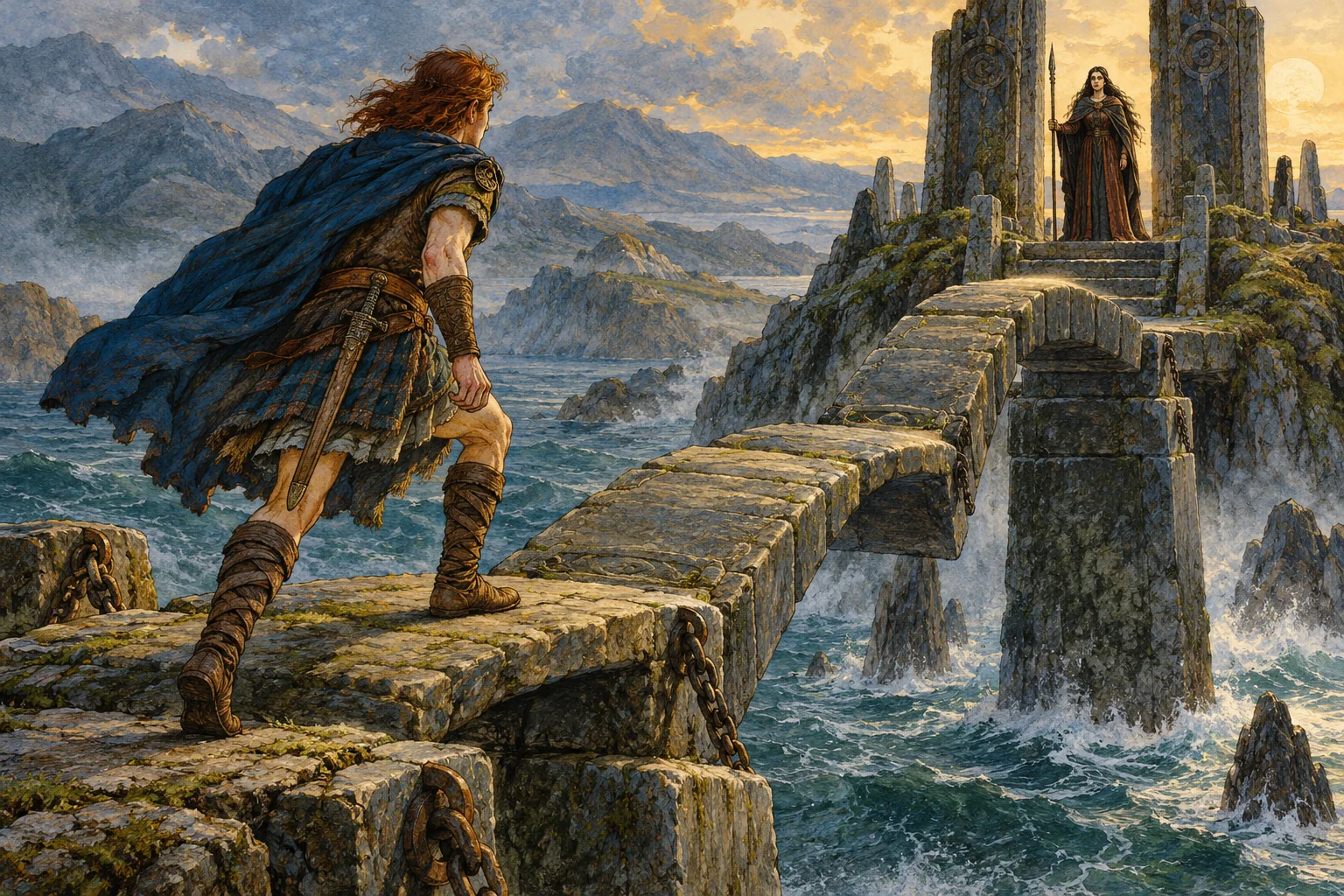
Cú Chulainn travelled to Domnall in Alba and then onwards towards Scáthach. An illusion of Emain drew his companions away. Alone, he crossed strange country with unexpected help, passing ground that trapped travellers and a dangerous glen. At last he reached the bridge leading to Scáthach’s island. Its ends rose and fell against anyone trying to cross. After repeated failures, he made an extraordinary leap and gained the far side.
His arrival brought further violence. After killing one of Scáthach’s champions, he undertook that warrior’s service. Her daughter Uathach advised him how to force a promise of instruction from her mother. He threatened Scáthach with a sword and demanded teaching, Uathach without a marriage payment, and knowledge of his future.
While he trained, Forgall tried to marry Emer to Lugaid. Emer told the intended bridegroom that she loved Cú Chulainn and that taking her would dishonour him. Lugaid withdrew. Abroad, Cú Chulainn fought for Scáthach against Aífe. He defeated Aífe through a trick and made sexual demands as conditions of sparing her life. She conceived his son, Connla. The hero’s own conduct had already broken the simple picture of faithful lovers waiting for reunion. Meyer, pp. 233–235 and 298–303.
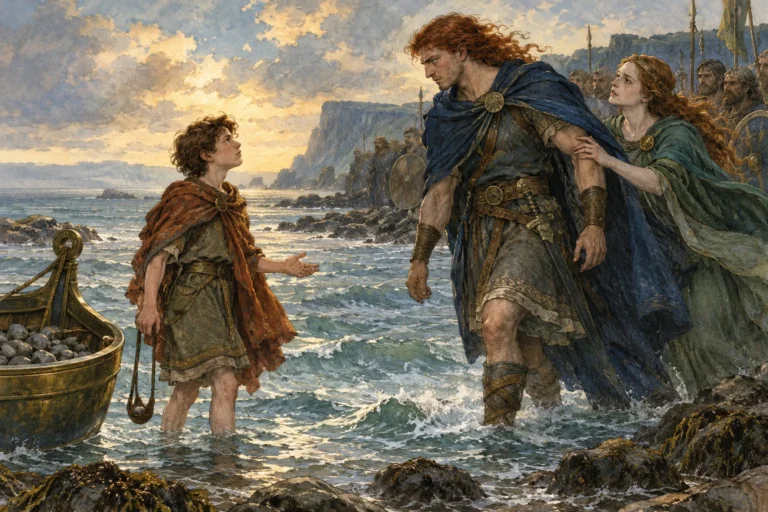
When he finally returned to Ireland, Forgall’s guards kept him from Emer for another year. Then he crossed the three ramparts, killed the guards and spared her brothers as promised. Forgall died while trying to escape. Cú Chulainn carried Emer and her foster-sister out, together with their gold and silver.
The pursuit continued across several fords, including a crossing of the Boyne. By night the fugitives reached Emain. Even there, the wedding almost provoked another disaster: Conchobar’s supposed privilege over a new bride threatened Cú Chulainn’s honour. Fergus and Cathbad supervised a compromise that prevented its sexual enforcement. The following day, the marriage payments were settled and Emer and Cú Chulainn became husband and wife. Meyer, pp. 305–306.
Versions and variations
Differences inside the medieval tradition. Meyer does not present a perfectly uniform text. At p. 234, Domnall’s rejected daughter Dornolla causes the illusion that separates Cú Chulainn from his companions; an alternative explicitly attributes it to Forgall. At p. 299, one account places Ferdiad and other Irish heroes among Scáthach’s students, while Meyer’s principal account does not place them there at that moment. At p. 300, an alternative makes Scáthach herself Cú Chulainn’s sexual partner; the principal narration instead has him with her daughter Uathach. These alternatives concern different passages and should not be bundled into one invented “original version”. Meyer, pp. 234, 299–300.
Gregory’s selected route. Gregory chooses Forgall as the maker of the illusion and explicitly includes Ferdiad and the sons of Usnach at the training ground. Her bridge becomes narrow, short, slippery and high in succession; Meyer’s description concentrates on its rising ends. She removes Cú Chulainn’s sexual demands from the conditions forced upon Aífe and describes love following peace. She also omits the dispute over Conchobar’s bridal privilege, bringing the couple into a welcoming court instead. These changes alter the hero’s character as well as the pace. Gregory, chapter III, pp. 33–43.
A source relationship, not two independent witnesses. Gregory lists Meyer’s translations among her authorities. Her chapter is an adaptation selecting and reshaping transmitted material. Meyer’s long translation likewise signals manuscript variation and gaps; it is not the entire history of Tochmarc Emire. The shorter recension and the separate later training tale need their own comparisons. Gregory’s source notes.
Context and evidence
Emer’s courtship is an exchange of knowledge as well as a series of feats. Place-name lore turns the landscape into a shared language: the Boyne appears both in the explanations of the lovers’ riddles and in their escape. The story returns to Emain Macha, but its court customs should be read as narrative claims, not automatically as documented laws of ancient Ireland. The training journey introduces Scáthach and prepares the tragedy of Connla. Emer’s guide follows her beyond this marriage story.
Sources for this entry
- Anonymous; translated by Kuno Meyer, The Wooing of Emer. The Archaeological Review 1 (1888), pp. 68–75, 150–155, 231–235, 298–307; CELT digital edition T301021. Courtship pp. 70–75 and 150–155; explanations pp. 231–233; journey pp. 233–235; Scáthach and Aífe pp. 298–303; return and marriage pp. 303–306. Read source — Principal long-text translation; its expressly reported alternative passages are compared individually.
- Lady Augusta Gregory, Cuchulain of Muirthemne. London: John Murray, 1902. III, “Courting of Emer”, pp. 21–47; particularly bridge pp. 34–36, Aífe pp. 37–39, wedding pp. 41–43. Read source — Examined literary adaptation dependent in part on Meyer. About this book
- Lady Augusta Gregory, Cuchulain of Muirthemne: Notes. London: John Murray, 1902. pp. 359–360, source-list preamble and “Courting of Emer”. Read source — Explicit evidence of dependence and editorial combination. About this book
Research coverage
Compared Meyer’s long-text translation, its specifically flagged alternatives, and the corresponding courtship/training passages in Gregory. This does not amount to a full collation of the short recension, all long-recension manuscripts or the later Foglaim Con Culainn training tale. Sexual coercion and omissions in adaptation are identified rather than harmonised.
The Myths · Irish collection · Editorial approach
Further Reading