Ulster Cycle · story
Cú Chulainn and Ferdiad
Two companions trained in the same arts are drawn into a duel during the cattle raid of Cooley. Victory leaves the survivor mourning the man he has killed.
Also found as: Fer Diad · Ferdia · Ferdia’s fight at the ford · The Combat of Ferdiad and Cuchulain · Táin Bó Cúailnge
Research reviewed 17 October 2026.
Read the story
This retelling follows the extended duel in the Book of Leinster tradition. Other versions compress the fight, and Gregory changes an important detail of its ending.
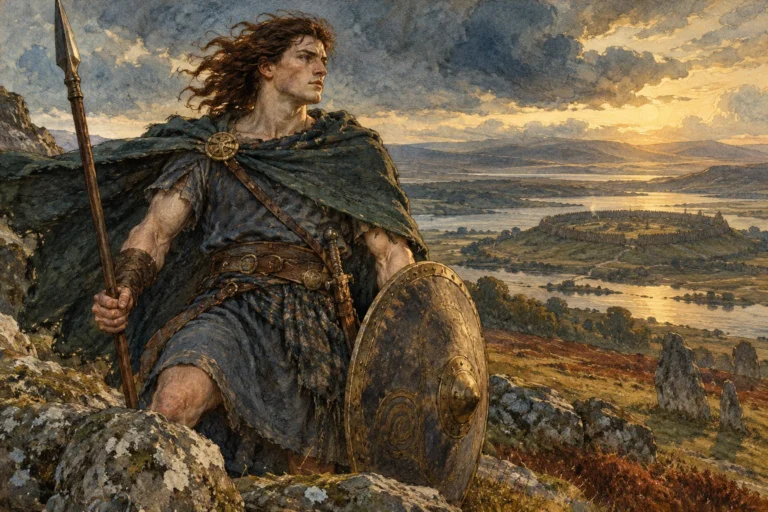
By the time Ferdiad was asked to fight Cú Chulainn, the army had lost many champions. One young defender was delaying the invasion of Ulster. Medb needed someone who could match him, and Ferdiad seemed the answer. He and Cú Chulainn had learned their fighting arts together; each knew what the other could do.
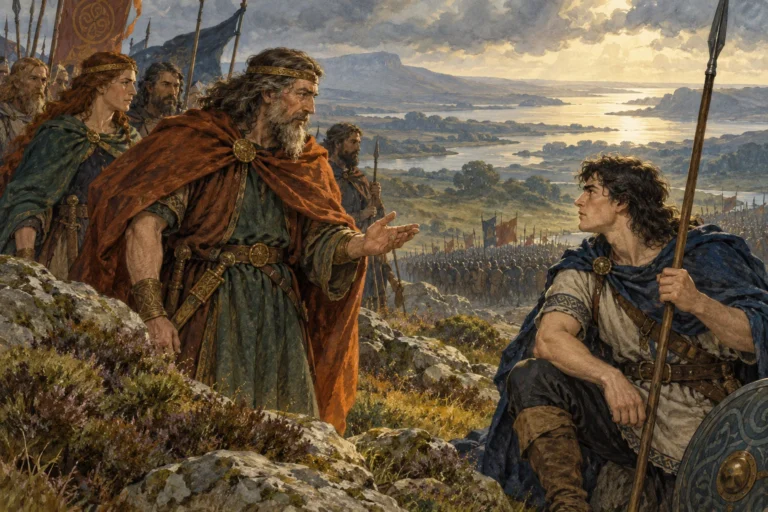
That knowledge made Ferdiad unwilling. He was being asked to kill a companion. Medb’s messengers became threats of public disgrace, then promises of wealth and marriage to her daughter Findabair. She also claimed that Cú Chulainn had spoken contemptuously of him. Affection, honour and wounded pride were pulled against one another until Ferdiad agreed.
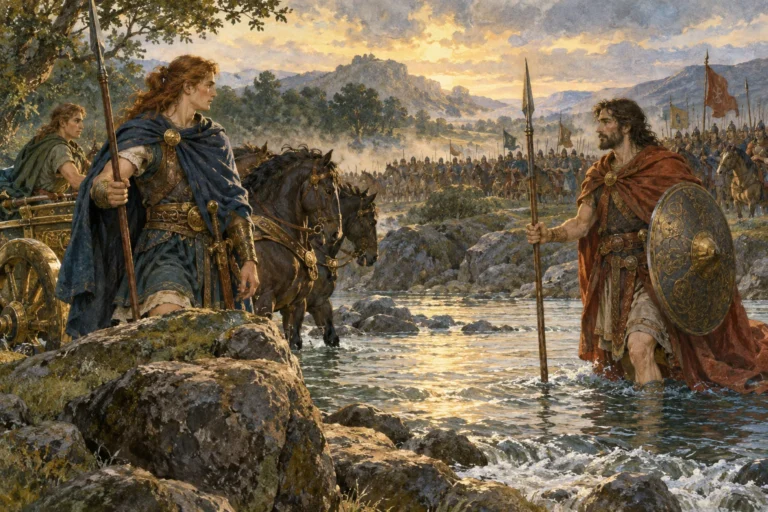
Fergus carried the warning to Cú Chulainn. This was an opponent whose arrival brought sorrow as well as danger. Yet neither man withdrew. They came to the ford, chose their weapons and began.
During the first days, their equality prolonged the fight. When the day’s combat ended, they embraced. Cú Chulainn shared healing supplies with Ferdiad; Ferdiad shared the provisions sent from the invading army. The men who wounded each other still attended to each other’s needs. But as the struggle continued, even that fragile companionship gave way. Dunn, “The Combat of Ferdiad and Cuchulain”.
On the last day Ferdiad prepared special protection for the weapon that Cú Chulainn alone possessed: the gáe bolga. At close quarters, Cú Chulainn tried to gain an advantage by springing onto his opponent’s shield. Ferdiad repeatedly threw him back. Láeg, watching from the bank, drove his master on with bitter taunts.
At last Cú Chulainn called for the deadly weapon. Láeg sent it towards him through the water. Cú Chulainn diverted Ferdiad’s guard with an attack above, caught the gáe bolga with his foot and drove it underneath the defence. Ferdiad received the wound from which he could not recover.
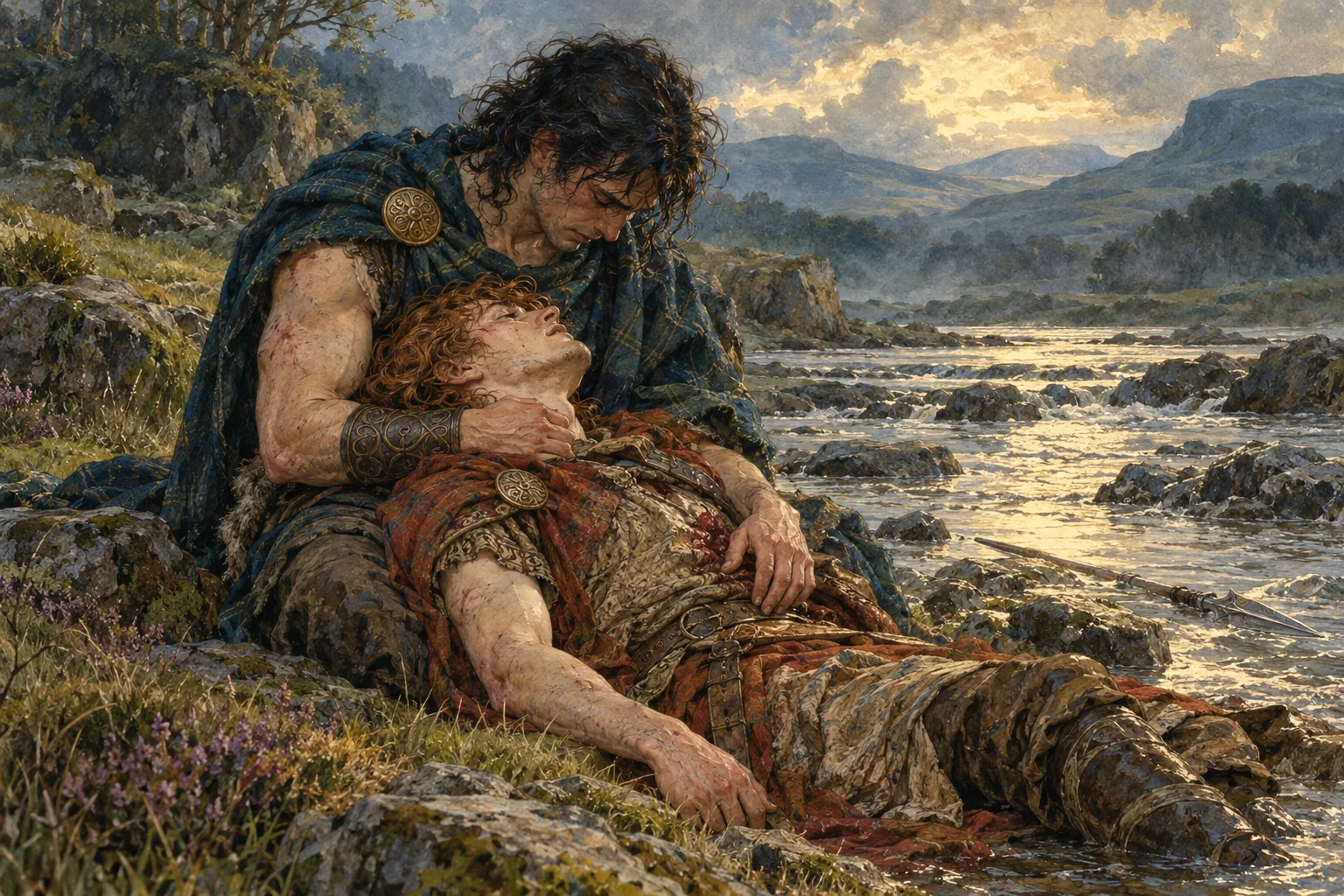
The fighting stopped, but there was no uncomplicated triumph. Cú Chulainn carried Ferdiad clear of the ford and grieved over him, remembering their training, their closeness and the body now ruined by the contest. The army’s problem had been solved only by turning companionship into a weapon against both men. Cú Chulainn had survived the duel; he had not escaped its loss. O’Rahilly, “The Encounter with Fer Diad”.
Versions and variations
The scale of the duel. The Book of Leinster account gives an extended sequence of days, weapons, exchanges and laments. Recension I’s encounter is much more compressed after the warriors meet. Faraday’s translation makes that contrast particularly easy to see: the fight moves rapidly from shield-leaping to the fatal weapon. A shorter account does not, by itself, prove that its teller imagined a different number of days. Faraday, pp. 111–113.
How the final weapon is used. In the Book of Leinster translation, Cú Chulainn uses his foot to deliver the gáe bolga beneath Ferdiad’s defence, after distracting him with an upper attack. Gregory has him receive it with his foot but cast it from his hand over the shield. This alters the mechanics and removes the medieval account’s explicit bodily detail. O’Rahilly, p. 229; Gregory, pp. 238–239.
Translation is not a new witness. Dunn, Faraday and O’Rahilly give readers access to manuscript traditions. Their books cannot simply be counted as independent oral variants. Gregory, meanwhile, acknowledges combining translations and moving material. Her work matters greatly to the story’s reception, but its source relationships need to remain visible.
Context and evidence
This is one episode within the Táin, not the whole cattle raid. Its emotional force comes from the collision between loyalty to a companion and the demands of reputation and warfare. Reading it beside the naming of Cú Chulainn also reveals how protection, obligation and public judgement recur across his stories.
The text names the ford Áth Fhir Diad. A place-name explanation inside a saga is evidence of the story’s relationship with a landscape, rather than proof that the combat occurred. A separate place entry should check the association with modern Ardee against place-name scholarship and archaeological evidence before presenting a precise location. The present entry keeps that distinction open.
Sources for this entry
- Anonymous; translated by Joseph Dunn, The Ancient Irish Epic Tale Táin Bó Cúalnge. London: David Nutt, 1914. The Combat of Ferdiad and Cuchulain; source readings marked in the edition. Read source — Checked extended narrative in an early translation incorporating manuscript variants.. About this book
- Anonymous; translated by Cecile O’Rahilly, Táin Bó Cúalnge from the Book of Leinster. Dublin Institute for Advanced Studies, 1970; CELT T301035. The Encounter with Fer Diad, beginning p. 211; fatal weapon sequence pp. 228–229 and following laments. Read source — Checked scholarly translation of the extended recension; comparison of the final weapon.. About this book
- Anonymous; translated by L. Winifred Faraday, The Cattle-Raid of Cualnge. London: David Nutt, 1904. The Combat of Fer Diad and Cuchulainn, pp. 99–113, especially pp. 111–113. Read source — Checked compressed Recension I account in translation.. About this book
- Lady Gregory, Cuchulain of Muirthemne. London: John Murray, 1902. XI. The War for the Bull of Cuailgne; Ferdiad episode, especially pp. 238–244. Read source — Checked literary adaptation, including altered handling of the gáe bolga.. About this book
- Lady Gregory, Cuchulain of Muirthemne: Notes by Lady Gregory. 1902. War for the Bull of Cuailgne and Awakening of Ulster source list, p. 360. Read source — Documents use of manuscript translations, O’Curry, O’Grady and Zimmer.. About this book
Research coverage
Compared the extended Book of Leinster duel, the compressed Recension I account and Gregory’s adaptation, with Dunn’s readings checked. The separate early modern Ferdiad texts, later oral versions and modern translations have not all been collated. The modern identification of the ford needs a dedicated place study.
The Myths · Irish collection · Editorial approach
Further Reading