Place · South Armagh, Northern Ireland
Slieve Gullion
The mountain of Fionn’s enchanted lake and grey hair, where a prehistoric passage tomb is also remembered as Calliagh Berra’s House.
Also found as: Sliabh gCuillinn · Slieve Cullinn · Slieve Cuilinn · Calliagh Berra’s House
A mountain entered through a story
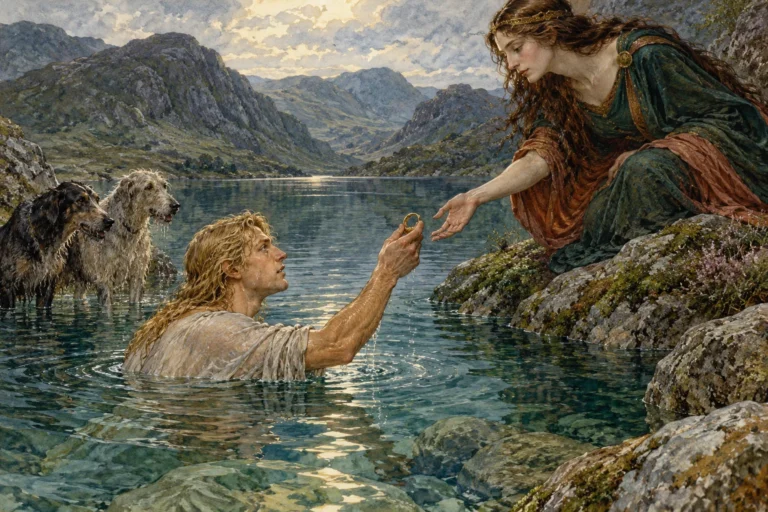
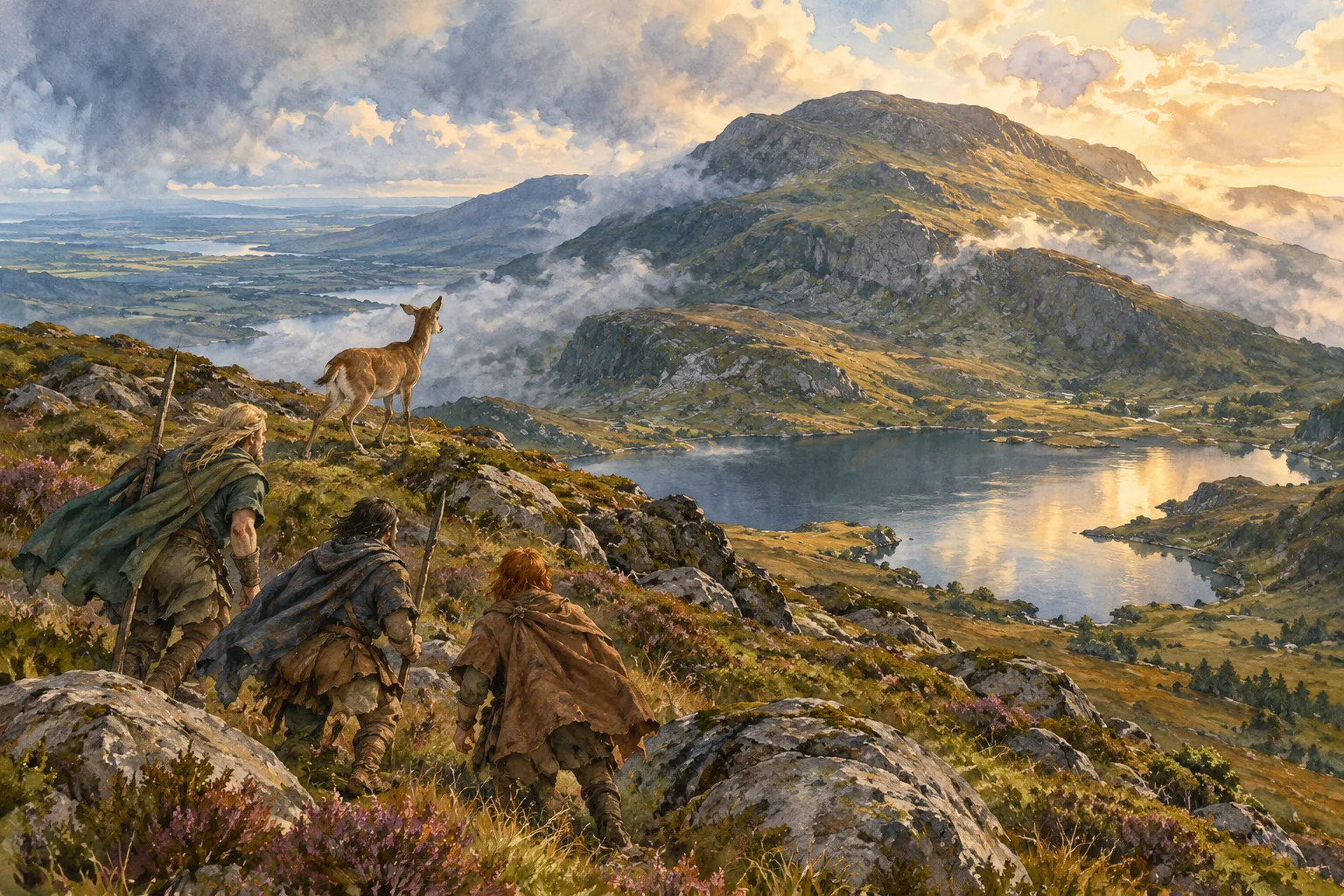
The Hunt of Slieve Gullion begins far away at Allen. Fionn follows a doe north with Bran and Sceólang until it disappears on the mountain. Beside a lake he encounters a woman mourning a lost ring. He enters the water to retrieve it and comes out aged and unrecognisable. The mountain becomes a place where familiar strength and identity can suddenly fail. This sequence follows Joyce’s “Chase of Slieve Cullinn”, pp. 351–361.
The route through the tale links the summit with Fionn’s household at the Hill of Allen. His friends follow his tracks, recognise the old man and dig into an underground dwelling to obtain a cure. Joyce has Milucra herself emerge with the restorative horn. Fionn accepts his restored strength but chooses to keep his silver hair. The story’s journey therefore ends with both rescue and a lasting transformation.
Milucra, Cuilinn and Calliagh Berra
The names and geography require care. Gregory’s “Hunt of Slieve Cuilinn”, Book IV, chapter XV, identifies the enchantress as Miluchradh but sends the Fianna to her father Cuilinn’s hill in Cuailgne for the cure. He supplies the vessel; she adds an identification with Manannán. Joyce’s cure takes place in Milucra’s dwelling on the mountain. The difference should remain visible when a literary scene is associated with a real monument.
The Ring of Gullion AONB’s cultural account links Fionn’s changed hair with Cailleach Berra, while the official monument record gives Calliagh Berra’s House as the South Cairn’s local name. Those associations are documented; they do not establish that every text’s Milucra and every local Cailleach tradition are identical.
The monument and its evidence
The South Cairn encloses an octagonal chamber reached through a short passage. Excavation in 1961 found disturbed burial deposits, cremated bone fragments and flints. These are archaeological observations recorded by the Department for Communities. The landscape partnership identifies the tomb as Neolithic, approximately five thousand years old, in its 2023 conservation notice.
A prehistoric burial monument and a later account of an underground enchanted dwelling can occupy the same cultural landscape without becoming the same kind of evidence. The tomb establishes ancient human activity here. Its later name records how people understood and remembered it. Neither the bones nor the chamber identifies Fionn, Milucra or the Cailleach as an excavated historical person.
Follow the connected stories
From the hunt, follow Bran and Sceólang to their unusual origins, or the cave of Kesh to another occasion when enchantment defeats the Fianna’s strength. The comparison is thematic: these are separate places and separate narratives, not interchangeable versions of one cave adventure.
For access information, consult the current South Cairn record. When checked on 17 October 2026 it listed the monument as not open to the public; older descriptions of entering the chamber should not be treated as a current access promise.
Sources for this place
- P. W. Joyce, Old Celtic Romances: The Chase of Slieve Cullinn. 1920 edition; first published 1879. pp. 351–361; preface p. xvi. Read source — Complete literary geography and encounter consulted. About this book
- Lady Gregory, Gods and Fighting Men: The Hunt of Slieve Cuilinn. 1905 edition; first published 1904. Part II, Book IV, chapter XV; Notes III, Authorities. Read source — Compared geography and cure; not silently harmonised with Joyce. About this book
- Department for Communities, Northern Ireland, Slieve Gullion South Cairn. Web record consulted 17 October 2026. About Slieve Gullion South Cairn; Additional Information; monument ARM 028:007. Read source — Physical monument, excavation summary, local name and dated access information.
- Ring of Gullion AONB, Culture. Web page consulted 17 October 2026. Intangible Cultural Heritage. Read source — Current local Cailleach association; not an attributed oral transcript.
- Ring of Gullion AONB, Slieve Gullion’s Passage Tomb and Cairn Need Your Help. 3 July 2023. Neolithic classification and approximate age paragraph. Read source — Custodian-partnership account of prehistoric date; only limited factual information used.
Research coverage
This page distinguishes textual settings, current local naming and archaeological observations. It does not identify the prehistoric tomb as Milucra’s actual residence or prove the hunt happened. The 1961 excavation publication and individually attributed local oral accounts remain research gaps; no route or visitor itinerary is supplied.
The Myths · Irish collection · Editorial approach
Further Reading