Manx spinning and name tales · story
The Lazy Wife and the Giant’s Name
A woman passes off one ball of wool as a loft full of work, then asks a giant to spin for her. To collect the thread, she must discover the name he sings when he thinks nobody can hear.
Also found as: The Lazy Wife · Mollyndroat
Research reviewed 18 October 2026.
Read the story
This retelling follows Sophia Morrison’s 1911 “The Lazy Wife”. Her earlier 1907 printing is compared below. The title belongs to the source’s comic presentation of its heroine.
A man grew tired of wearing ragged clothes while his wife left the wool unspun. At last he gave her a month to finish it, threatening to turn her out if she did not. She made a show of working whenever he was near, but as the deadline drew closer she still had only one coarse, knotty ball.
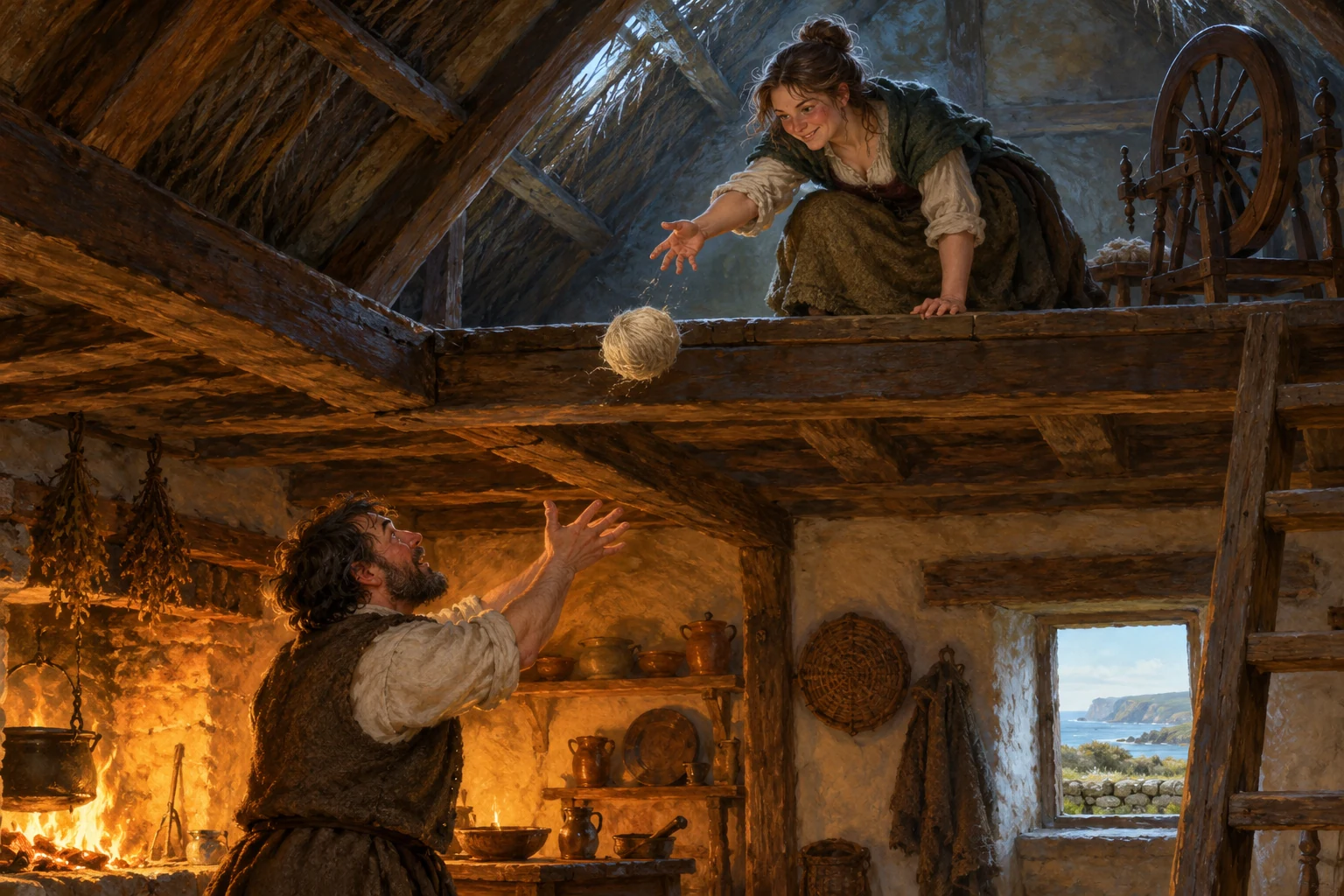
She took it into the loft and called her husband below. She would throw down the finished balls for him to count, she said, and he could throw them back. Down came the ball. Up it went. Down it came again. By repeating the trick she persuaded him there were many balls of thread where there was only one.
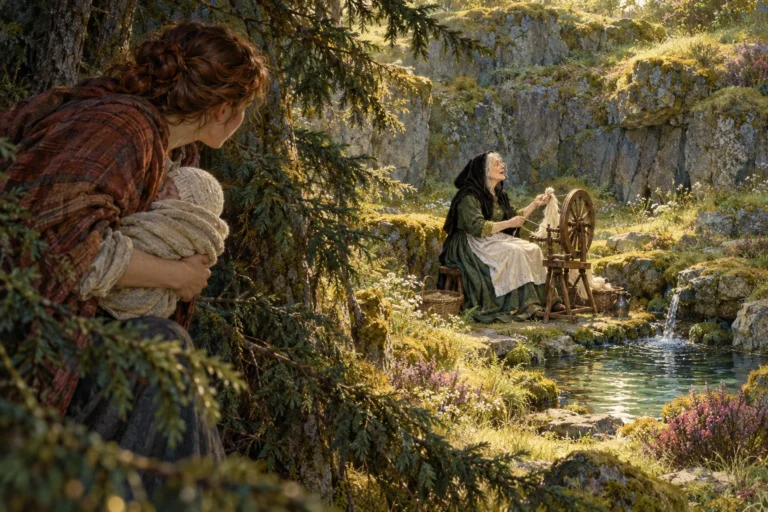
The real work still had to be done. She carried the wool to a giant who lived in a house on a mountain. He would spin it, but there was a condition: when she returned a week later, she must tell him his name. If she failed, he would keep the thread.
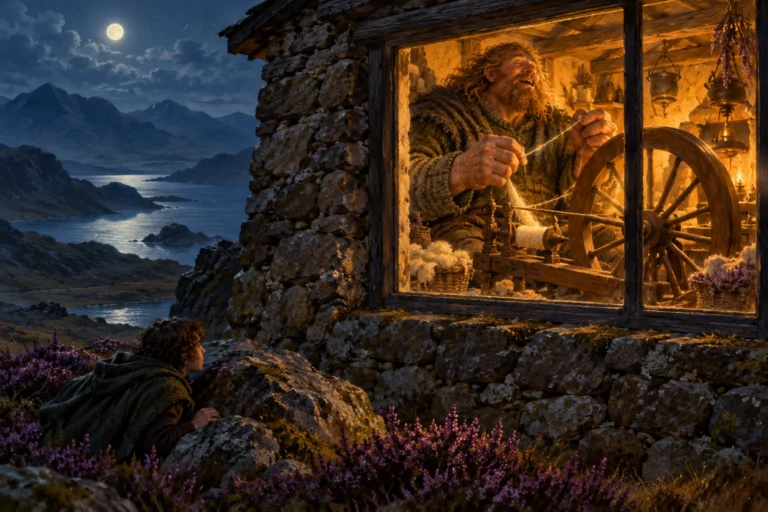
Meanwhile her husband passed the giant’s house after dark. Through the bright window he could see the enormous spinner working at astonishing speed. The giant was singing to himself, and in his song he gave away his own name, Mollyndroat.
The husband went home and told his wife what he had heard. She made him teach her the song. When the week was over, she set out for the mountain with the answer already in her head.
She did not immediately reveal what she knew. She tried a succession of other names, as though she were guessing. The giant rejected each one. At last she named Mollyndroat. Furious, he accused her of obtaining the answer through fortune-telling and flung the balls of thread at her.
She gathered her winnings and went away. Morrison’s narrator declines to say whether the woman ever became industrious afterwards. The story ends with her bargain won, leaving that question open.
Versions and comparisons
The Manx Quarterly, 1907
Morrison’s earlier printing calls the supernatural spinner a Foawr, glossed as a giant. It already contains the single-ball trick, the week’s bargain, the overheard song and the name Mollyndroat. The 1911 book uses Giant in place of Foawr and makes minor verbal changes, but preserves the sequence closely.
These are two publications by the same collector, not two independent interviews. Neither consulted passage identifies a named narrator, a recording date or a particular mountain. The story’s use of local names gives it Manx colour without supplying a precise address for the giant’s house.
The terms of the bargain
The giant can keep the spun thread if his name is not discovered. He does not demand the woman’s first-born child or her lifelong service in either of these printings. Those stakes belong to other name-guessing traditions and should not be added simply because the plot recalls Rumpelstiltskin.
Whuppity Stoorie and Habetrot
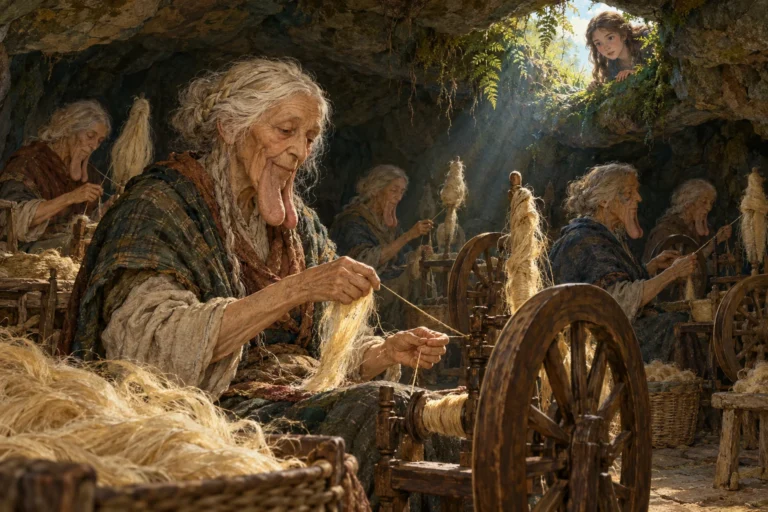
The Scottish Whuppity Stoorie also makes an overheard name the means of escaping a supernatural bargain, but a child is at stake there. Habetrot and the Fairy Spinners centres on extraordinary textile work and a woman’s future domestic obligations. The Horned Women turns spinning into an invasion of a household. These tales help compare work, bargains and supernatural knowledge, while retaining their different endings.
A musical afterlife
Culture Vannin’s account by Chloë Woolley traces the Mollyndroat song through collecting and performance, including Morrison and Cushag’s 1908 stage adaptation. This is a further route into the tale’s life beyond the printed story. The original musical manuscripts, recordings and stage script have not been collated for this entry.
Cunning, work and the unnamed mountain
The heroine wins twice by controlling what someone else can hear or count. Her husband counts repeated appearances of the same ball; the giant believes his name is unknown because he has not realised that a listener stood outside. In each case private information becomes more valuable than the visible work.
Morrison’s closing refusal to tell us whether the heroine reformed matters. The story can make fun of laziness without resolving itself into a lesson in which every clever woman becomes an obedient worker.
The mountain setting remains unnamed in the examined texts. This entry therefore links to the Manx collection and related beings without inventing a location on Snaefell or elsewhere. Mollyndroat’s separate figure guide records what these sources actually say about him.
Sources for this entry
- Sophia Morrison, Manx Fairy Tales. London: David Nutt, 1911. “The Lazy Wife”, pp. 62–70. Read source — Book version, closely matching the 1907 story while using Giant in place of Foawr. About this book
- Sophia Morrison, The Lazy Wife. The Manx Quarterly, no. 3, November 1907. pp. 251–252. Read source — Earlier printed telling, calling the spinner a Foawr and giving Mollyndroat as his name. About this book
- Chloë Woolley, Culture Vannin / Manx Music, How a lazy wife and giant inspired a children’s song. 17 May 2024. Song and performance history. Read source — A modern account of the tale’s musical afterlife. The archival recordings and stage script were not directly compared.
Research coverage
Morrison’s 1907 and 1911 texts were compared directly. They are closely related printed witnesses, not a full oral-variant survey. The modern music article supplies a clearly labelled performance-history lead. No exact mountain location has been established.
The Myths · Manx collection · Editorial approach
Further Reading