Manx coastal folklore · figure
Manx Mermaids: Ben-varrey
Manx mermaid stories range from generosity and friendship to capture, rejected love and revenge. Their sources and endings need to be kept distinct.
Also found as: Ben-varrey · Ben varrey · Manx sea-women
Research reviewed 18 October 2026.
A name for sea-women
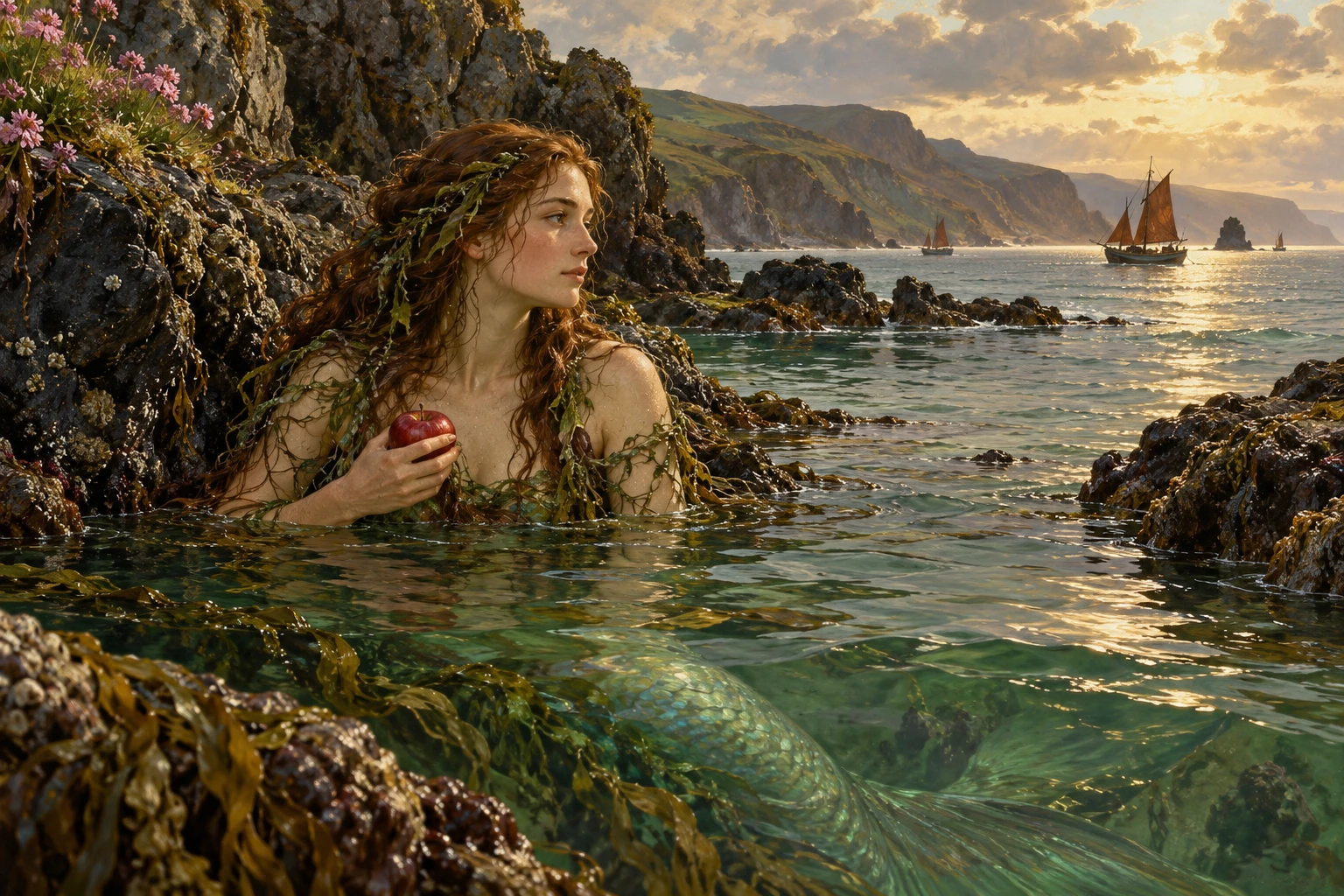
The 1924 Vocabulary of the Anglo-Manx Dialect records ben-varrey as a mermaid and explains the expression as “sea-woman”. It is a category of being, not necessarily the personal name of one mermaid who appears in every story.
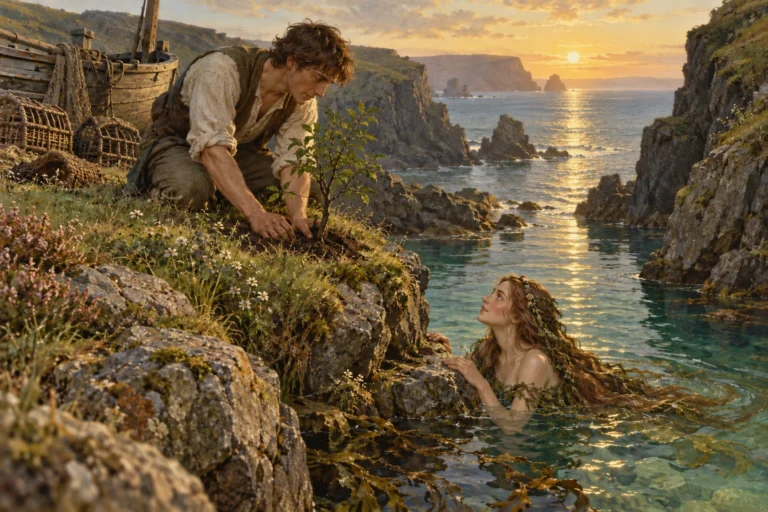
Sophia Morrison’s Mermaid of Gob-ny-Ooyl befriends the Sayle family and appreciates apples, which she calls land eggs. Fishing luck accompanies the relationship. When Evan leaves, he plants an apple tree above her haunt. Eventually she goes to seek him, and neither returns in the account.
That mermaid is not introduced through a stolen magical garment or forced marriage. Her gifts, her sadness and her eventual departure give the story its own shape. The sources below preserve markedly different encounters.
Different Manx encounters
The captured mermaid
A. W. Moore prints a narrative, credited to Waldron, in which a mermaid is caught in a net. She refuses food and drink. After three days the captors release her, fearing misfortune. When other mermaids ask about her experience, she criticises the humans for throwing away the water in which they boil eggs. This is a capture-and-release tale, not an episode in Evan’s friendship.
The rejected courtship
Another account in Moore, also credited to Waldron, has a sea-woman offer a shepherd coral, pearls and shells. He recoils from her embrace and breaks away. She throws a stone after him, and he dies after seven days of suffering. Its violence should not be added to Morrison’s open ending.
The island revenge story
Moore attributes a wider narrative of a rejected mermaid, concealing mist and the island’s discovery to William Collins’s note to his Ode to Liberty. The attribution matters: Moore is gathering earlier printed material here, rather than reporting three newly recorded local interviews.
These are differences within Manx mermaid tradition, not three independently verified versions of one encounter. Repeated publication of a Waldron account also does not multiply its evidence.
Comparisons across the Irish Sea
The Irish merrow and Scottish selkie invite comparison because they too connect human households with the sea. Their individual stories can involve hospitality, marriage, captivity or departure. Similar themes do not make the labels interchangeable: a selkie’s seal-skin transformation, for example, is not a feature to insert automatically into a Manx mermaid tale.
The accounts establish what collectors and authors printed about sea-beings. They do not establish mermaids as zoological creatures. No single appearance, temperament or set of powers can safely be assigned to every Manx mermaid from the passages examined here.
For a complete narrative, begin with Gob-ny-Ooyl. For comparisons, follow the Irish Lady of Gollerus and the Scottish Goodman of Wastness, then return to their source notes to see how each telling was transmitted.
Sources for this entry
- Sophia Morrison, Manx Fairy Tales. London: David Nutt, 1911. “The Mermaid of Gob-ny-Ooyl”. Read source — The Sayle family, Evan, apples and the mermaid’s departure. About this book
- A. W. Moore, The Folk-Lore of the Isle of Man. 1891. Chapter IV, “Mermaids”: “The Captured Mermaid”, “The Mermaid’s Courtship” and “The Mermaid’s Revenge”. Read source — Different mermaid narratives with printed attributions, used as comparisons rather than variants of Evan’s story. About this book
- A. W. Moore, Sophia Morrison and Edmund Goodwin, A Vocabulary of the Anglo-Manx Dialect. 1924. B, entry “Ben”, sub-entry “Ben-varrey”. Read source — Historical vocabulary evidence for the name, not an additional mermaid sighting. About this book
Research coverage
Morrison’s Gob-ny-Ooyl story, Moore’s three named mermaid passages and the 1924 vocabulary entry were examined. Waldron is accessed here through Moore’s credited extracts; his entire original text has not been freshly collated for this guide.
The Myths · Manx collection · Editorial approach
Further Reading