story · England
Robin Hood and the poor knight
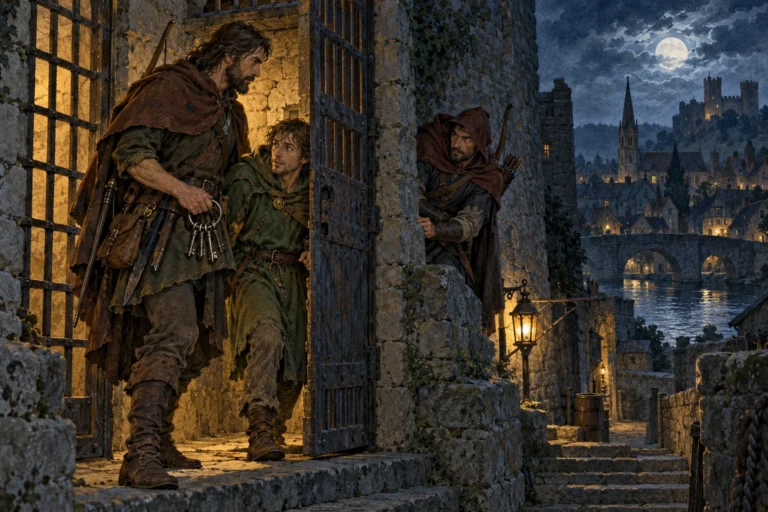
A ruined knight needs four hundred pounds to save his land. Robin’s unexpected loan sets a chain of obligations in motion.
Also found as: Sir Richard at the Lee · Sir Richard of the Lea · The knight and the abbot. Research reviewed 18 October 2026.
Read the story
This retelling brings together the knight’s debt episodes in the first, second and fourth fyttes of A Gest of Robyn Hode, Child no. 117. The poem later names the knight Sir Richard at the Lee. It is an episode within a longer work, not a separate medieval ballad with this modern page title. Read the Gest.
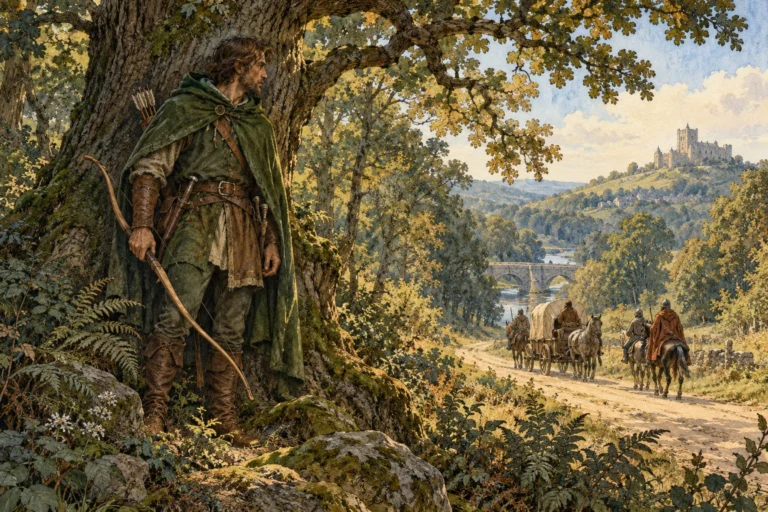
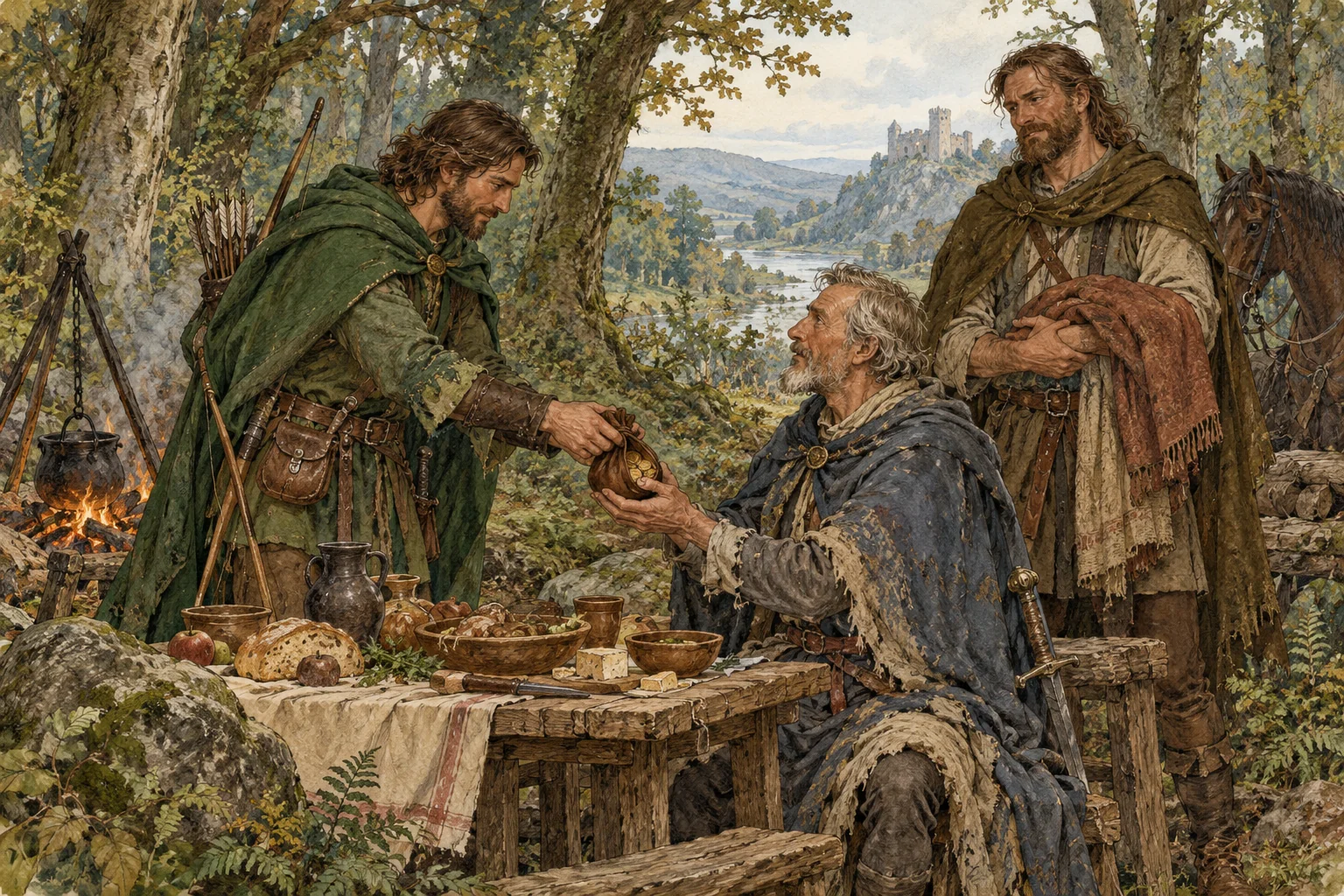
Robin would not dine until his men had found a guest. They brought back a knight whose clothes and bearing told of hard times. After the meal Robin asked him to pay. The man had only ten shillings. When the outlaws checked his bag and found that he had spoken truly, Robin asked what had brought him so low.
The knight’s son had killed a knight and a squire in a jousting encounter. To help him, his father had pledged his lands to the abbot of St Mary’s at York for four hundred pounds. The repayment day was almost upon him. The friends who had welcomed him when he was rich no longer knew him.
Robin asked who would stand surety for a loan. The knight had nobody to offer except God and, finally, Our Lady. Robin accepted the Virgin as his guarantor. He lent the money, and the company supplied clothes, horses, boots and spurs. John’s generous measuring of the cloth made the others laugh. John himself went with the knight as an attendant.
At the abbey, the knight first appeared in poor clothing and asked for more time. The abbot and his allies were eager for his land. A prior spoke against their hardness, but they would not listen. When their refusal was clear, the knight produced the four hundred pounds. Their hopes collapsed; he could go home with his property saved.
By the following year the knight had gathered repayment and a gift of fine bows and arrows. On his way back he stopped to protect a stranger threatened at a wrestling match. Remembering Robin’s kindness to him, he would not leave another man without help.
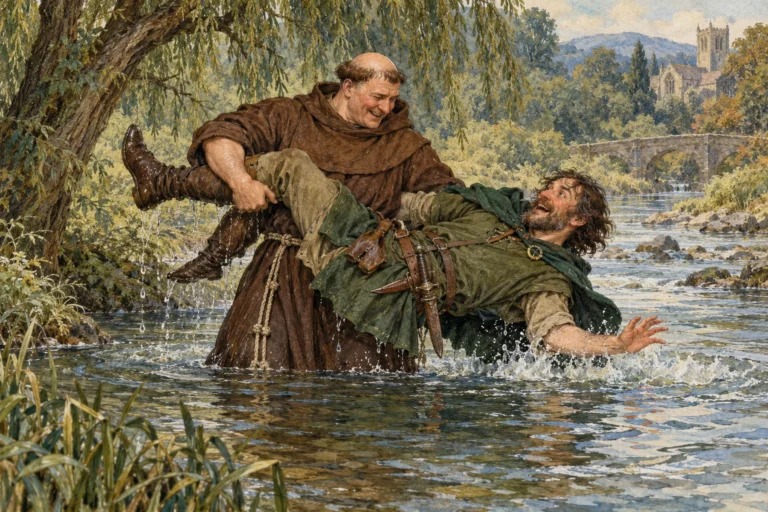
Meanwhile Robin’s men had brought a monk from St Mary’s to dine. The monk claimed to have little money, but his luggage held eight hundred pounds. Robin treated this as repayment sent by the Virgin whose surety he had accepted. When the knight arrived, Robin refused to take his loan back. He accepted the bows and arrows, then gave the knight a further four hundred pounds. In the poem’s later adventures the knight shelters Robin and his men, returning hospitality with hospitality.
Versions and variations
One thread through a larger poem
The Gest interweaves the knight, Little John’s service with the sheriff, encounters with the king and a short death notice. Our narrative selects the debt thread and identifies that selection. It does not present the whole Gest as a single compact loan story. Fyttes I, II, IV and V.
A later named and relocated retelling
Pyle titles his corresponding chapters “Robin Hood Aids a Sorrowful Knight” and “How Sir Richard of the Lea Paid His Debts”. His chapter sequence uses Emmet Priory. The base text here retains the Gest’s St Mary’s at York; those settings should not be silently exchanged. Pyle’s knight chapters.
A different monk
The monk whose money pays the debt is not identified as the informer in Robin Hood and the Monk. Similar hostility towards wealthy clergy does not establish a shared identity.
Context and evidence
Generosity is certainly present in this early Robin Hood. Yet the beneficiary is a landowning knight, and the poem preserves distinctions of rank and courteous behaviour. It is more particular than a general programme of taking from every rich person and giving to every poor person.
Barnsdale and York give the episode a strong Yorkshire setting. The financial and devotional jokes belong to a poem. They are not evidence that St Mary’s Abbey issued this particular loan or that its abbot committed the actions described.
Sources for this entry
- Francis James Child, editor, The English and Scottish Popular Ballads, volume III. Boston, Houghton, Mifflin, 1888. No. 117; fyttes I, II and IV; stanza 310 and subsequent hospitality in fytte V. base debt narrative and identification of the knight. Read source · About this book
- Howard Pyle, The Merry Adventures of Robin Hood. 1883; Project Gutenberg text. Chapter titles and setting in “Robin Hood Aids a Sorrowful Knight” and “How Sir Richard of the Lea Paid His Debts”. limited comparison of later naming and setting. Read source · About this book
Research coverage
The named texts and selected editorial notes have been examined. This entry does not claim to collate every manuscript, broadside, oral performance or modern adaptation.
The Myths · Robin Hood collection · Editorial approach
Further Reading