story · England
Robin Hood and the Potter
A travelling potter defeats Robin, who borrows his clothes and turns a market day into a trap for the sheriff.
Also found as: Robin and the potter. Research reviewed 18 October 2026.
Read the story
This retelling follows the Cambridge manuscript text in Child, no. 121. Read the source.
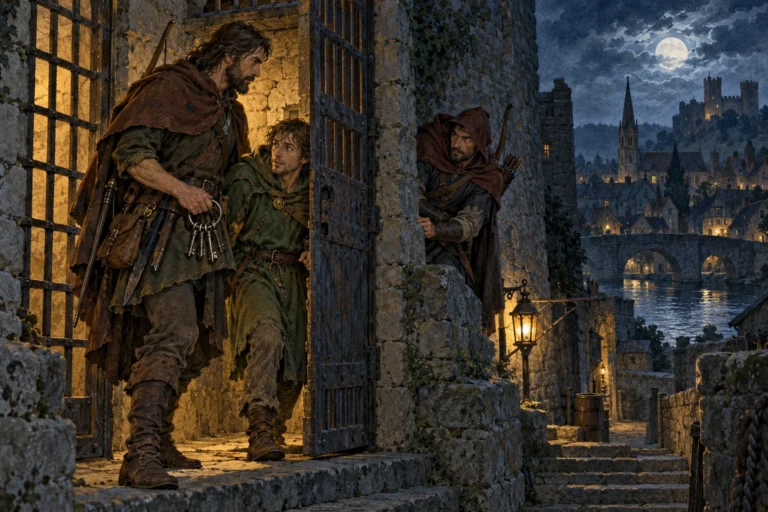
Robin saw a potter driving his wares along the road and complained that the man had never paid him a toll. Little John knew better than to dismiss the traveller. At Wentbridge he had already felt the strength of the potter’s blows. He wagered forty shillings that Robin could not force him to leave a pledge.
Robin stopped the cart. The potter refused to pay and reached for a two-handed staff. Against Robin’s sword and buckler he stood his ground, knocked the shield away and brought the outlaw down. John had won his wager. The potter told Robin that stopping a poor yeoman on his journey was discourteous, and Robin admitted the justice of it.
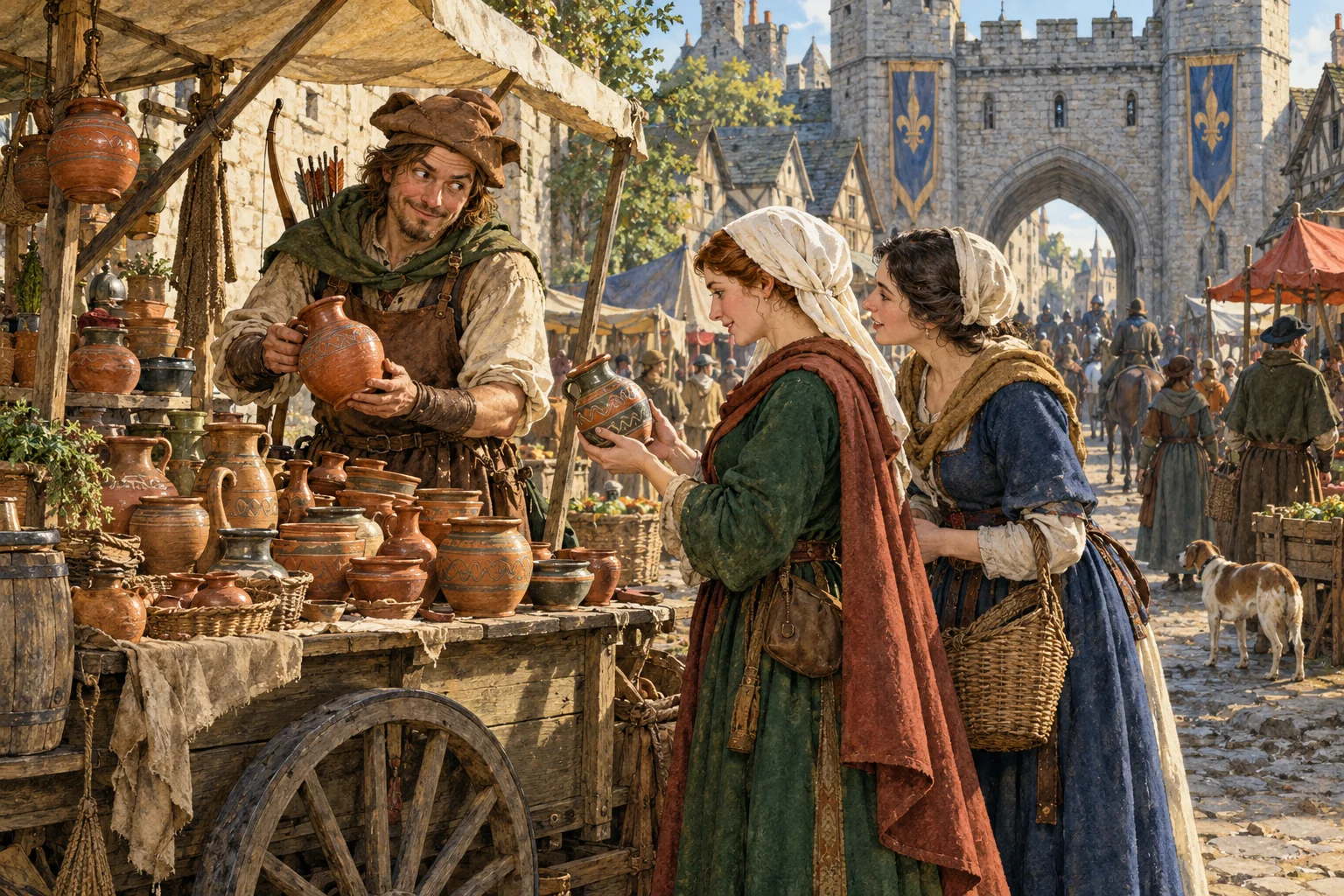
The quarrel turned into an agreement. Robin borrowed the potter’s clothes and cart and went to Nottingham to sell the pots, while their owner stayed safely with the outlaws. He offered the wares so cheaply that customers doubted he knew his trade. When only five pots remained, he sent them to the sheriff’s wife. Delighted, she invited the obliging trader to dinner.
After the meal Robin joined an archery contest. His shooting astonished the sheriff’s men. Still playing the potter, he said that he had a bow given to him by Robin Hood and knew where the outlaw could be found. The sheriff eagerly accepted an invitation to go into the forest the next morning.
Among the trees Robin sounded his horn. His men appeared, and the supposed potter was revealed as the very outlaw the sheriff had hoped to catch. Robin took the sheriff’s horse and possessions. For his wife’s kindness, however, he let him go and sent her a white palfrey. The sheriff returned on foot with a humiliating story; his wife laughed at how well her pots had been paid for.
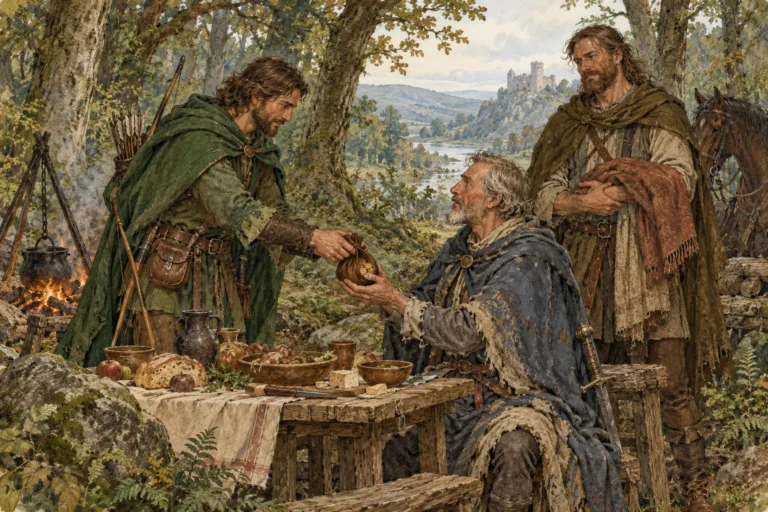
Back in the wood Robin asked what the pottery had been worth. The potter named two nobles. Robin gave him ten pounds and promised that he could travel that way freely. The man who had refused the outlaw’s toll left with far more than the value of his stock.
Versions and variations
A manuscript story, not a first meeting with a new Merry Man
Child’s source is Cambridge University Library MS Ee.4.35, dated in his edition to about 1500. The potter wins respect and compensation, but the tale does not say he abandons his trade to join the band. No. 121, headnote and text.
The butcher and the stage potter
Child’s headnote compares Robin Hood and the Butcher, in which the trader disguise and the sheriff’s journey recur. He also identifies a Potter episode in the play printed with Copland’s Gest. Those comparisons are reported here from his introduction; the play and all Butcher witnesses have not been independently collated for this entry.
Robin meets his match
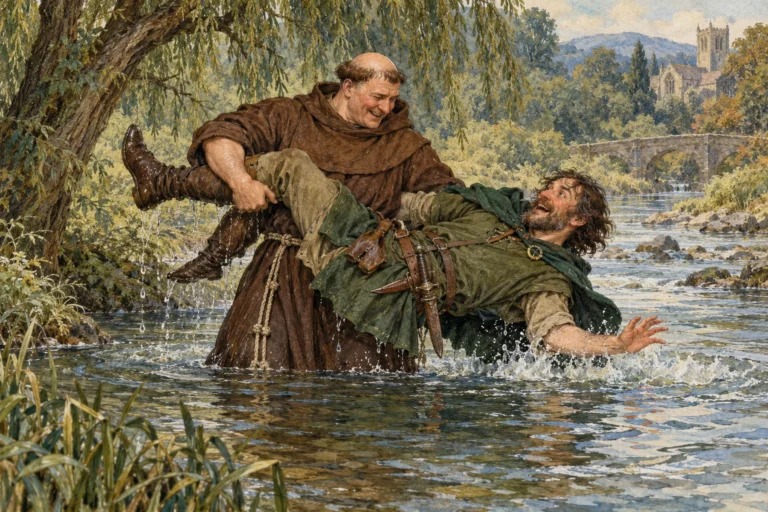
Compare the bridge fight and the river crossing with the friar. The recurring pattern gives Robin a capable opponent who can puncture his pride. It does not make the three opponents the same person.
Context and evidence
This Robin attempts to take money from a working traveller. The potter’s rebuke matters: the famous protector of ordinary people has to be reminded of courtesy by an ordinary person.
Wentbridge enters through John’s remembered encounter. Nottingham supplies the market and sheriff. The story’s scattered place references should be recorded separately rather than squeezed into a single modern walking route.
Sources for this entry
- Francis James Child, editor, The English and Scottish Popular Ballads, volume III. Boston, Houghton, Mifflin, 1888. No. 121; headnote; stanzas 4–29, 32–83. base narrative, Wentbridge reference and related trader disguises. Read source · About this book
Research coverage
The named texts and selected editorial notes have been examined. This entry does not claim to collate every manuscript, broadside, oral performance or modern adaptation.
The Myths · Robin Hood collection · Editorial approach
Further Reading