The Four Branches of the Mabinogi · story
Branwen, Daughter of Llŷr
A marriage intended to unite Britain and Ireland becomes a catastrophe after an insult to the bridegroom. Branwen's appeal brings her giant brother across the sea, but rescue becomes a war from which almost nobody returns.
Also found as: Branwen ferch Llŷr · Branwen the Daughter of Llyr · The Second Branch of the Mabinogi
Research reviewed 17 October 2026.
Read the story
This original retelling follows Charlotte Guest’s “Branwen the Daughter of Llyr”, in the 1912 edition edited by O. M. Edwards, pp. 39–60. The cauldron’s embedded history and the final genealogical account are condensed.
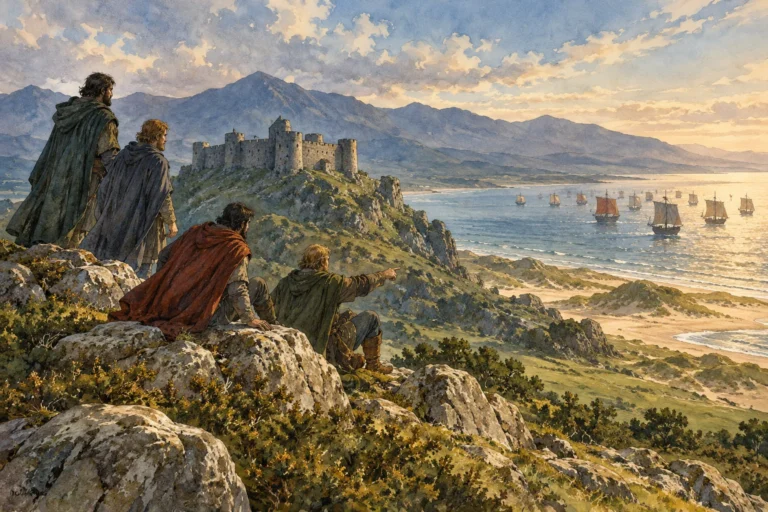
From the rock at Harlech, Bendigeidfran watched thirteen ships approaching from Ireland. Their king, Matholwch, had come to ask for Branwen, Bendigeidfran’s sister, in marriage. The proposal promised friendship between the islands. The family agreed, and the wedding feast was held at Aberffraw, beneath tents: no ordinary building could accommodate the giant Bendigeidfran.
One member of the family had not been consulted. Efnisien, Branwen’s half-brother, discovered the wedding and took his anger out on the Irish king’s horses, mutilating them terribly. Matholwch prepared to leave in humiliation.
Bendigeidfran offered replacement horses, silver and gold. To restore friendship further, he gave Matholwch a cauldron with a fearful power. A dead warrior placed inside it would rise alive the next day, but without speech. Its earlier owners, a giant couple who had escaped an attempt to burn them in Ireland, had brought it to Britain.
Matholwch accepted the settlement and sailed home with Branwen. At first she was welcomed. She gave gifts generously and bore a son, Gwern. But resentment over the injured horses endured. Eventually Matholwch’s people demanded that the insult be answered.
Branwen was sent to work in the kitchen. The butcher struck her daily, and ships were prevented from carrying news of her disgrace across the sea. She found another messenger. A starling became her companion; she taught it to speak, fastened a letter to it and sent it to Britain.
The bird found Bendigeidfran at Caer Seiont. On learning what his sister suffered, he assembled an army and sailed for Ireland, leaving his son Caradog to guard Britain. He himself waded beside the ships. Irish watchers reported a moving forest with a mountain behind it. Branwen understood: the forest was the fleet’s masts, and the mountain was her brother.
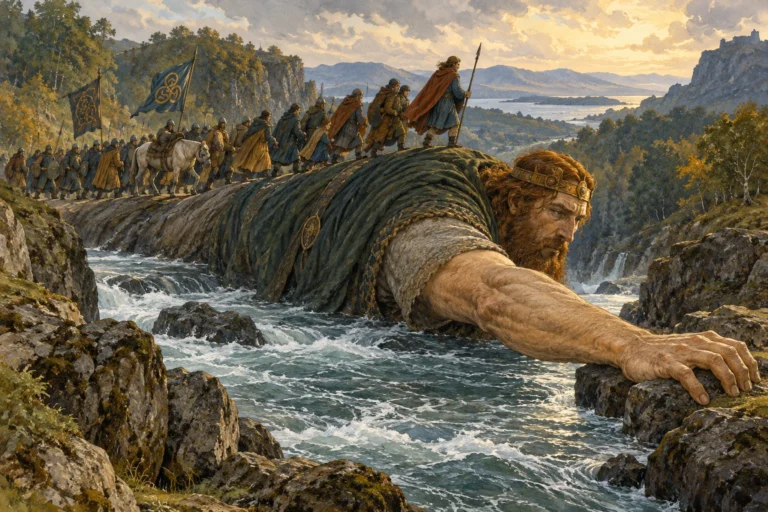
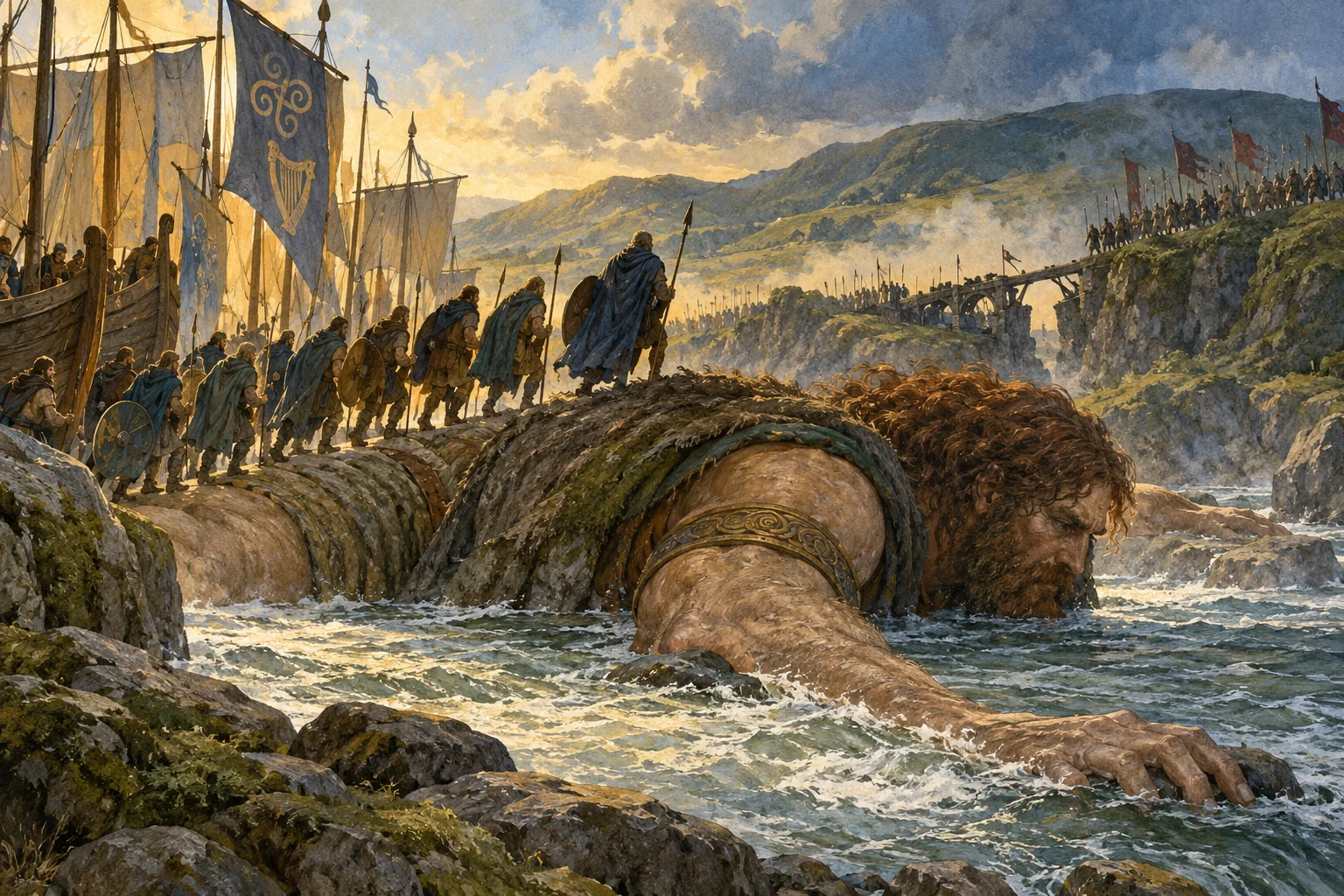
The Irish withdrew beyond a river and broke its bridge. Bendigeidfran laid his immense body across the water, allowing his followers to cross over him. Matholwch offered peace: Gwern would receive the kingdom, and a hall large enough for the giant would be built. Branwen urged reconciliation before the country was destroyed.
Yet the new hall concealed an ambush. Beside its hundred pillars hung two hundred bags, supposedly filled with flour. Efnisien inspected them. Finding a warrior in each, he crushed their heads through the bags. He had prevented one betrayal, but carried another into the feast himself.
Gwern moved affectionately among his relatives. When he reached Efnisien, his uncle seized him and threw him into the fire. Branwen tried to follow her child, but Bendigeidfran held her back and sheltered her with his shield. The hall erupted into battle.
Matholwch’s dead soldiers were carried to the cauldron and returned to the fighting. Watching his own people perish, Efnisien recognised what his malice had caused. He lay among the Irish corpses and was thrown into the vessel. There he stretched himself with such force that the cauldron broke apart. His own heart broke with it.
Only seven of Bendigeidfran’s company survived the fighting. The king had received a poisoned wound in his foot. He ordered his companions to cut off his head and carry it home. They were to feast with it for seven years at Harlech, then spend eighty years at Gwales, keeping one particular door closed. Afterwards they must bury the head in London’s White Mount, facing France.
The seven returned with Branwen and the head. At Aber Alaw she looked towards the two islands and grieved for the ruin surrounding her marriage. Her heart broke, and they buried her beside the river. They also learned that Britain had been seized by Caswallawn and that Caradog was dead.
At Harlech, three birds sang so wonderfully that other music seemed poor beside them. For seven years the survivors feasted with the head. At Gwales they passed eighty more in a hall where grief and loss scarcely troubled them, until Heilyn opened the forbidden door. Memory returned at once.
They continued to London and buried the head as instructed. Its presence would protect the island while it remained concealed. The tale ends with a devastated Ireland rebuilt through a handful of survivors: an account of legendary origins after catastrophe, far removed from the friendship the wedding had promised.
Versions and variations
The two translations examined preserve the same main catastrophe, but their wording can change how readers understand particular objects and places. In Guest’s main text, p. 45, Bendigeidfran’s explanation makes the cauldron sound like a gift especially appropriate for someone from Ireland. Edwards’s corrective footnote instead expresses uncertainty about whether its former owner originally obtained it there. Loth’s 1913 translation likewise presents the Irish origin as uncertain at that point. A firm provenance should therefore not be built from Guest’s sentence alone.
The crossing supplies another visible difference. Guest describes Bendigeidfran carrying provisions on his back; Loth has the musicians aboard him. Meanwhile Guest’s difficult description of the narrow sea receives a substantial correction in Edwards’s note to p. 50: two rivers, Lli and Archan, once separated the lands before the sea spread between them. These are textual and translation questions, not recorded alternatives from two oral storytellers. This retelling keeps to the agreed action of the giant wading beside the fleet.
Loth’s preface describes a revised translation based principally on the Red Book, with White Book readings used where he judged them preferable. Edwards explains that he retained Guest’s body text while supplying corrections in notes. Neither editorial arrangement should be mistaken for a third independent narrative tradition. This comparison does not replace direct collation of the Welsh witnesses.
The enchanted respite also offers a useful comparison with the Irish Voyage of Bran, where a wondrous journey unsettles ordinary experience of time. The Welsh giant and the Irish voyager are different characters. Their shared name and extraordinary departures are starting points for comparison, not permission to combine their biographies.
Context and evidence
The Second Branch belongs to the manuscript tradition of the Four Branches. The National Library of Wales describes their presence in the White Book and Red Book traditions. This is evidence for the transmission of the story, not for a historical marriage alliance or an invasion led by a giant.
Its geography should be followed carefully: the first meeting occurs at Harlech, the wedding at Aberffraw, and the bird reaches Bendigeidfran at Caer Seiont. Harlech’s seven-year feast is separate from the eighty years at Gwales. The narrative’s attempt to explain Ireland’s later population is a legendary conclusion, not demographic evidence. Read the connected guide to Bendigeidfran.
Sources for this entry
- Charlotte Guest, translator; Owen M. Edwards, editor, The Mabinogion, volume III: Branwen the Daughter of Llyr. London: T. Fisher Unwin, 1912; Project Gutenberg 19976. Guest's original three-volume collection was complete in 1849.. Pp. 39–60; Edwards's corrective notes to pp. 45 and 50.. Read source — Public-domain narrative basis; complete Second Branch read, with the embedded cauldron history and genealogical epilogue compressed. About this book
- Joseph Loth, translator, Les Mabinogion, tome I: « Branwen, fille de Llyr ». Paris: Fontemoing, 1913; revised from the 1889 edition.. Second Branch, pp. 119–150; complete narrative and relevant annotations.. Read source — Public-domain comparison translation; consulted for concrete differences in the cauldron's provenance and the sea crossing. About this book
- Joseph Loth, Les Mabinogion, tome I: Préface. Paris: Fontemoing, 1913.. Preface, pp. 3–10, especially the relationship between the 1889 and 1913 editions and the Red and White Books.. Read source — Translator's explanation of his revised textual basis; not an independent oral account. About this book
- National Library of Wales, White Book of Rhydderch. Online; consulted 17 October 2026.. Peniarth MS 4 and the Red Book comparison.. Read source — Manuscript description; no direct collation.
Research coverage
Examined: the complete Second Branch in Guest/Edwards 1912 and Loth 1913, including relevant editorial corrections. Not examined: a direct Welsh manuscript collation, all medieval poetic or triadic references, or every later adaptation. Translations are not counted as independent oral variants.
The Myths · Welsh collection · Editorial approach
Further Reading