Manx supernatural beings · figure
The Fynoderee
A shaggy, enormously strong worker associated with Manx farms and glens. His help, departures and mistakes differ between collectors and local tellings.
Also found as: Fenodyree · Phynnodderee · Phynodderree · Fynoderee
Research reviewed 17 October 2026.
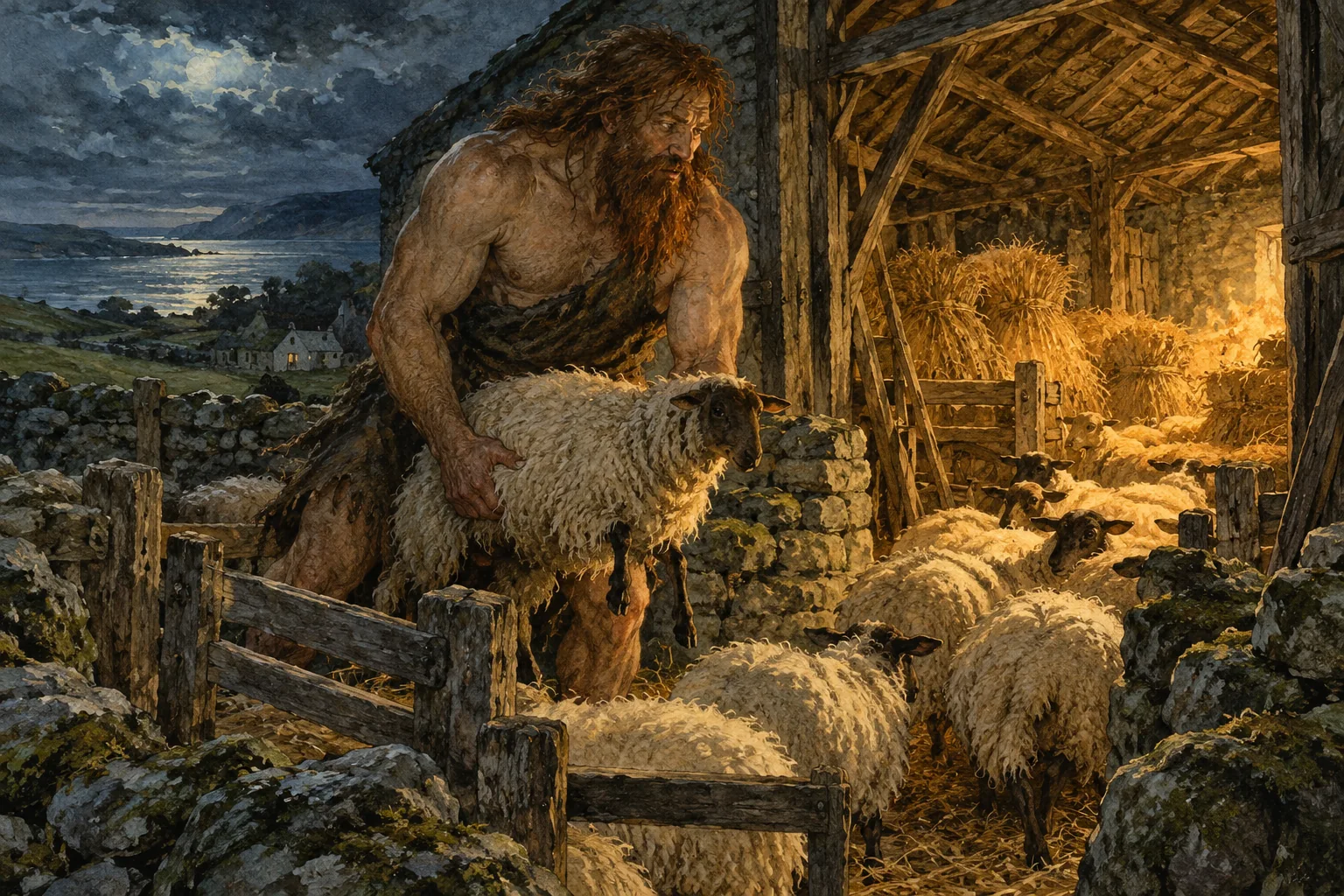
The Fynoderee is a figure to approach through particular accounts. In the Manx sources examined here, extraordinary strength and agricultural work recur, but there is no single biography agreed by every teller. Even the place where he works and the reason he leaves need to be attached to a source.
A worker after dark
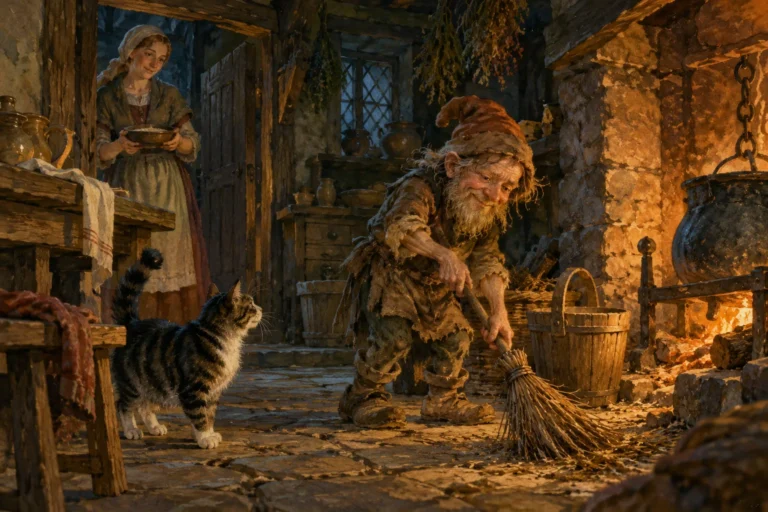
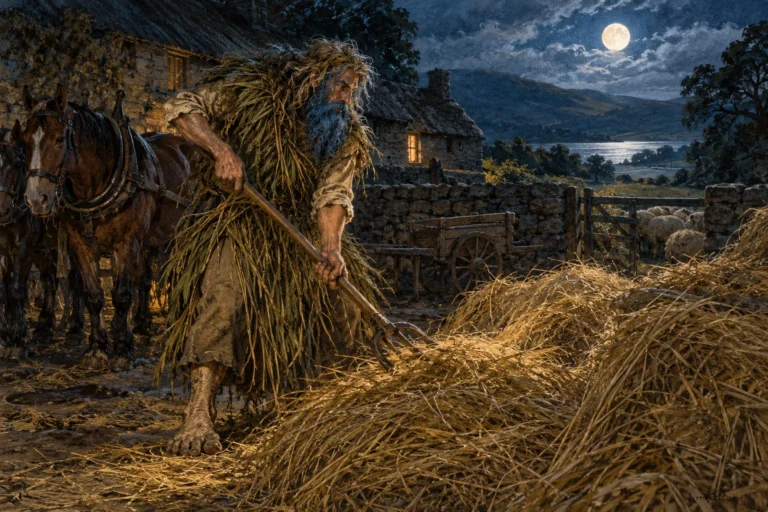
In Morrison’s Gordon story, he grinds and threshes corn, cuts crops and brings in sheep. He can finish a barnful of work overnight, provided the sheaves have been loosened. That condition matters: the wonder is organised around the practical routines of farming. His labour helps a household without making him an ordinary hired servant.
Moore’s collection gives him another major task. At Tholt-e-will, he carries quarried building stones, including a block that the parish’s combined strength cannot shift. The story puts his power into the transformation of a real landscape. Moore attributes that account to Train, so its appearance in his book is part of a printed chain of transmission.
Power and misunderstanding
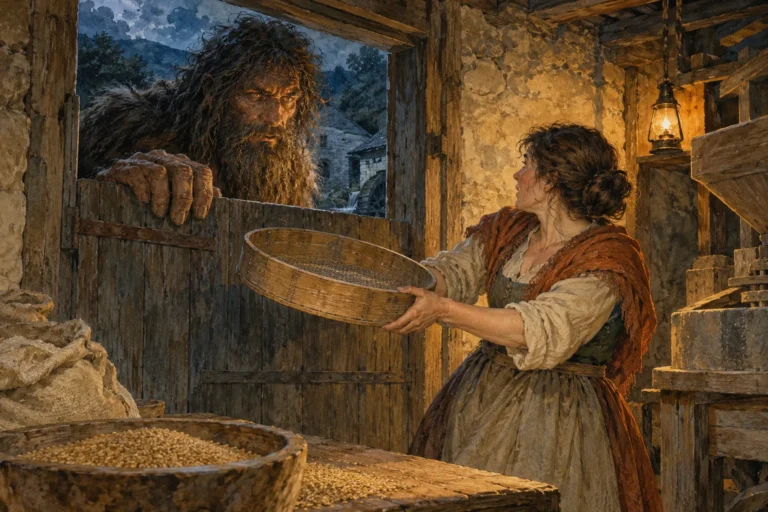
The Fynoderee can crush iron, yet be defeated by a sieve. He gathers sheep safely, but fails to recognise the hare he has chased into the flock. Morrison also has him puzzled by a farmer who warms his hands and cools his porridge with the same breath. The comic episodes depend on the distance between physical capability and everyday understanding.
That comedy should not erase the darker material. Moore describes anger at criticism of mowing. Morrison’s ending has the Fynoderee hurl stones at his fleeing wife. The same published cluster includes useful labour, mistaken kindness, aggression and frightening force.
The gift that ends the help
Clothes repeatedly mark a break. In Morrison, the farmer provides them out of pity for the helper’s nakedness. The Fynoderee interprets them as harmful and goes to Glen Rushen. Rhys records the same association of garments with sickness; Moore’s stone-carrying account also ends in departure after a gift of clothing. These similarities are substantial, but the surrounding events are not identical.
A being with changing explanations
Moore includes Eliza Craven Green’s account of an elfin lover punished after abandoning the fairy court for a Manx woman. That is a particular literary explanation of his condition. It should not be presented as an opening chapter supplied by every farm narrator. Rhys, meanwhile, is uncertain whether people thought there was more than one Fynoderee and notes overlapping descriptions of the glashtyn.
The useful figure guide therefore holds the accounts together without flattening them. Its questions are who recorded a detail, where they located it, and whether another book repeats their text or supplies a separately attributed telling.
Versions and variations
Names, places and numbers
Morrison’s Fynoderee, Moore’s Phynnodderee and Rhys’s fenodyree are spelling forms in these English-language publications. Gordon, Tholt-e-will, Ballachrink, Lanjaghan and Glen Rushen have different roles in the records. The hare chase moves between Barrule and Snaefell and between two and three circuits. The story page sets those differences side by side.
Comparisons that retain differences
Rhys’s chapter V compares a Lincolnshire household helper, Cornish material and the brownie of Blednoch. In one comparison, replacing a linen gift with hemp drives the helper away; elsewhere clothing itself ends the service. That distinction is more informative than calling all the beings identical.
The Irish púca accounts also include supernatural labour and parting gifts. Kennedy’s Kildare worker is released from a punishment, while Wilde’s helper adopts the status of his fine new clothes. Those are different explanations from the Manx fear that clothes bring sickness. Shared motifs invite comparison; they do not prove a common historical individual or one recoverable original tale.
Context and evidence
Rhys records his unsuccessful search for knowledgeable people in Glen Rushen in 1890. Such admissions help define the evidence: a collector’s unsuccessful visit says something about that enquiry, not everything about a community’s memory.
Older writers classified beings as Celtic, Norse, satyrs, brownies or trolls using theories that require independent scrutiny. This guide uses their recorded narratives while keeping those explanations attributed. The surviving texts show people telling stories about supernatural labour; they do not demonstrate that a supernatural worker existed.
Sources for this entry
- Sophia Morrison, Manx Fairy Tales. London: David Nutt, 1911. “The Fynoderee of Gordon”, pp. 48–53. Read source — Named printed telling; oral collection shaped for publication About this book
- A. W. Moore, The Folk-Lore of the Isle of Man. Douglas: Brown & Son; London: D. Nutt, 1891. Chapter IV: The Phynnodderee; Legend of the Black Dog, Moddey Doo; distinguish the individual attributions. Read source — Comparison of collected material and acknowledged earlier print sources About this book
- John Rhys, Celtic Folklore: Welsh and Manx. Oxford: Clarendon Press, 1901, volume I. Chapter IV, opening discussion of the fenodyree, its localities, sheep and clothing. Read source — Comparison with reported local beliefs and the author’s fieldwork About this book
- John Rhys, Celtic Folklore: Welsh and Manx. Oxford: Clarendon Press, 1901, volume I. Chapter V, opening comparison: items 3–4 and the Blednoch brownie. Read source — Comparative motifs; not proof of a single origin About this book
Research coverage
This guide compares selected passages in Morrison, Moore and Rhys. The original publications behind every quotation in Moore and Rhys have not all been independently collated. Their theories and cited comparisons remain attributed rather than adopted as established origins.
The Myths · Manx collection · Editorial approach
Further Reading