Manx ghost legends · story
The Moddey Dhoo of Peel Castle
A black dog lies beside the garrison’s fire every evening. One soldier decides to challenge the visitor. He returns from the passage unable to say what happened.
Also found as: Moddey Doo · Mauthe Doog · Black Dog of Peel Castle
Research reviewed 17 October 2026.
Read the story
A modern retelling of the Peel Castle passage in George Waldron’s 1731 account, consulted in William Harrison’s 1865 edition. The story includes a frightening death.
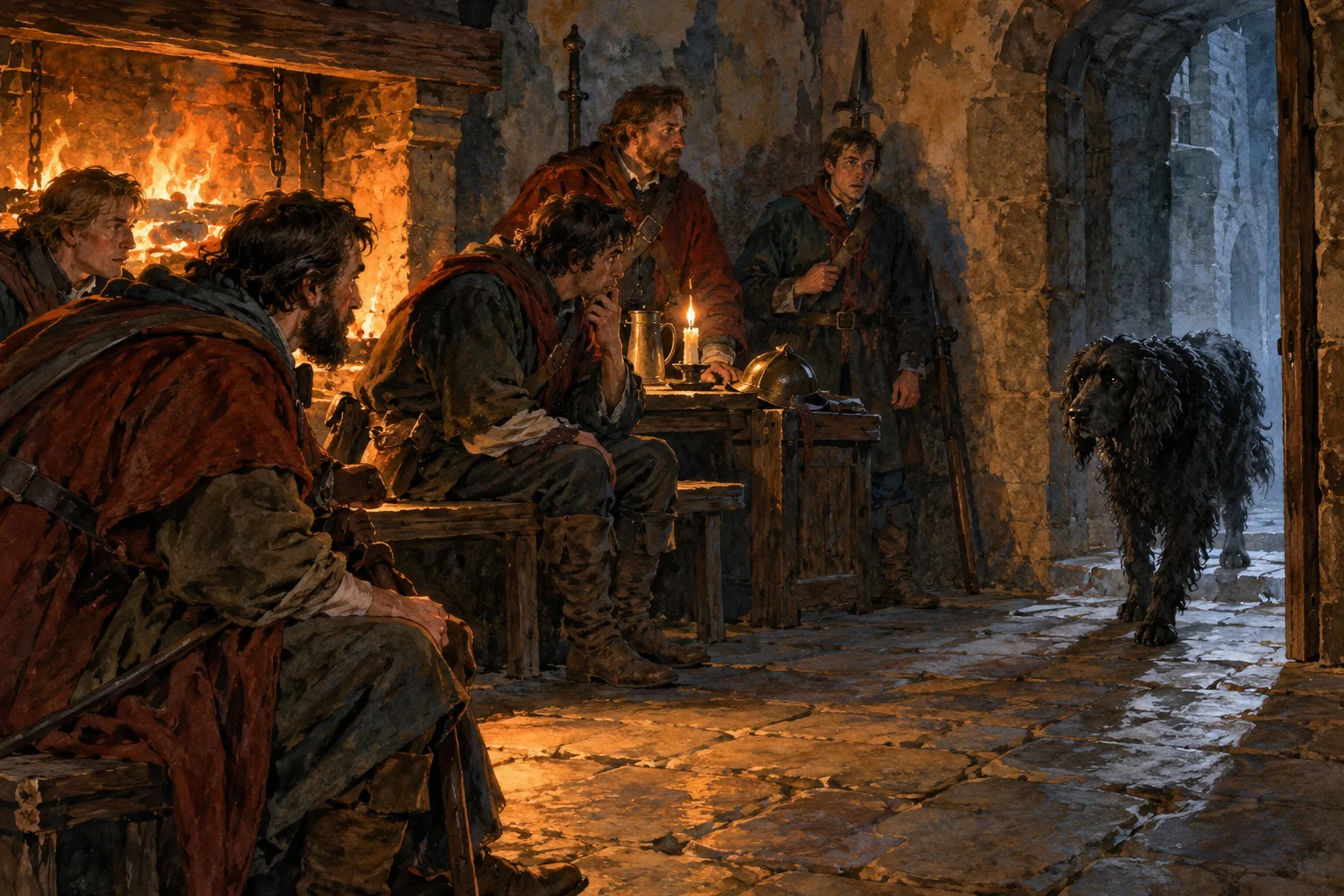
At Peel Castle, an old passage led through a church towards the captain’s rooms. At dusk, according to the story, a large black dog came out of it. Its hair was curled and shaggy, like a spaniel’s. When the soldiers lit their candles, it entered the guardroom and settled beside the fire.
At first the men were frightened. As the dog returned night after night, they became accustomed to sharing the room with it. Familiarity was not quite trust. They believed it was a spirit waiting for permission to harm them, and kept their swearing and rough talk in check while it lay nearby.
None of them wanted to be left alone with it. The nightly duty of locking the gates and carrying the keys to the captain meant using that passage, so the soldiers arranged to go in pairs. One man performed the task, accompanied by the man whose turn would come next. The dog’s habit of entering the passage again at dawn made it seem especially dangerous.
One evening a soldier who had been drinking mocked the others’ fear. Although it was not his turn, he insisted on taking the keys himself. The warnings only made him more determined. He would find out what sort of creature they were afraid of.
He took the keys and went out alone. After a while the men heard a great noise. Nobody dared to follow him to discover its cause.
When the soldier came back, his boasting had stopped. He could not speak. People begged him to explain what had happened, or at least to give them a sign, but he communicated nothing they could understand. In Waldron’s telling, he lived for three days and died in distress.
The dog was never seen in the castle again. The men would no longer use the old passage, so it was closed and another route made.
The story withholds its central encounter. There is no description of a fight in the dark, no explanation from the soldier and no answer from the dog. What remains is the change between the man who leaves and the man who returns, along with a doorway that people will not use again.
Versions and variations
Waldron and his informants
Waldron says the incident happened about sixty years before his account and that several people vouched for it, particularly an old soldier who said he had often seen the dog. He does not name that witness or the dead man. The approximate interval must not be turned into a precise, independently documented year.
Moore’s reprinting
Moore’s 1891 chapter IV reproduces the familiar castle sequence and attributes it to Waldron. It therefore records the circulation of that account in another book. Counting it as a second independent eyewitness report would overstate the evidence.
Modern visitor interpretation
Manx National Heritage’s audio guide compresses the narrative: a boastful soldier ventures alone, his companions hear a scream and find him terrified, and he dies without explaining himself. That presentation places emphasis on the frightening discovery. Waldron instead says the men did not investigate the noise and that the soldier returned to them. The visitor guide is evidence of modern retelling, not a new seventeenth-century witness.
The spellings Mauthe Doog, Moddey Doo and Moddey Dhoo do not by themselves represent different plots. Nor does resemblance to other black-dog legends establish that every such apparition belongs to one creature’s biography.
Context and evidence
Peel Castle is a surviving historic site. Its buildings and military history provide a setting in which the legend makes sense; they do not verify the apparition. No independent service record or named death record has been established for the soldier in the material examined here.
The story’s force comes partly from restraint. The dog initially does little more than occupy the hearth. The men’s rules make it possible to live alongside the unknown, until one soldier tries to force an answer. An interpretation centred on fear, boasting and forbidden investigation is a reading of the narrative, not a medical explanation for the reported death.
Sources for this entry
- George Waldron; William Harrison, editor, A Description of the Isle of Man. 1731 text; consulted in the Manx Society XI edition, Douglas, 1865. Peel Castle passage in the section transcribed as pp. 1–15, beginning with the passage to the captain’s apartment. Read source — Principal early printed account of the castle’s black dog About this book
- A. W. Moore, The Folk-Lore of the Isle of Man. Douglas: Brown & Son; London: D. Nutt, 1891. Chapter IV: The Phynnodderee; Legend of the Black Dog, Moddey Doo; distinguish the individual attributions. Read source — Comparison of collected material and acknowledged earlier print sources About this book
- Manx National Heritage, Peel Castle Audio Guide Transcript. Official visitor interpretation, online transcript. Section 03: The Moddey Dhoo. Read source — Modern presentation of the legend, compared with Waldron
- Manx National Heritage, Peel Castle – Cashtal Phurt Ny H-Inshey. Official site description, consulted 17 October 2026. About; Things to See and Do. Read source — Evidence for the surviving place and its present interpretation
Research coverage
The early Waldron account, Moore’s dependent reprinting and the modern heritage audio guide are compared. No full survey of later black-dog collections or independent archival confirmation of the soldier’s death has been completed.
The Myths · Manx collection · Editorial approach
Further Reading