Folklore; connections with the Mythological Cycle · story
Glas Gavlen and Balor
A marvellous cow leads a desperate sword-seeker across the sea, into Balor’s household and into a prophecy that no locked door can prevent.
Also found as: The Gloss Gavlen · Glas Gaibhnenn · Glas Gavlen · The Grey Cow of the Smith
Research reviewed 17 October 2026.
Read the story
An original retelling of John McGinty’s account, recorded and translated by William Larminie as ‘The Gloss Gavlen’, pp. 1–9. Its names and sequence are retained; the other accounts are compared below.
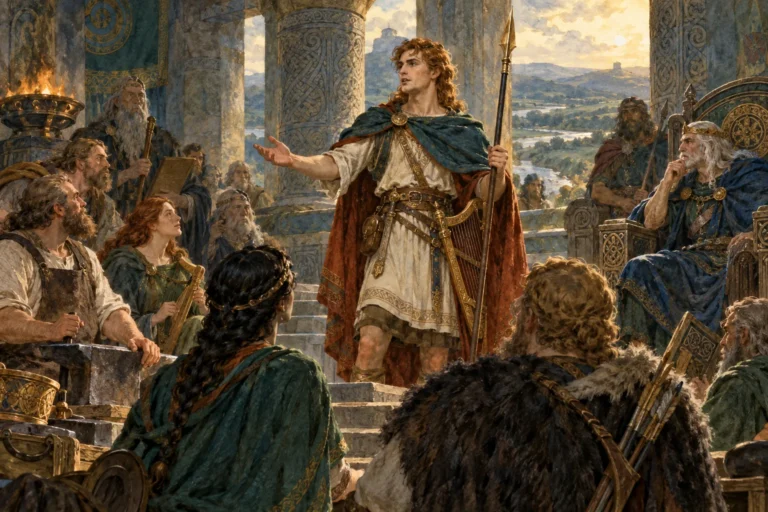
The Gobaun Seer and his son set off east to build a palace for Balar Beimann. On the road, the father asked his son to make the journey shorter. The young man ran ahead. His father turned home. The same thing happened the next day, until the son’s wife explained the puzzle: a good story could shorten a road without changing its length. On the third morning he began a tale, and they reached their destination.
They built so well that Balar decided no other ruler should ever have such a palace. He ordered the scaffolding removed, leaving the builders trapped above. His daughter passed beneath them and offered a hint: stones were easier to send down than lift up. The builders began dismantling their work. Balar promptly restored the scaffolding.
The older Gobaun then declared that a flaw remained. Three tools from his home would put it right, and Balar’s own son must fetch them. The tools’ strange names concealed a warning. When the messenger arrived, the young builder’s wife understood that her family was being held. She directed him into a chest, shut him inside and sent word that he would remain there until the builders returned with their wages. Balar paid and released them.
Before they left, he asked who could make the palace’s ironwork. The Gobaun recommended Gavidjeen Go. At home, he advised the smith to ask for the Gloss Gavlen as payment: a cow whose milk could fill twenty barrels. Balar agreed to give her away, but kept her byre-rope. Without that rope, he knew she would eventually return to him.
The smith devised a bargain for the champions who wanted his swords. Each must guard the cow for a day and bring her safely home. Losing her meant losing his head. Kian, son of Contje, accepted. He held her tail through her enormous day’s journey and returned with her at evening. At the forge, however, the Laughing Knight drew him inside with an urgent warning about the tempering of his sword. Kian forgot to secure the cow. When he looked again, she had gone.
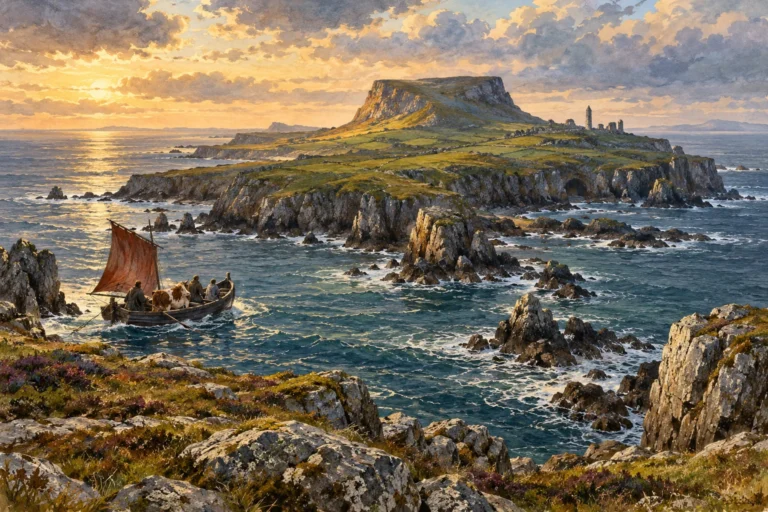
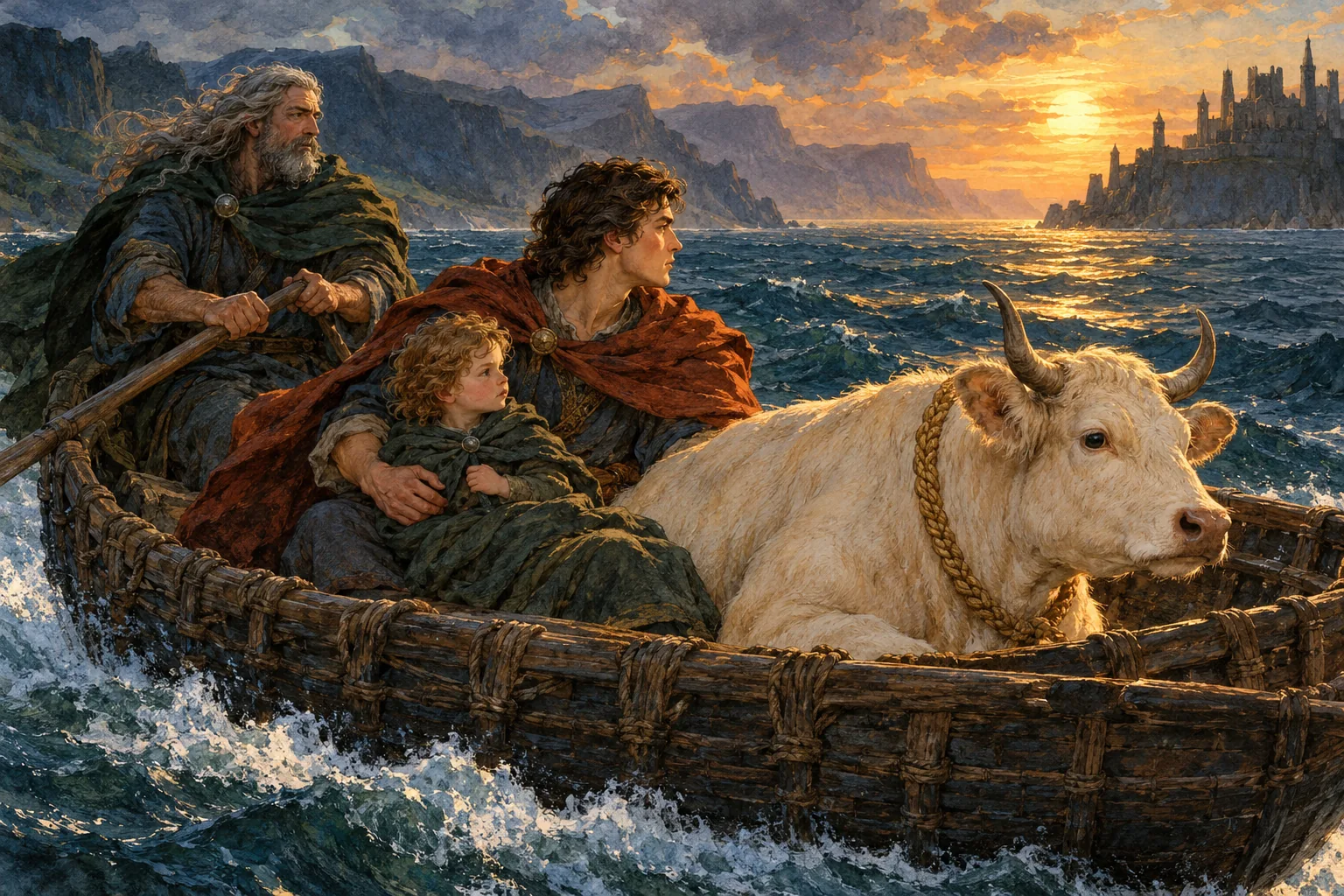
The smith demanded the promised penalty. Kian begged for three days to recover her and received them. Following her tracks, he reached the sea, where the trail ended. As he wandered the shore in despair, a man rowed towards him in a currach. It was Manannán, son of Lir. He offered passage to the cow’s whereabouts in exchange for half of everything Kian gained before his return.
Kian agreed. In an instant the boat reached the kingdoms of the cold, where nobody cooked their food. Kian lit a fire and made a meal. Balar heard of this useful stranger and employed him as cook, fire-tender and storyteller. He did not know that Manannán had given Kian another gift: every lock he touched would open and close again behind him.
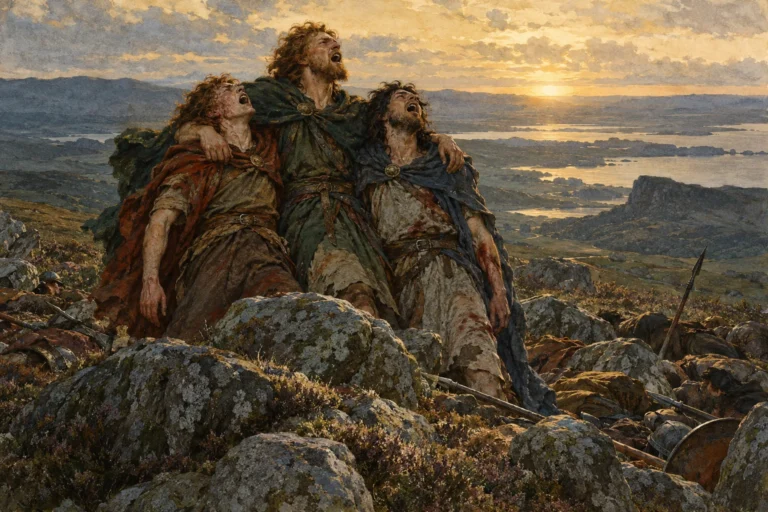
Balar kept his daughter confined because a prophecy said her son would kill him. Kian noticed where Balar carried her food, followed him and opened the locked door. He made a fire for the women inside and returned often. In time, Balar’s daughter bore Kian a son. When her brothers warned their father against his new servant, she knew that Kian must leave. She showed him the cow’s rope hanging on the wall and told him to take their child.
Kian hurried to the landing place and called on Manannán. The boatman appeared; Kian and the cow boarded. Balar pursued them with storms, but Manannán stilled the water. Balar set the sea ablaze, and Manannán quenched it with a stone. They reached home safely.
Then came the reckoning. Kian had promised half his gains, but the child could not be divided. He offered Manannán the whole boy to foster. That was the gift Manannán had wanted. He named him the Dul Dauna and trained him in the arts of a champion.
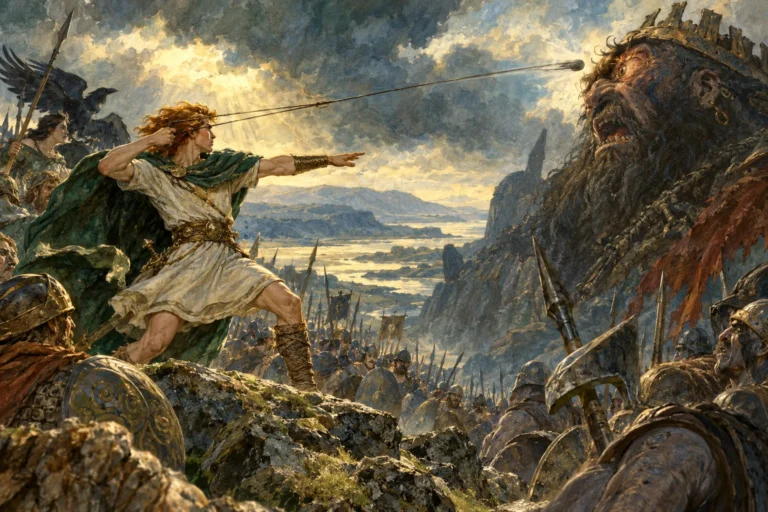
Years later, they saw Balar’s fleet at sea. Looking through a ring, the young man picked out a figure walking the deck. He did not know that the man was his grandfather. He threw a dart and killed him. Balar’s precautions had carried him, through builders, a cow and a locked room, directly towards the fate he had tried to prevent.
Versions and variations
McGinty’s Achill account: builders, cow and fosterage
Larminie names John McGinty of Valley, Achill Island as narrator. His introduction describes taking stories down from dictation and checking difficult passages. His note on pp. 251–252 calls the builder episode a distinct component and connects Dul Dauna with Lugh’s name Ildánach. That identification is Larminie’s interpretation: the retelling retains the narrator’s published name. The eastern opening and later kingdoms of the cold do not supply one consistent map.
Curtin: a theft from the mainland to Tory
In Curtin’s ‘Balor on Tory Island’, pp. 283–295, Gavidin’s cow is his enchanted stepsister. Balor’s agents steal her while Fin MacKinealy enters the forge. Gial Duv, a member of the fairy company, assists Fin; Manannán does not perform that role. Fin must apparently consume seven hides before a light burns out, and Balor’s daughter must throw him the halter. Later, twelve infants become seals while Balor’s grandson survives. Lui Lavada eventually strikes Balor with a heated spear; the fatal confrontation and its aftermath extend to the Donegal mainland.
Curtin says he wrote this telling down on the mainland, found another there, and encountered two incomplete versions on Tory. Those additional accounts are reported witnesses, not four complete texts compared here. The printed tale does not identify its narrator in the way Larminie’s heading does. Fin MacKinealy should not be relabelled Fionn mac Cumhaill merely because their names resemble one another.
Lady Gregory: Birog, Ethlinn and a rescued child
Gregory’s ‘The Coming of Lugh’, Part One, Book Two, chapter I, gives the cow to Cian. Balor disguises himself as a boy to deceive Samthainn. Birog takes Cian to Ethlinn in disguise, then rescues their son from the sea; Taillte receives him as foster-child. This differs from McGinty’s Manannán fosterage and Curtin’s larger group of children. Gregory also questions the report that Balor killed Cian because she has chosen the Tuireann account of Cian’s death. This is visible literary selection, not a reason to erase the competing account.
Context and evidence
The cow joins the household economy to an immense mythic world. Milk feeds people, a rope controls movement, a sword creates a dangerous obligation, and the recovery of livestock brings about a ruler’s death. The story also grants crucial decisions to women: the builder’s wife wins the men’s release, and Balar’s daughter makes the escape possible.
The sources document storytelling and editorial choices. They do not prove that Balar’s palace stood at a particular ruin, that his cow crossed the sea, or that the young champion was a recoverable historical person. Tory’s association belongs to the particular Donegal account; it should not be inserted into every telling. For the related but differently structured war narrative, see Lugh and the Battle of Mag Tuired.
Sources for this entry
- John McGinty, narrator; William Larminie, collector and translator, West Irish Folk-Tales and Romances. London: Elliot Stock, 1893. ‘The Gloss Gavlen’, pp. 1–9; introduction pp. xxiii–xxv; notes pp. 251–252. Read source — Complete base tale, named narrator, collection method and explicit editorial interpretation examined. About this book
- Jeremiah Curtin, collector, Hero-Tales of Ireland. London: Macmillan, 1894. ‘Balor on Tory Island’, pp. 283–295, including concluding collection note. Read source — Complete compared account; distinguishes printed narrative from Curtin’s report of further witnesses. About this book
- Lady Gregory, Gods and Fighting Men. 1905 edition; first published 1904. Part One, Book Two, chapter I, ‘The Coming of Lugh’, birth narrative. Read source — Compared literary synthesis, helper, fosterage and explicit decision between conflicting deaths of Cian. About this book
Research coverage
Three published treatments are compared here; they are not three identically documented oral witnesses. Curtin’s second Balor tale, O’Donovan’s Donegal record, additional cow legends and individual oral-archive recordings require further entry-level comparison. No exhaustive catalogue or reconstruction of an original version is claimed. Larminie’s nineteenth-century racial and nature-myth theories are not adopted as current scholarship.
The Myths · Irish collection · Editorial approach
Further Reading