Place · County Westmeath, Ireland
Hill of Uisneach
A real landscape of monuments and a symbolic centre in Irish literature: the setting for Connla’s invitation, an assembly of Ireland and competing stories of Lugh’s lake.
Also found as: Uisneach · Uisnech · Usnech · Usna · Ushnagh · Ail na Míreann · Catstone
The hill and its monuments
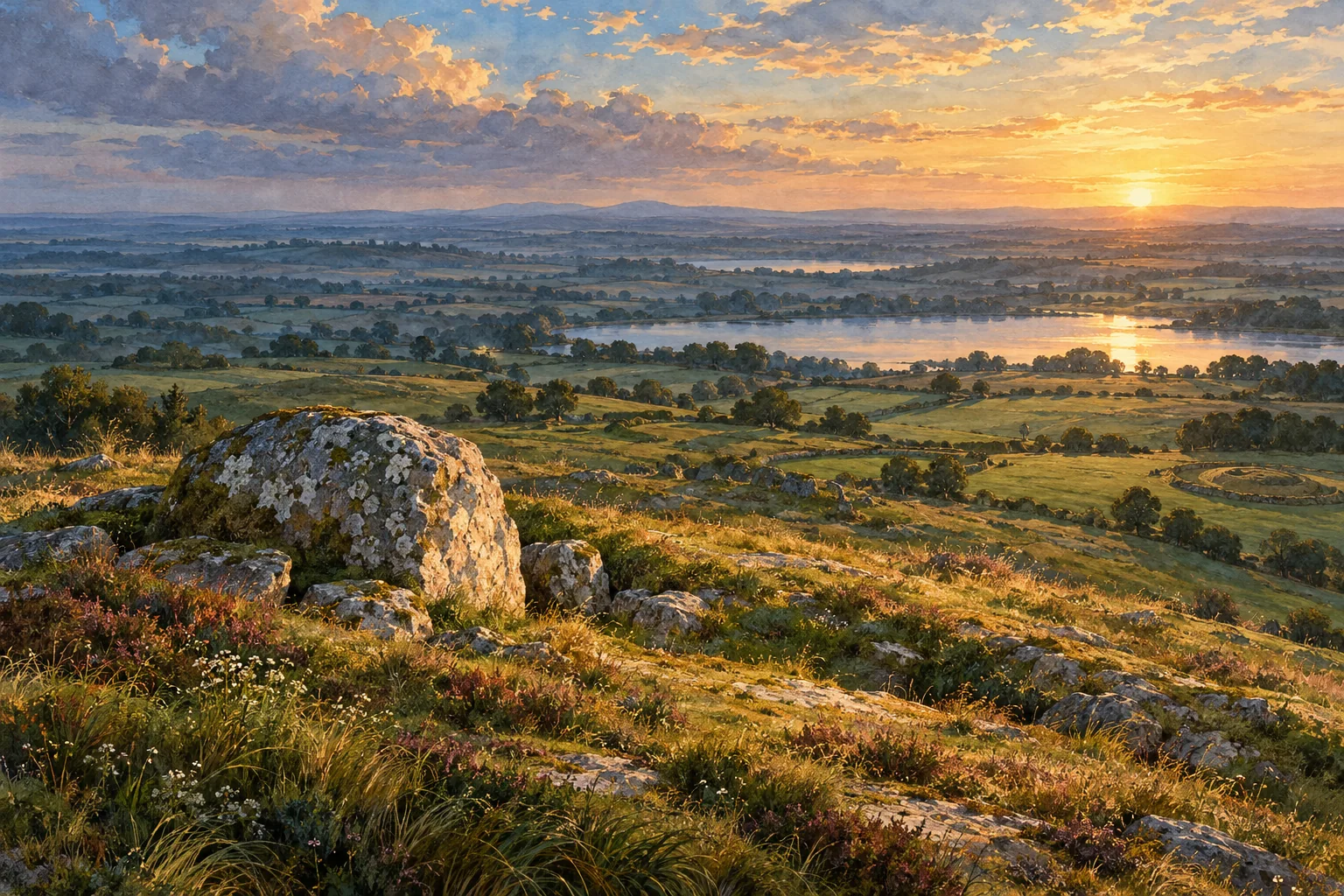
Uisneach is a hill in County Westmeath whose archaeological remains and literary associations reward being explored together. It is described as Ireland’s centre in tradition. That symbolic position should not be confused with a modern calculation of the island’s geographical midpoint.
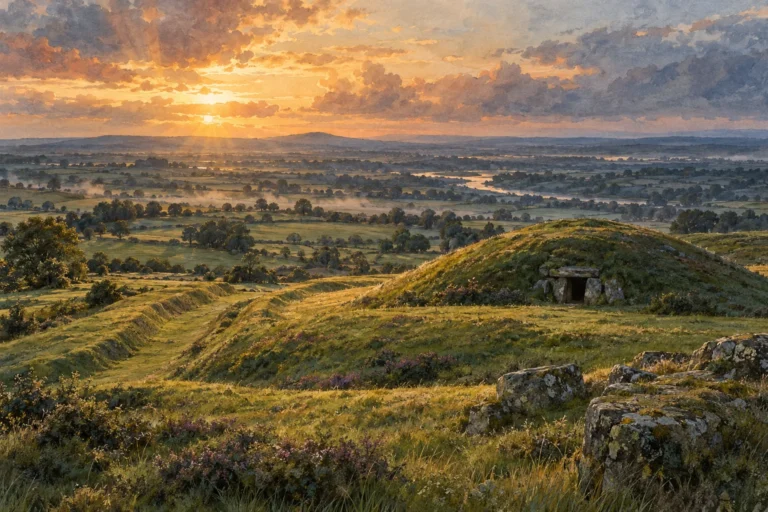
The Office of Public Works records more than twenty ancient monuments on the hill. Its Catstone is a large limestone boulder within a barrow, near a ringfort in Kellybrook townland. The OPW lists Ushnagh Hill–Catstone as a National Monument in its care. The stone’s alternative name, Ail na Míreann, recalls its traditional role as a meeting point of divisions. OPW site description.
The wider landscape includes enclosures, barrows, cairns, wells and roads. The site operator’s archaeological overview describes remains ranging from prehistory into the medieval period. Excavation of the conjoined ringfort known as the Palace revealed domestic structures and souterrains. The name does not establish which legendary king occupied it. Uisneach archaeological overview.
The summit monument called St Patrick’s Bed is interpreted as a possible Neolithic passage tomb, but the same account says it remains unexcavated. Work at Lough Lugh suggests that an older body of water was cleared again in the late prehistoric period. A ritual function is an interpretation, not proof that the supernatural events attached to the lake occurred. St Patrick’s Bed and Lough Lugh.
A place where stories begin
In Connla’s adventure, the prince stands beside his father on Uisneach when a woman appears whom only he can see. Everyone can hear her. The setting makes the royal gathering a place where the familiar order is suddenly challenged: the king has authority over his company, but cannot simply command this visitor to leave. Joyce calls the hill Usna; Gregory calls it Uisnach. Joyce, “Connla of the Golden Hair”; Gregory, “His Call to Connla”.
Uisneach also appears in the opening portion of Tochmarc Étaíne. Aengus and Midir go there to consult the Dagda about obtaining a dwelling. That is one of the links between this hill and the story of Aengus and the Brú; it does not make the Brú itself a monument at Uisneach. Bergin and Best, Part I, §5.
Lugh’s lake: two explanations
The place-lore account of Loch Lugborta describes a meeting at Caendruim, identified there as Uisneach. Lugh meets the three sons of Cermait, whose father he has killed, supposedly to make peace. They have planned his death. Wounded by a spear, he reaches the lake and is killed and drowned; a nearby cairn is explained as his grave. This supplies a literary association for Lugh beyond his victory in battle. Gwynn, “Loch Lugborta”, paragraph 1.
The very next paragraph offers another explanation. It connects the name with Lugaid mac Táil, also called Delbaeth, his settlement and a magical fire associated with his sons. These are alternatives recorded by the source itself. Choosing the Lugh account for a sign, illustration or retelling does not make the other explanation disappear. Neither identifies a historically verified burial. “Loch Lugborta”, paragraph 2.
Assembly and evidence
The medieval compilation containing Cormac’s adventure lists the great meeting of Uisneach on Mayday alongside Tara’s feast and Tailtiu’s fair. It provides evidence for how the literary tradition organised important gatherings. It cannot, unaided, date every earthwork on this hill or reconstruct an unchanged ceremony extending back into prehistory. Stokes, assembly passage, p. 217.
The place therefore works as a route through several kinds of reading: an archaeological landscape, a setting for Otherworld encounters and a focus of stories about kingship and belonging. Each connection needs its own source.
Sources for this place
- Office of Public Works, Ushnagh Hill – Catstone. Heritage Ireland, online site description, consulted 17 October 2026. Site description and National Monument notice. Read source — Physical location, limestone boulder and surrounding earthwork; literary centre-of-Ireland association kept separate..
- The Hill of Uisneach, Archaeology. Official site operator’s online archaeological overview, consulted 17 October 2026. Overview; The Palace; Lough Lugh; St Patrick’s Bed; bibliography. Read source — Concise physical-site overview. Interpretations and unexcavated features are explicitly qualified; no exact Catstone height adopted..
- P. W. Joyce, Old Celtic Romances. London: Longmans, Green, and Co., 1920; first published 1879; Project Gutenberg 38041. Connla of the Golden Hair and the Fairy Maiden, opening, p. 106. Read source — Public-domain literary association with Uisneach, named Usna.. About this book
- Lady Gregory, Gods and Fighting Men: The Story of the Tuatha de Danaan and of the Fianna of Ireland. London: John Murray, 1905; first published 1904; Project Gutenberg 14465. Part I, Book IV, chapter XIII, His Call to Connla. Read source — Public-domain literary association; hill named Uisnach.. About this book
- Anonymous; edited and translated by Osborn Bergin and R. I. Best, Tochmarc Étaíne. Ériu 12 (1938), pp. 137–196; CELT T300012. Part I, §5. Read source — Brief literary association of Aengus, Midir and the Dagda with Uisneach..
- Anonymous; edited and translated by Edward Gwynn, The Metrical Dindshenchas, Part IV. Royal Irish Academy, Todd Lecture Series 11; Dublin: Hodges, Figgis, & Co.; London: Williams and Norgate, 1924; public-domain translation reproduced by CELT. Supplementary prose, Loch Lugborta, paragraphs 1–2, English pp. 279–281. Read source — Both alternative place-name explanations read: Lugh’s killing and drowning, or Lugaid/Delbaeth’s settlement and magic fire.. About this book
- Anonymous; edited and translated by Whitley Stokes, The Irish Ordeals, Cormac’s Adventure in the Land of Promise, and the Decision as to Cormac’s Sword. In Ernst Windisch and Whitley Stokes, eds, Irische Texte mit Übersetzungen und Wörterbuch, third series, part I; Leipzig: S. Hirzel, 1891, pp. 183–229. Assembly passage, English p. 217. Read source — Medieval literary association of the Uisneach assembly with Mayday..
Research coverage
Physical overview checked against the OPW and the site operator; literary passages directly read. The place-lore alternatives are retained. Exact Catstone height is omitted because the consulted modern descriptions differ. Excavation reports, the full Uisneach dindshenchas, inauguration traditions and local oral collections have not yet been reviewed.
The Myths · Irish collection · Editorial approach
Further Reading