Otherworld journeys · story
Connla and the Otherworld Woman
A woman visible only to Connla offers him a life beyond ageing. His father’s druid can silence her voice, but cannot remove the longing left by her gift.
Also found as: Echtra Chondla · Connla the Red · Connla Ruad · Connla of the Golden Hair · Connla and the Fairy Maiden · The Adventure of Connla
Research reviewed 17 October 2026.
Read the story
This retelling follows P. W. Joyce’s “Connla of the Golden Hair and the Fairy Maiden”, with his expanded final song condensed into prose. This is Connla, son of Conn of the Hundred Battles, not Cúchulainn’s son Connla.
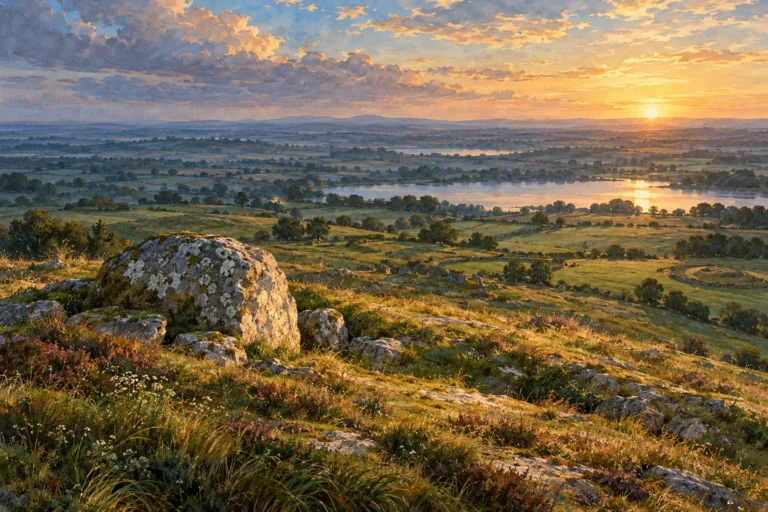
Connla stood beside his father on the Hill of Uisneach. Conn was a king accustomed to being heard and obeyed, and his company had gathered around him. Then Connla saw a woman approaching in clothing unlike anything he knew. When she came near, he asked where she had come from.
She answered that her home was the Land of the Living. There, people did not grow old or die. Their feasts brought neither quarrels nor exhaustion, and pleasure did not end in sorrow. People in Ireland called them the inhabitants of the fairy hills, she explained, because their dwellings lay within the green mounds.
The listeners heard her voice, but saw nobody. Only Connla could see the person speaking. Conn turned towards his son and asked whom he was addressing. Before Connla could answer, the stranger spoke for herself.
She was a woman of noble birth, beyond the reach of age. She loved Connla and had come to invite him to Mag Mell, the plain of unending delight. If he accompanied her, he would become a king there. The beauty and strength he possessed would not fade, and grief would have no claim on him.
To Conn, this was a threat for which a royal household had no ordinary defence. He could hear the stranger claiming his son’s attention, but could not confront her face to face. He called for Corann, his druid, and asked him to oppose her power. All his experience as king had left him unprepared for a contest with an invisible woman.
Corann began to chant. His spell overcame her voice, and she was forced to withdraw. Connla could no longer see her; the others could no longer hear her. But as she departed she threw him an apple.
Back at the palace, the prince would eat nothing else. A day passed, then another, and still the fruit remained whole. Each time he ate, it gave him nourishment without diminishing. Other food and drink seemed worthless beside it. For a month the apple sustained him, while his thoughts returned to the woman who had given it. Corann had driven her away from the gathering, but the absence had not restored Connla’s peace.
At the month’s end Connla was again beside his father, this time on the Plain of Arcomin. The stranger returned from the west. She spoke of his place among the royal company, surrounded by people who must one day die. Beyond them, she said, the ever-young inhabitants of Mag Mell had watched him and wanted him among them.
Conn ordered his attendants to summon Corann again. The woman answered that the druids’ power would not endure: another righteous law would silence their spells. Yet Connla remained quiet. Finally his father asked whether the words had moved him.
Connla answered that he loved his own people above everything. Nevertheless, he was unhappy because of the woman. His attachment to home was real, and so was the longing that had taken hold of him.
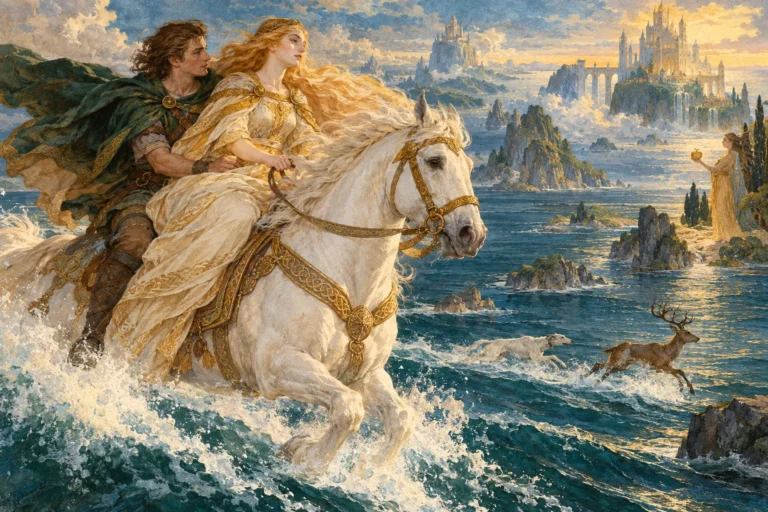
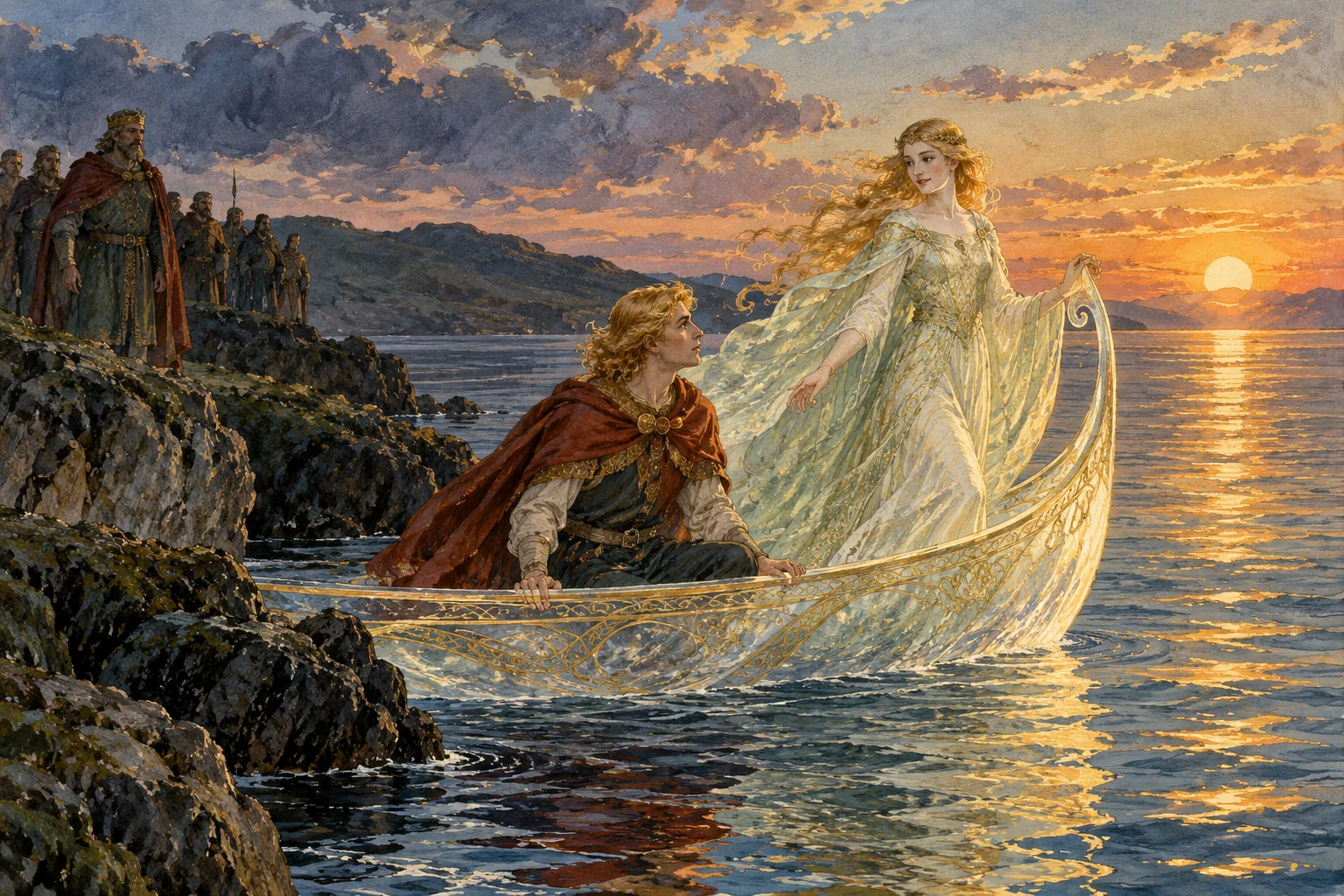
She sang once more. In the west lay a country of clear streams, green valleys and unchanging summer. Her crystal boat could carry him there before nightfall, however far away the shore appeared. It would protect him from the druid’s spells, and they would share a life beyond sickness and separation.
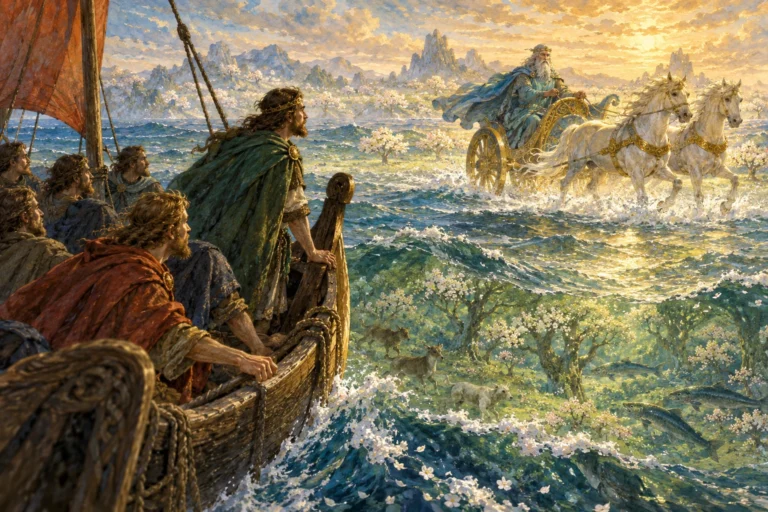
When the song ended, Connla left his father’s side and sprang into the shining boat. Now king and company could watch it moving across the sea towards the sinking sun. They followed it with their eyes until distance swallowed it. Connla never appeared among his people again. What happened after that crossing is left beyond the story’s sight.
Versions and variations
Joyce calls the prince golden-haired; Joseph Jacobs calls him fiery-haired; Gregory uses red-haired. These English descriptions do not establish three different characters or three independent oral traditions. All three identify him through Conn, his father. Cúchulainn’s son belongs to a separate tragedy.
Joyce expands the final invitation into a substantial English song, stressing a peaceful western kingdom and the crystal boat’s protection. Jacobs’s shorter prose account preserves the name Boadag for the Otherworld ruler and refers to a country inhabited by women. His notes openly identify Zimmer’s translation as his main source, acknowledge touches borrowed from Joyce, and say that the final sentence of the woman’s last speech is his addition. That romantic promise must therefore be attributed to Jacobs’s handling, not silently quoted as a medieval line.
Gregory makes a different editorial connection. She introduces the tale by suggesting that Manannán probably sent the messenger. Her wording is tentative. Her authorities name O’Beirne Crowe and Windisch, and her chapter title, “His Call to Connla”, places the story within a Manannán sequence. The woman herself remains unnamed; this framing does not entitle us to identify her as Niamh or any other named Otherworld lover.
The UCC parallel presentation includes the explanation of Art’s title, “the Lone One”, after his brother disappears. Its editorial note warns that the three displayed columns partly use different manuscripts, particularly at the opening and conclusion. That is a textual issue, unlike Joyce’s new English verse or Jacobs’s declared addition. These differences are recorded separately here rather than turned into a claim that three translators heard three local storytellers.
Across the compared retellings, Connla leaves permanently. There is no return, sudden ageing or death on Irish soil. Those familiar motifs belong to comparisons such as Bran and Oisín, and should not be added to this ending.
Context and evidence
The story’s opening makes Uisneach a meeting point between a king’s visible assembly and a presence only his son can see. It supplies a literary association with the hill, not archaeological evidence for Connla’s visit. The medieval tale’s mixture of supernatural invitation, druidic resistance and Christian expectation deserves to remain visible; it need not be forced into a single religious category. Read the parallel text and its editorial warning.
The anonymous woman is an active speaker who describes the promised life, resists the druid and persuades Connla. The surviving narrative does not tell us her personal name or provide a subsequent account of their life together. This page treats those absences as limits of its evidence.
Sources for this entry
- P. W. Joyce, Old Celtic Romances. London: Longmans, Green, and Co., 1920; first published 1879; Project Gutenberg 38041. Connla of the Golden Hair and the Fairy Maiden, pp. 106–111; note LXIX. Read source — Principal retelling; entire tale, including the long final song, read.. About this book
- Joseph Jacobs; illustrations by John D. Batten, Celtic Fairy Tales. London: David Nutt, 1892; Project Gutenberg 7885. I, Connla and the Fairy Maiden; Notes and References I. Read source — Full tale and its source note consulted. Jacobs identifies Zimmer’s translation, borrowing from Joyce, and his own added sentence.. About this book
- Lady Gregory, Gods and Fighting Men: The Story of the Tuatha de Danaan and of the Fianna of Ireland. London: John Murray, 1905; first published 1904; Project Gutenberg 14465. Part I, Book IV, chapter XIII, His Call to Connla; Notes III. Read source — Later literary adaptation compared with identified translations; not an independent oral witness.. About this book
- Anonymous; presented by Irish Sagas Online, University College Cork, Echtra Chondla. Online parallel medieval Irish, modern Irish and English presentation. Note to the reader and §§1–8. Read source — Editorial warning about differing manuscript bases; brief corroboration of the Art Óenfer framing, not the basis of the full retelling..
Research coverage
Joyce, Jacobs and Gregory compared as literary retellings, with their acknowledged sources. UCC’s manuscript-base warning and framing consulted. Crowe, Windisch, Zimmer and all surviving manuscript forms have not been independently collated here. No exhaustive oral-variant claim.
The Myths · Irish collection · Editorial approach
Further Reading