Ulster Cycle · story
Macha and the Curse of Ulster
A farmer boasts that his pregnant wife can outrun the king’s horses. When the gathering refuses her plea for time, Macha turns its cruelty into a curse upon Ulster.
Also found as: Noínden Ulad · Ces Noínden Ulad · The Debility of the Ulstermen · The Debility of the Ultonian Warriors · Macha’s Race
Research reviewed 17 October 2026.
Read the story
An original retelling following Eleanor Hull’s 1898 “Debility of the Ultonian Warriors”. Hull combines Ernst Windisch’s translations of two manuscript accounts and marks important additions from the Book of Leinster in brackets.
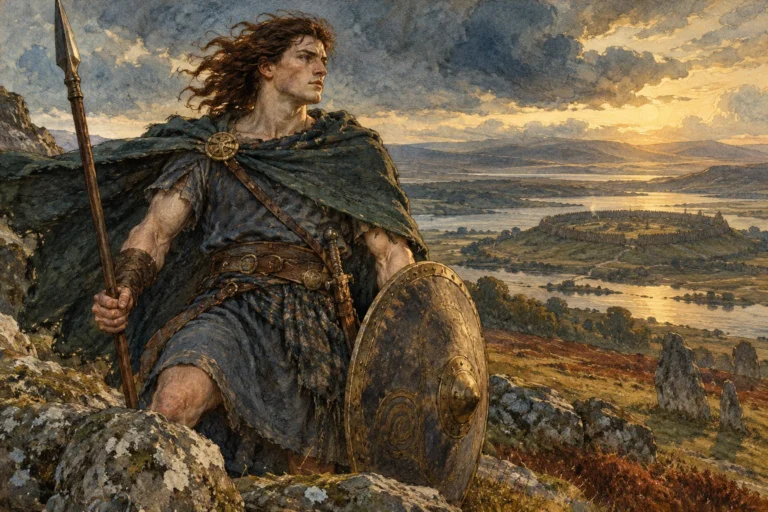
Crunnchu lived among the hills, wealthy in cattle but without a wife. His four sons remained with him after their mother’s death. One day, as he rested in the house, a woman entered. She wore fine clothing and carried herself with assurance, yet offered no explanation of where she had come from.
She sat beside the hearth and tended the fire. She prepared food, milked a cow and began directing the household. When the others had gone to their beds, she put out the fire and lay beside Crunnchu. She stayed. Their life together prospered, and his wealth grew greater than before.
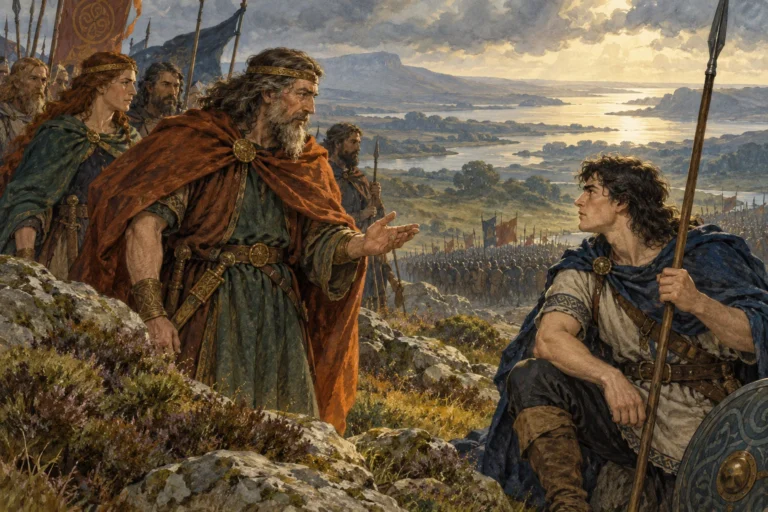
Then came an assembly of the Ulstermen. Crunnchu wanted to attend, as his neighbours did. His companion warned him against speaking about her there: their union could continue only if he kept silent. He promised that he would say nothing. Leaving her at home, heavily pregnant, he joined the crowds at the festival.
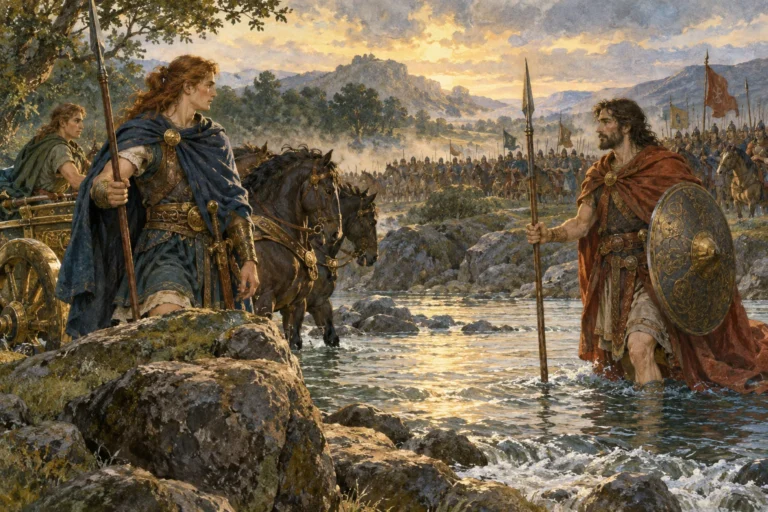
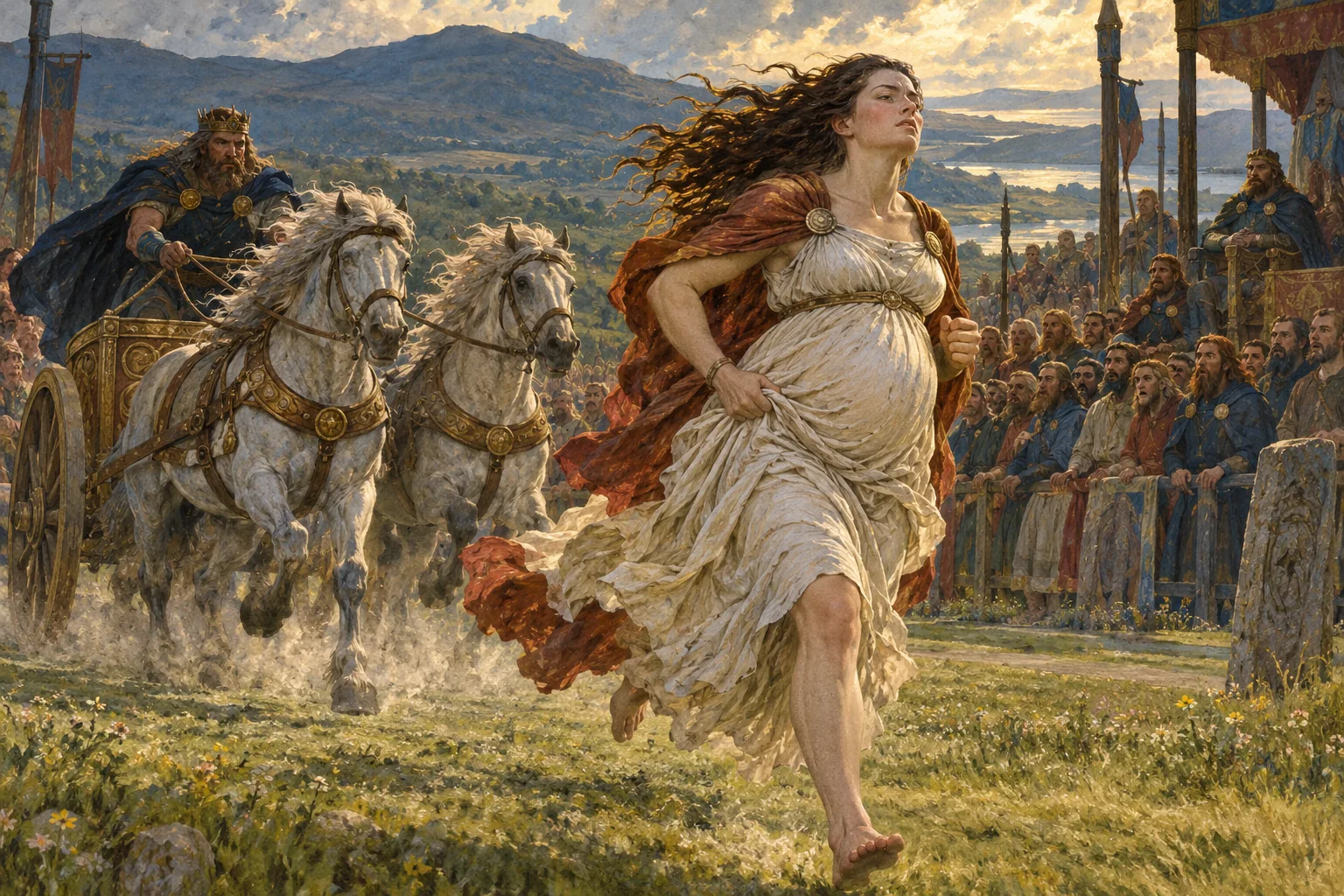
The gathering was full of races, contests and splendid horses. When the king’s chariot appeared, its team surpassed the others. The praises of the horses spread through the company. Nobody in Ireland, people declared, possessed a faster pair. Crunnchu could not leave the claim unanswered. His wife, he announced, could run faster than both of them.
The king ordered him seized. Messengers were sent to bring the woman and make her prove his boast. She welcomed them, then heard what her husband had done. She was close to giving birth, she explained. The answer was that Crunnchu would die unless she came. So she went to the assembly. Hull, pp. 97–99.
People crowded around her. She protested at being stared at in such a condition and asked why she had been summoned. They wanted her to race the horses. Again she explained that her child was about to be born. The king answered by ordering his men to draw their swords against Crunnchu.
She appealed to the gathering: every person there had been borne by a mother. Surely that shared beginning entitled her to help now. She did not demand that the competition be cancelled. She asked for enough time to deliver her child. The king would allow no delay.
Then she named herself Macha and warned them that her name, and her children’s, would remain attached to this place. They had denied her compassion; the humiliation they imposed upon her would return to them. She ordered the horses brought forward and ran.
Macha reached the finish before the team. There she cried out and gave birth to twins, a son and a daughter. Those who heard her cry were seized by weakness. The strength they had trusted to watch her suffering could no longer support them.
She declared that, at their time of greatest pressure, the men of Ulster would endure the weakness of childbirth for five days and four nights. The curse would reach through nine generations. The place became Emain Macha, explained in this account as Macha’s twins. The tale names exceptions, including the women and children and Cú Chulainn; the warriors’ failure would one day leave the defence of their province resting heavily upon him. Hull, pp. 99–100.
Versions and variations
Two manuscripts inside one translation. Hull’s introductory note identifies the Book of Leinster, p. 125b, and Harley 5280, fol. 53b, through Windisch’s edition. She uses the fuller Harley account as her basis and brackets selected Leinster additions. Those additions include Macha’s appeal to the spectators as children of mothers, her declaration of her name and ancestry, and the explicit explanation of Emain Macha as her twins. At the ending, the named endpoint of the curse differs: Fergus mac Domnaill in one formulation, or a descendant named Forc in the bracketed alternative. These are actual distinctions preserved by the edition, though its combined English text is not a complete separate translation of each witness. Hull, pp. 96–100.
Later compression. T. W. Rolleston keeps the stranger’s arrival, the warning, the boast, the forced race, twins and nine-generation curse. He omits Hull’s detailed closing exceptions and treats the spectators’ craving for entertainment as central to their cruelty. His version should be counted as a later retelling, not as an independently recorded oral performance. Neither this passage nor Hull’s narrative explicitly says Macha dies after giving birth. Rolleston, chapter V, “The Curse of Macha”, pp. 177–179.
Another Macha, another explanation. The Wooing of Emer material retold by Gregory explains Emain’s name through a ruling Macha who marks out a fortress with her brooch. That queen’s story must be distinguished from the race of Crunnchu’s partner. A shared name and landscape invite comparison, but do not justify silently turning these narratives into one continuous biography. Gregory, chapter III, pp. 26–27.
Context and evidence
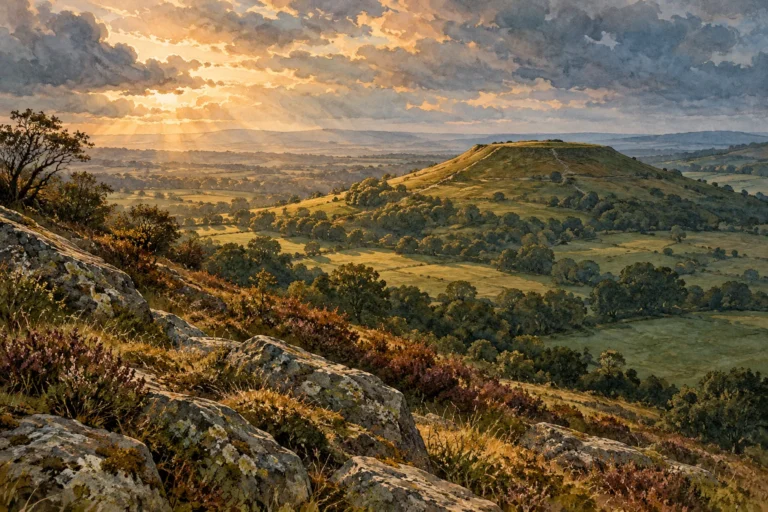
This is both a story about cruelty and an explanation of the Ulster warriors’ disabling weakness before the cattle raid. Its place-name explanation belongs to the literary identity of Emain Macha / Navan Fort. Archaeological evidence for an important prehistoric site does not verify the race or curse. Elva Johnston’s scholarly account discusses Macha’s connection with sovereignty and the failings of the Ulster kingship; that is an interpretation of the narrative, not a recovered report of an actual event. Dictionary of Irish Biography, “Macha”. Follow the consequences towards Cooley and Cú Chulainn’s combat with Ferdiad.
Sources for this entry
- Anonymous; Eleanor Hull adapting Ernst Windisch’s German translations, The Debility of the Ultonian Warriors, in The Cuchullin Saga in Irish Literature. London: David Nutt, 1898. Introduction p. 96; narrative pp. 97–100; bracketed Book of Leinster additions pp. 99–100; manuscript locators reported in introduction: LL 125b and Harley 5280, fol. 53b. Read source — Principal examined retelling basis; openly combined translation with individually marked manuscript differences. About this book
- T. W. Rolleston, Myths and Legends of the Celtic Race. London: George G. Harrap, 1911. Chapter V, “The Curse of Macha”, pp. 177–179. Read source — Examined later adaptation; no independent oral collection claimed. About this book
- Lady Augusta Gregory, Cuchulain of Muirthemne. London: John Murray, 1902. III, “Courting of Emer”, pp. 26–27, explanation of Emain Macha through Macha’s brooch and fortress. Read source — Comparison with a different Macha narrative and alternative place-name explanation, not another version of the race. About this book
- Elva Johnston, Macha. Dictionary of Irish Biography, Royal Irish Academy, October 2009. Entry paragraphs 1–6 and bibliography; DOI 10.3318/dib.009257.v1. Read source — Modern scholarly context; distinguishes narrative interpretation from archaeology.
Research coverage
Examined Hull’s composite translation and its marked Book of Leinster/Harley differences, Rolleston’s later retelling, and Gregory’s distinct Macha place-name story. Vernam Hull’s critical edition, “Noínden Ulad”, Celtica 8 (1968), pp. 1–42, remains a priority for fuller manuscript collation. Macha’s death is not added to accounts that do not state it.
The Myths · Irish collection · Editorial approach
Further Reading