Mythological Cycle; overlaps with the Cycles of the Kings · story
The Wooing of Étaín
Driven from one life and born into another, Étaín becomes a queen at Tara. Her former husband returns from the Otherworld, and a wager begins a struggle over who she is and where she belongs.
Also found as: The Courtship of Etain · Tochmarc Étaíne · Tochmarc Etaine · Midir and Étaín · Midhir and Etain · The Sick-bed of Ailill
Research reviewed 17 October 2026.
Read the story
Version followed: this original retelling follows “Midhir and Etain”, Part One, Book Four, chapter VII of Lady Gregory’s Gods and Fighting Men (1905). Gregory joins material into one narrative. Her recovery of Étaín is not the ending of every manuscript-based account.
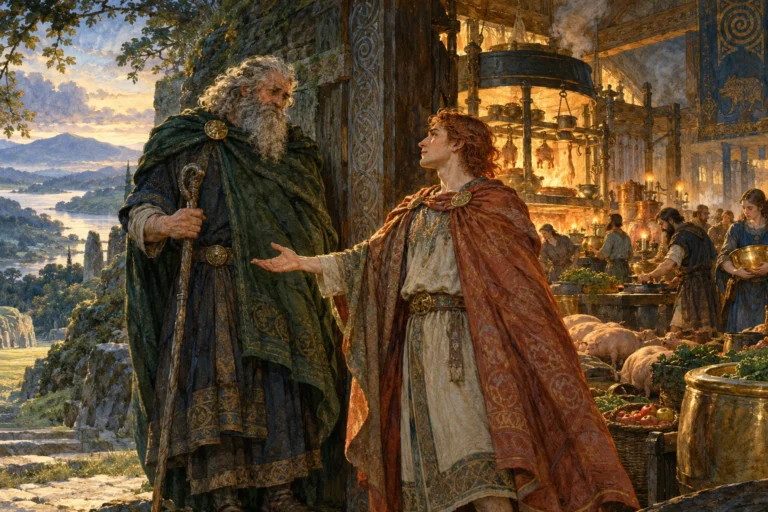
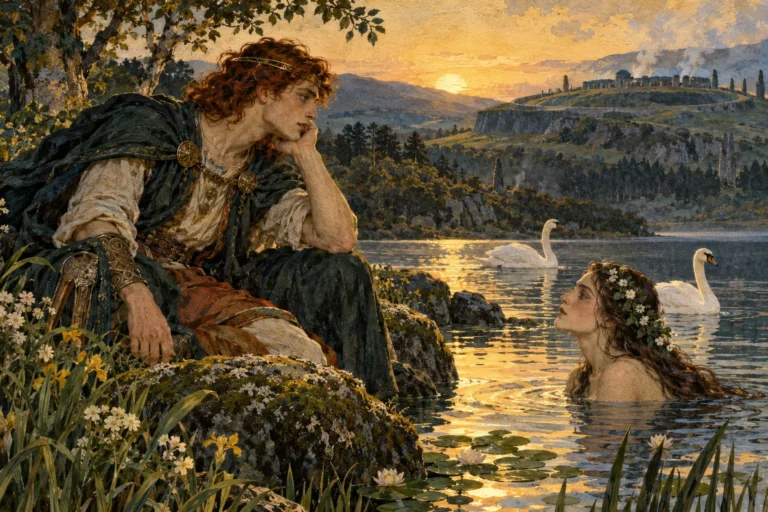
At Brí Léith, Midir loved Étaín, and his earlier wife Fuamnach resented her. With a druid’s help, Fuamnach drove Étaín away. Aengus sheltered her at Brú na Bóinne, making a hidden, flower-filled dwelling and keeping her with him. But safety brought a second attack. While Aengus was absent, Fuamnach changed Étaín into a fly and swept her out upon a magical wind.
For seven years she was carried through Ireland. Then she fell from a roof-beam into a cup of wine at a feast. Étar’s wife drank from it, and later bore a daughter who was given the same name: Étaín. The girl grew up among the children of princes, with no ordinary explanation for the life she had lived before.
In time the king Eochaid saw her and took her as his queen at Tara. His brother Ailill also fell in love with her. He hid the cause of his distress until desire became a wasting sickness. When Eochaid travelled away, he asked Étaín to care for his brother.
Étaín wanted to save Ailill. But at the meetings she arranged, someone else came in his likeness. The stranger eventually named himself: Midir of Brí Léith, her husband from her previous life. He said that he had caused Ailill’s longing and prevented the meetings. He offered Étaín an Otherworld home, but she would not leave Eochaid without his permission.
Midir next approached the king with a board game. Eochaid won horses and, in a later game, demanded enormous works, including a road across a bog. Midir’s people performed them. When Midir finally won, he asked for Étaín. Eochaid refused, then agreed only to an embrace and a kiss after a month’s delay.
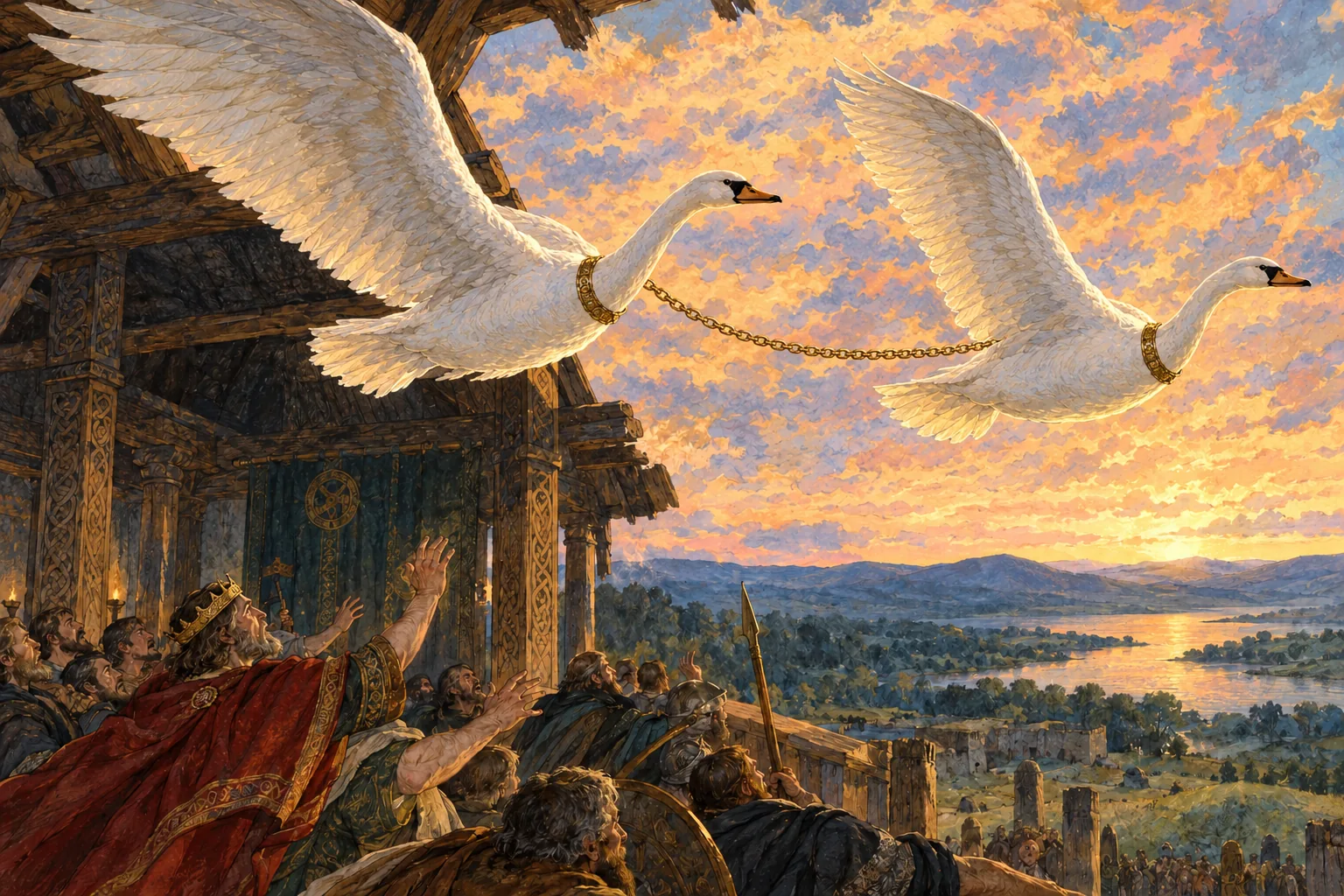
When the day came, armed men filled the hall. Midir nevertheless appeared, took Étaín in his arms and rose through the roof. The men running outside saw two swans flying above them, joined by a golden chain.
Eochaid searched for years. At last a druid revealed that Étaín was at Brí Léith, and the king attacked the fairy dwelling. As his men dug into the hill, Midir sent out sixty women who all looked like her. Eochaid first chose his own daughter Esa. Then Étaín called to him, and he recognised her and brought her home.
The recovery did not end the feud. In Gregory’s telling, the insult to Midir’s hill would be remembered, and its consequences would reach Eochaid and Étaín’s descendants.
Versions and variations
An abduction at the races, or a wager at Tara?
A. H. Leahy prints distinct “Egerton” and “Leabhar na h-Uidhri” versions. In his Egerton account Midir carries Étaín and her attendant away from a gathering at Frémainn; Eochaid destroys the fairy dwelling and recovers her. The Tara board-game bargain and the flight as linked birds belong to the other presentation. They should not be inserted into the Egerton account without marking the combination. Leahy, “The Courtship of Etain”, both versions.
The troubling identification
The Bergin–Best edition’s third part ends differently from Gregory. Eochaid selects a woman who resembles Étaín, lives with her, and subsequently learns that she is his own daughter, conceived before Étaín’s removal. A further child and her abandonment follow. Gregory instead lets Étaín speak and correct the mistaken choice, so that the actual wife returns. That is a major change in the story’s outcome. Bergin and Best, part III, §§17–20; Gregory, “Midhir and Etain”.
A reteller’s synthesis
Gregory lists O’Curry, Kuno Meyer, Müller, Nutt, de Jubainville and a manuscript lent by Standish Hayes O’Grady among her authorities for this chapter. Leahy also identifies editorial repairs to gaps in his text. These are visible acts of arrangement and translation, not extra independent oral witnesses. Gregory, Authorities; Leahy, introduction to the tale.
Context and evidence
The named places connect several kinds of story: Tara supplies a royal court, Brú na Bóinne a refuge, and Brí Léith an Otherworld household. Their roles belong to the accounts cited here. The survival of a landscape or monument does not authenticate Étaín’s rebirth or identify a historical woman behind her.
Even the king’s name needs a source label: Gregory first calls him Eochaid Feidlech, while the manuscript-based narratives distinguish Eochaid Airem. Leahy discusses contradictions in the inherited chronology. This directory therefore records the literary relationships rather than forcing the episodes into a dated royal biography. Gregory, chapter VII; Leahy, introduction and the two versions.
Sources for this entry
- Lady Gregory, Gods and Fighting Men. 1905 edition; first published 1904. Part One, Book Four, chapter VII, “Midhir and Etain”; Notes III, Authorities, “Midhir and Etain”. Read source — Main retelling; joined narrative, recovery ending and named source list.. About this book
- A. H. Leahy, translator, Heroic Romances of Ireland, volume I. London: David Nutt, 1905; Project Gutenberg text. “The Courtship of Etain”: Introduction, “Prologue in Fairyland”, “Egerton Version” and “Leabhar na h-Uidhri Version”. Read source — Separate literary witnesses compared; Frémainn abduction, Tara wager, editorial gap-filling and chronological difficulties.. About this book
- Anonymous; edited and translated by Osborn Bergin and R. I. Best, Tochmarc Étaíne / The Wooing of Étaín. Ériu 12 (1938), pp. 137–196; CELT electronic edition T300012. Part III, §§17–20; source description in the electronic edition. Read source — Brief comparison of the mistaken-daughter ending. Not the prose source of the main retelling..
Research coverage
Gregory, Leahy’s separately presented Egerton and Lebor na hUidre accounts, and the ending in Bergin–Best have been examined. Manuscript-by-manuscript textual collation, the related place-name poems and later oral or literary adaptations remain to be added. This page does not call a composite version the single original.
The Myths · Irish collection · Editorial approach
Further Reading