Fenian Cycle · story
Sadhbh and the birth of Oisín
Fionn’s hounds recognise a hunted deer as someone like themselves. She finds safety at his home, but a false likeness of her protector draws her outside the gates.
Also found as: Sadb · Sadbh · Saav · Oisin’s Mother · The Youth of Oisin · Fionn and Sadhbh · Birth of Oisin
Research reviewed 17 October 2026.
Read the story
This retelling follows Lady Gregory’s “Oisin’s Mother”. Her spellings Sadbh, Bran and Sceolan are rendered here as Sadhbh, Bran and Sceólang.
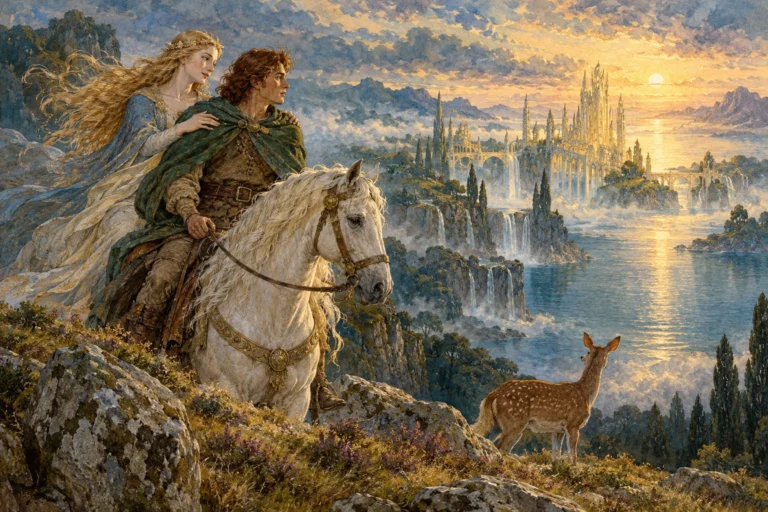
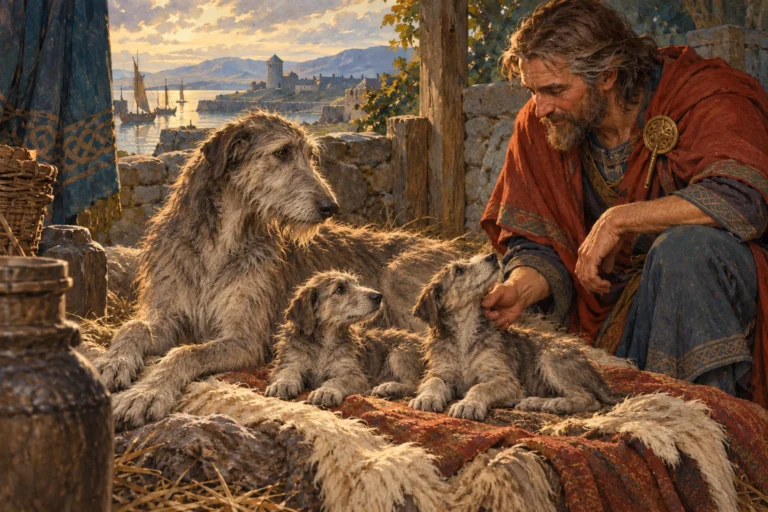
The deer had run until the hunters fell behind her. Only Fionn and his two hounds still followed when she stopped in a green valley and lay down. Bran and Sceólang reached her first. Instead of attacking, they circled and licked her as though greeting a friend.
Fionn spared the animal. She followed him back to Almhuin, playing with the hounds, and entered the protection of his stronghold. That night a woman came to him and explained that she was the deer he had hunted. Fear Doirche, the Dark Druid, had changed her shape because she refused his love. For three years she had endured the dangers of a wild animal’s life. A servant who pitied her had told her how to escape: reach a stronghold of the Fianna, where the druid’s power could no longer hold her.
She had trusted Bran and Sceólang because they possessed human understanding. They had recognised what the hunters could not. Fionn loved her, and she became his wife. For a time he put hunting and the other pleasures of his life aside.
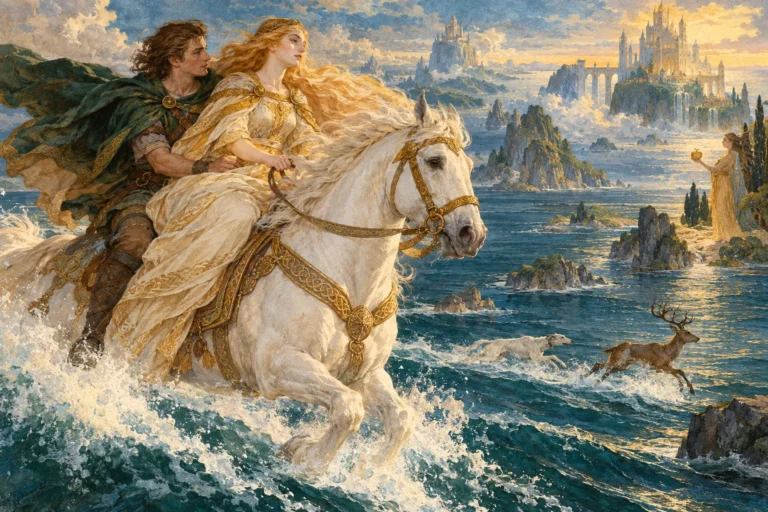
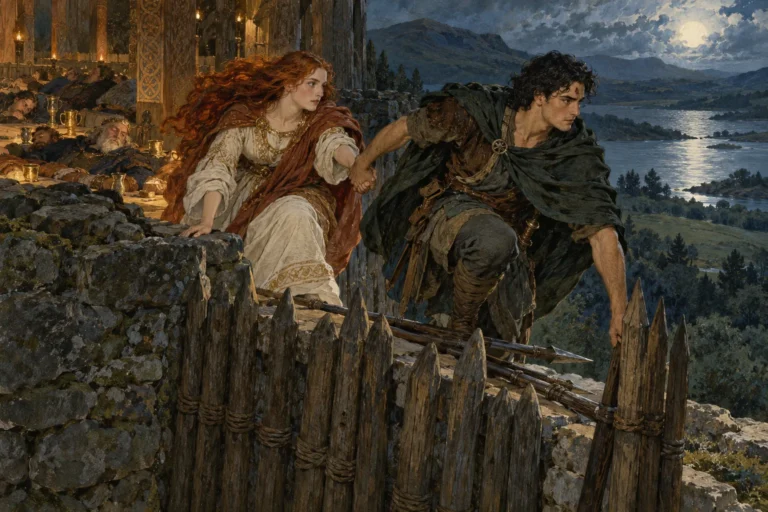
Then hostile ships appeared below Beinn Edair, and he went away with the Fianna to meet them. When he returned, Sadhbh was missing. His household told him that a figure exactly like him had appeared outside, accompanied by two dogs that looked like his hounds. Sadhbh, carrying their unborn child, had run to greet him.
The false Fionn struck her with a hazel rod. She became a deer again. Each time she tried to reach the gate, the false hounds dragged her back. Before the household could rescue her, woman, dogs and captor had disappeared.
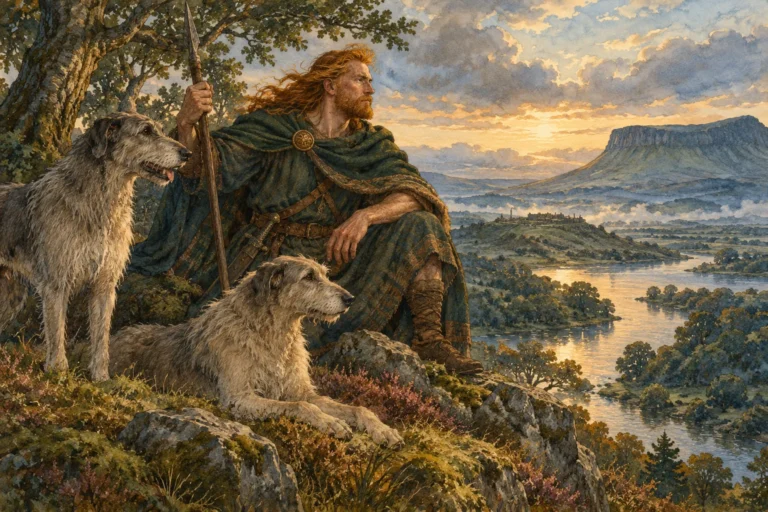
For seven years Fionn searched whenever fighting did not call him elsewhere. On hunts he took only the five dogs he most trusted, afraid that other hounds might kill Sadhbh without knowing her.
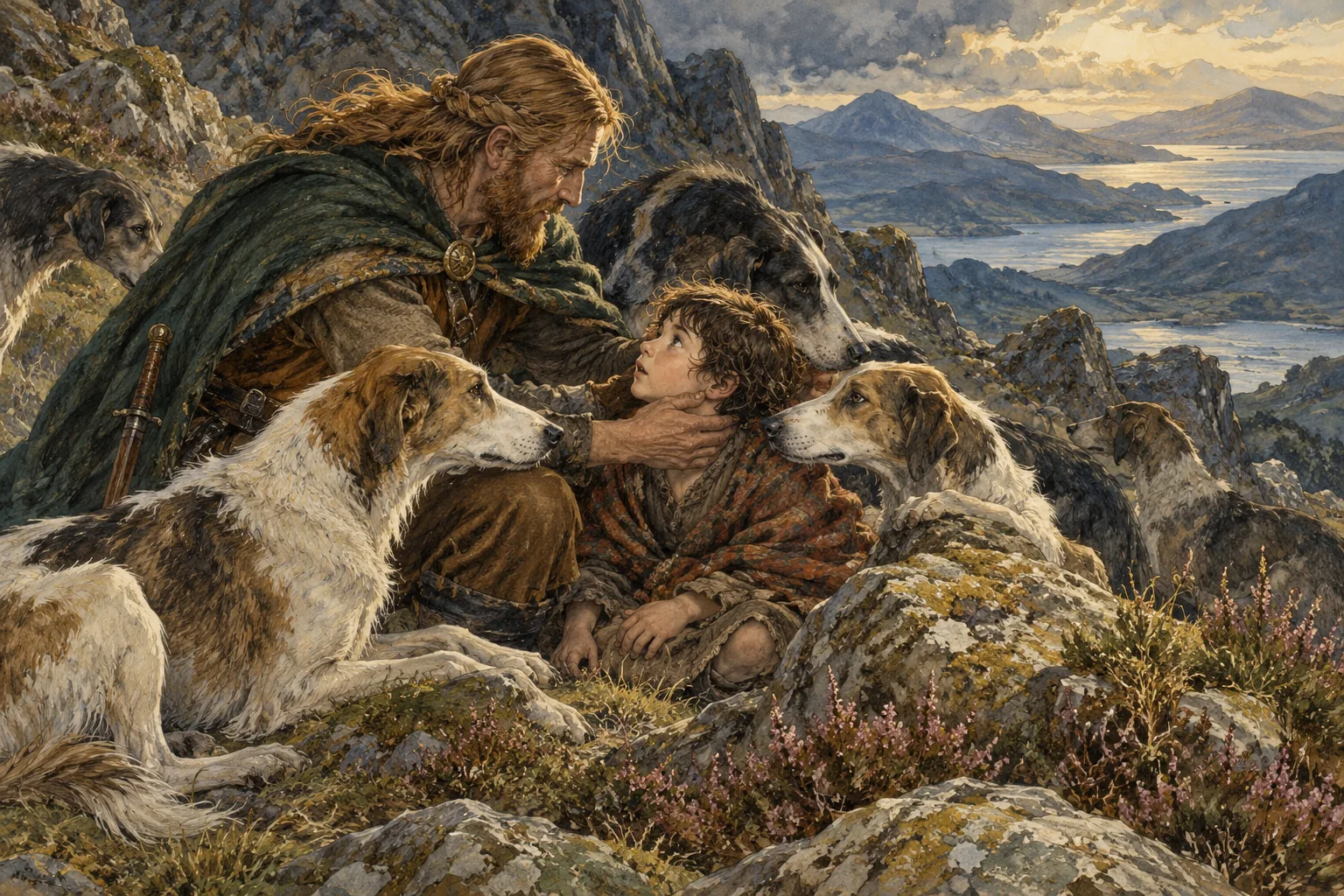
At last, on Beinn Gulbain, those dogs gathered around a human boy and defended him from the rest of the pack. Fionn saw Sadhbh’s likeness in his face and brought him home. When the boy learned their speech, he told of the deer who had sheltered him in a valley enclosed by cliffs. A dark man had repeatedly visited her, speaking gently and then angrily. Finally he struck her with a wand and led her away. The child could neither follow nor call her back.
He had awakened on the mountainside. The hidden valley could not be found again. The Fianna called the boy Oisín; he would become a warrior and a maker of poems. But the story did not bring his mother home. Read Gregory, Part II, Book I, chapter IV.
Versions and variations
Seven years, fourteen years and a human child
Patrick Kennedy’s “The Youth of Oisin”: the woman is named Saav. Fion searches for seven years, then continues mourning and searching through a second seven-year period. The discovery of the youth follows that second period. Kennedy expressly places Bengulban in Sligo. His child is already human when the hounds find him; long hair covers his body, and he subsequently learns speech. Read the full account.
Lady Gregory’s “Oisin’s Mother”: Sadbh is found in the same deer-sanctuary sequence, but the boy is discovered after seven years. He is described as a young human boy with long hair. The story does not say that Fionn brings a fawn home and turns it into a child. Gregory retains the lost valley and the unanswered fate of the mother. Part II, Book I, chapter IV.
How the accounts are related: Gregory names Kennedy among her authorities for this chapter, alongside Mac Innis and Leabhar na Feinne. Their shared sequence therefore cannot be counted as two independent confirmations of one oral telling. The difference in elapsed time is real in the printed accounts; its precise origin has not yet been established. Notes III, “Oisin’s Mother”.
Context and evidence
The hounds’ recognition connects this tale with the separate story of their own birth to a woman transformed into a dog. It helps explain their behaviour inside the narrative, rather than providing evidence for transformation outside it. Almhuin and Benbulben give the story distinct landscape associations: sanctuary at one, discovery at the other. Neither account identifies an archaeological find as Sadhbh or Oisín. The narrative also leaves Sadhbh’s fate unresolved. A reunion or a definite death would require a different, cited account; it should not be added merely to supply a tidier ending. Gregory, Part II, Book I, chapters III–IV.
Sources for this entry
- Lady Gregory, Gods and Fighting Men. 1905 edition displayed by Project Gutenberg; work first published 1904. Part II, Book I, chapters III–IV, Birth of Bran and Oisin’s Mother; Notes III, Oisin’s Mother; Notes V, Beinn Gulbain. Read source — Principal retelling and explicit list of antecedent sources; directly consulted. About this book
- Patrick Kennedy, Legendary Fictions of the Irish Celts. 1891 second edition, as identified by Library Ireland; work first published 1866. The Youth of Oisin, entire chapter. Read source — Earlier printed account cited by Gregory; directly consulted. About this book
Research coverage
Two related printed accounts compared, with their dependence explicitly recorded. Gregory’s references to Mac Innis and Leabhar na Feinne are leads awaiting passage-level examination, not additional witnesses counted as read. Further work should examine the Gaelic birth lays, Scottish accounts and individually identified oral records. This entry does not claim to inventory all Sadhbh/Oisín birth traditions.
The Myths · Irish collection · Editorial approach
Further Reading