Orkney fairy tale · story
Kate Crackernuts
A queen’s jealousy puts a sheep’s head on her stepdaughter. Her own daughter refuses to abandon her, and finds two cures inside a fairy hill.
Also found as: The Story of Kate Crackernuts · Katie Crackernuts
Research reviewed 28 October 2026.
Read the story
This retelling follows Joseph Jacobs’s “Kate Crackernuts” in English Fairy Tales, tale XXXVII. His named revision of the earlier Orkney record is set out below.
A king and queen each had a daughter. The king’s daughter Anne was thought the prettier, but the two girls loved one another. The queen could not bear the comparison. She consulted a henwife, who told her to send Anne to the house without breakfast.
The next morning Anne was sent to ask for eggs. On her way through the kitchen she ate a crust of bread. At the henwife’s house she was told to lift the lid of a pot. Nothing happened. The henwife sent her back with a message: the queen should keep her cupboard better shut.
On the second morning Anne ate peas offered by people working beside the road. Again the pot did nothing. On the third morning the queen went with her, making sure that she ate nothing. When Anne raised the lid, her own head vanished and a sheep’s head appeared in its place.
The queen was satisfied. Kate was not. She wrapped her stepsister’s head in fine linen, took her hand and left home with her. They travelled until they reached another king’s castle. Kate asked for shelter for herself and her sick sister.
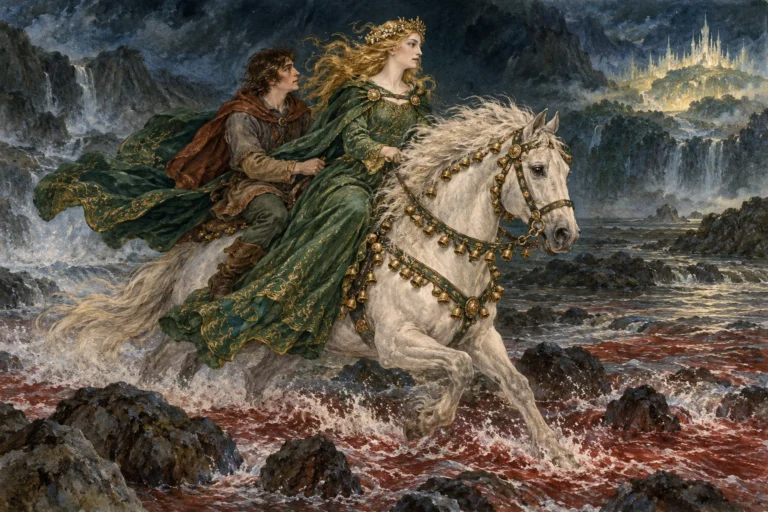
One of the princes there was wasting away. Nobody knew why, and those who watched him at night disappeared. Kate agreed to keep watch in return for silver. At midnight the prince rose, dressed and went to the stable. Kate followed, climbed onto the horse behind him, and rode unnoticed through the wood. As they passed the trees, she filled her apron with nuts.
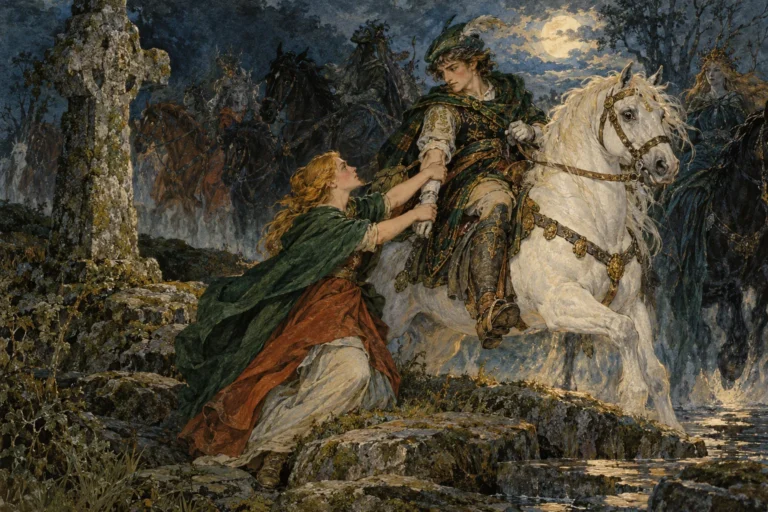
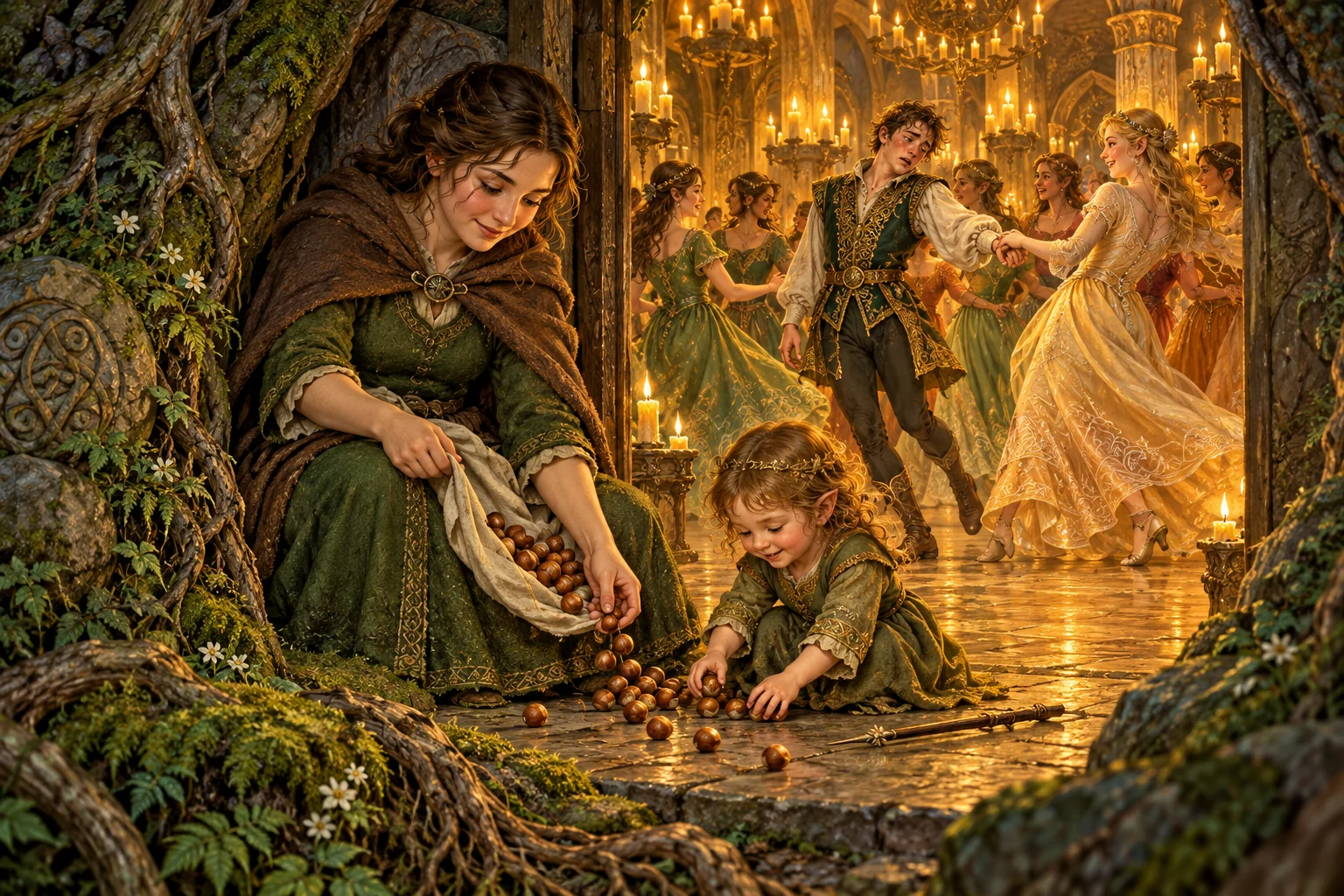
At a green hill, the prince called for an entrance for himself, his horse and his hound. Kate quickly added that his lady rode behind him. The hill opened. Inside lay a brilliant hall, where fairies drew the prince into a dance. He danced until he fell exhausted, was revived, and had to dance again. Kate stayed concealed by the doorway.
At cockcrow they rode home. In the morning Kate sat by the fire, cracking nuts. She agreed to watch another night, this time for gold. Again she rode to the hill. Now she noticed a fairy child playing with a wand and heard that three strokes of it would restore her sister.
Kate rolled nuts towards the child. The child followed them, letting the wand fall. Kate hid it in her apron and brought it home. She touched Anne three times, and the sheep’s head disappeared. Her sister was herself again.
For the third night Kate asked to marry the sick prince if she kept watch. In the hill she saw the fairy child playing with a bird. Three bites of that bird, she overheard, would cure him. Once more the nuts drew the child away, and Kate carried the bird out of the hill.
At home she cooked it. The prince smelled the food and asked for a taste. After the first bite he could prop himself on an elbow; after the second he sat up; after the third he rose and dressed. When the household came in, the prince and Kate were cracking nuts together beside the fire.
The other prince had fallen in love with Anne. The two marriages followed. Kate had undone the queen’s cruelty without turning against her sister, and freed the prince by paying attention to what happened around the edge of the fairy dance.
Versions and variations
The earlier Orkney text
The 1890 Folk-Lore printing credits D. J. Robertson of the Orkneys and identifies an earlier appearance in Longman’s Magazine, volume XIII. Both girls are called Kate in that text. The closing marriages distinguish the sick and well sisters, but the shared name makes parts of the narration harder to follow. The credit locates the collection connection; it does not name the castle or hill.
A renamed sister and a changed sequence
Jacobs calls the enchanted sister Anne and the rescuer Kate. His note openly says that he substantially rewrote the account. In the earlier text Kate obtains the wand on the first visit; the second night is briefly said to repeat the first. Jacobs moves the wand episode to the second visit and explicitly describes Anne’s restoration when they return. The three-night structure therefore has a more neatly separated task on each night.
What Jacobs makes more explicit
Jacobs describes the prince collapsing from repeated dancing and being fanned so he can continue. He also states that earlier watchers were never seen again. Those details are not stated in the shorter 1890 text examined here. The sisters’ loyalty, the nuts, the wand, the curative bird and the double marriage are shared. Jacobs’s book is a later adaptation of the recorded story, not an additional independent field collection.
Context and evidence
Despite its appearance in a volume called English Fairy Tales, the earlier printed record explicitly connects this tale with an Orkney collector. A collection’s title is not a reliable label for the origin of every item it contains. Nor does the nineteenth-century record prove that the story began in that period.
The tale makes female loyalty its central action. The queen expects beauty to set the girls against one another; Kate instead protects the sister who has been harmed. That is a reading of this plot, not a claim about the beliefs of every storyteller who used it.
The prince’s illness is explained by enchantment within the story. It should not be treated as an account of a real medical condition. Similarly, no named Scottish hill is identified here. The Eildon Hills belong to other fairy traditions, notably Thomas the Rhymer; linking them offers a comparison, not a location for Kate’s adventure. Compare also the rescue from fairy power in Tam Lin and The Smith and the Fairies.
Sources for this entry
- Joseph Jacobs, English Fairy Tales. First published 1890; consulted Project Gutenberg text, tale XXXVII and note XXXVII. Read source — Complete retelling and editorial admission of rewriting. About this book or article
- D. J. Robertson, credited collector, The Story of Kate Crackernuts. “English and Scotch Fairy Tales”, Folk-Lore, vol.1, no.3 (September 1890), pp.299–301; prior Longman’s appearance identified in the printed credit. Read source — Earlier two-Kates narrative and first-night wand episode. About this book or article
Research coverage
The 1890 Folk-Lore printing and Jacobs’s tale and source note were directly compared. The earlier Longman’s printing, later oral recordings and international parallels have not all been collated. Differences described here are observed textual changes; they are not automatically separate oral variants.
The Myths · Scottish collection · Editorial approach
Further Reading