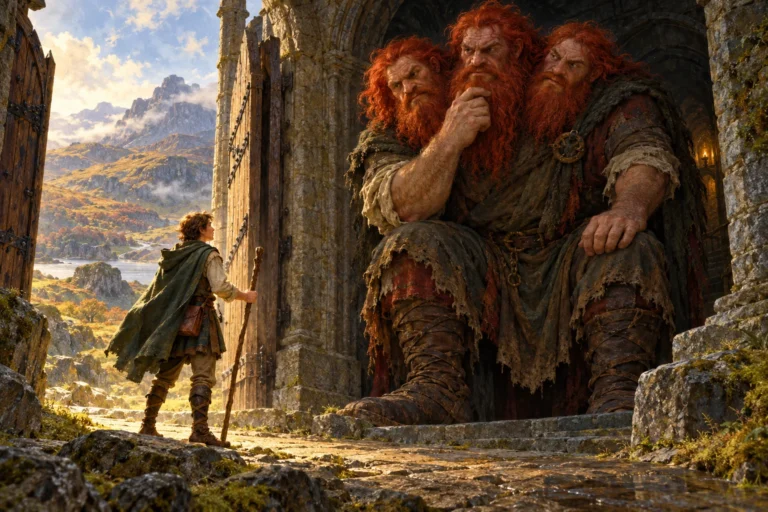
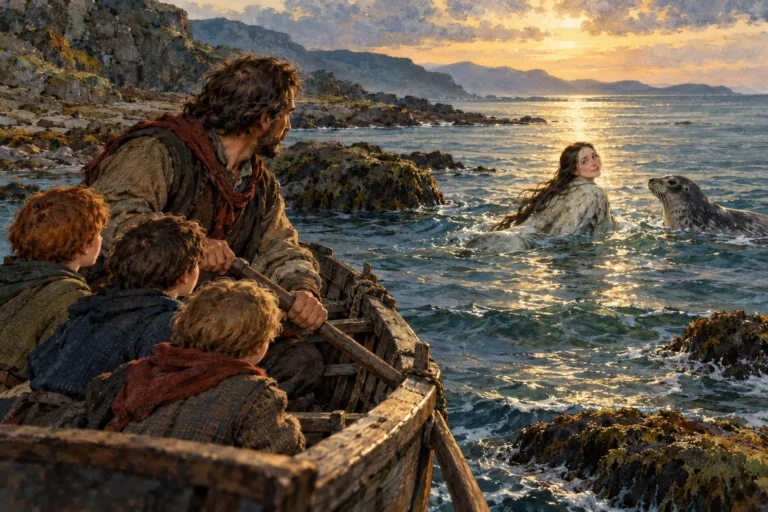
Orkney folklore · story
Assipattle and the Stoorworm
Nobody believes the boy who lies among the ashes can save a kingdom. He needs a boat, a little fire and the courage to enter a monster’s mouth.
Also found as: Assipattle and the Mester Stoorworm · Mester Stoor Worm · Stove Worm
Research reviewed 28 October 2026.
Read the story
This retelling follows Elizabeth W. Grierson’s “Assipattle and the Mester Stoorworm”, pp.221–244 of The Scottish Fairy Book. The shorter account published by Walter Traill Dennison in 1891 is compared below.
Assipattle was the youngest of seven brothers. His clothes were ragged, his hair full of ashes, and his head full of adventures. While the others worked on their father’s farm, he dreamed of giants and trolls. His brothers mocked him; only his sister listened kindly. When she went to the king’s palace to serve Princess Gemdelovely, home became a lonelier place.
Then the Mester Stoorworm turned towards the coast. Its immense body lay across the sea, and its poisonous breath threatened every living thing on shore. The king’s counsellors could find no defence. At the queen’s urging they consulted a sorcerer, who demanded that seven young women be given to the creature each Saturday.
The sacrifices did not drive it away. At last the sorcerer said the monster must have the king’s only daughter. The queen, Gemdelovely’s stepmother, welcomed the proposal. The king grieved, but agreed that his child could not be spared while other families lost theirs. He asked for three weeks in which a champion might save her. The reward would be her hand, the kingdom and Sickersnapper, a sword once wielded by Odin.
Thirty-six champions arrived. One look at the Stoorworm sent twelve home in terror and made twelve fall ill. Those who stayed could do nothing. Assipattle said that he would fight it. His brothers answered with laughter and blows.
On the last night, he overheard his father explaining how to control the swift horse Go-Swift. A touch on one shoulder stopped her; touches on the other set her moving; a whistle through a goose’s windpipe made her race. Assipattle took the whistle and slipped into the stable. His family woke and pursued him, but the horse carried him beyond their reach.
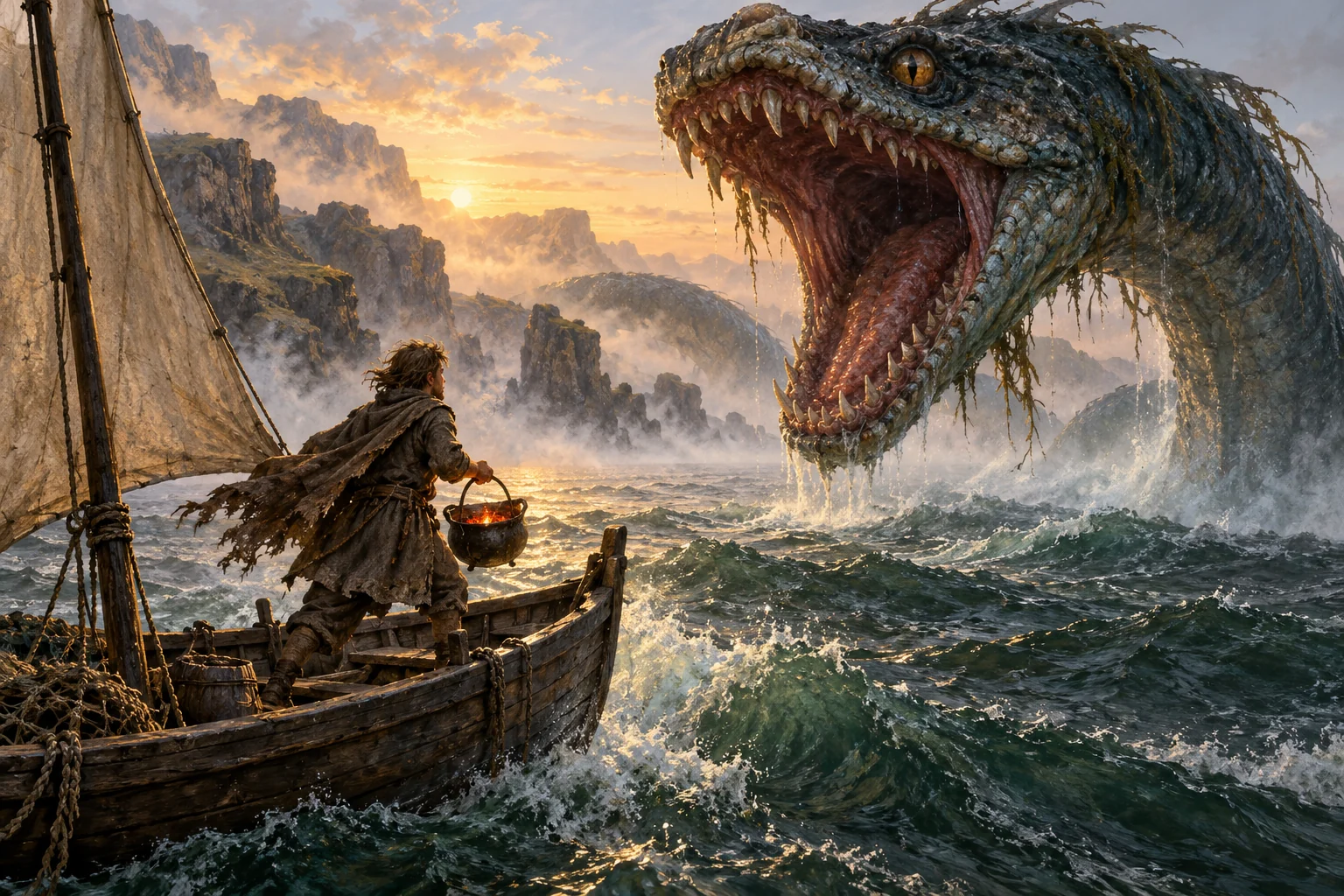
At a cottage near the shore he found a sleeping woman, an iron pot and a live peat on the hearth. He took the pot and the glowing fuel. Then he came upon the king’s boat, guarded by a cold, reluctant boatman. Pretending to search for shellfish, Assipattle suddenly cried that he had found gold in the sand. The guard rushed ashore. Assipattle pushed off with his pot.
The king reached the beach too late to stop him. Out on the water, Assipattle watched the Stoorworm yawn. He lowered the sail and steered towards its mouth. The next great intake of seawater swept the boat down its throat.
Inside, the water drained away through openings until the boat grounded. Assipattle climbed out and found the creature’s enormous liver. He made a hole in it and placed the burning peat inside. The oil caught fire. As the monster convulsed, he scrambled back aboard, and the boat was thrown out of its mouth and onto the land.
The watchers fled uphill. The Stoorworm’s tongue struck the earth, cutting the straits between Denmark and Norway and Sweden. Its falling teeth became Orkney and Shetland. Its body curled into the mass of Iceland, where the hidden fire still burned beneath the mountains, according to the tale.
The king embraced the boy, clothed him in the royal mantle and gave him Sickersnapper. Yet the danger at court was not finished. Assipattle’s sister revealed that the queen and sorcerer had fled together. On Go-Swift, Assipattle caught them. The sorcerer trusted his enchantment to protect him from ordinary weapons, but Odin’s sword killed him. The queen was taken back and imprisoned in a tower.
When the time came, Assipattle married Gemdelovely. After the king’s death they ruled the kingdom. The boy dismissed as a useless dreamer had saved it by noticing what stronger people overlooked.
Versions and variations
Dennison’s shorter account and Grierson’s full adventure
Dennison’s 1891 account explicitly abbreviates the tale. He leaves out Assipattle’s earlier life and the preparations for entering the monster. That omission is not a conflicting version in which the horse, family and boatman never existed. Grierson provides a developed literary narrative, including Gemdelovely, Go-Swift and the pursuit of the queen and sorcerer. These are two printed treatments, not two securely independent oral performances.
Ten weeks or three weeks
Dennison gives the king ten weeks to find a champion. Grierson gives him three. Both retain the weekly sacrifice of seven maidens and the threat to the king’s only child. Grierson also identifies the Stoorworm with the biblical Leviathan; that identification belongs to her narration and should not be silently imposed on every Orcadian telling.
Which islands does the monster make?
Dennison’s teeth become Orkney, Shetland and the Faroes. His forked tongue catches a horn of the moon before falling and gouging the sea between Denmark and Norway and Sweden. Grierson keeps Orkney, Shetland and Iceland but omits the Faroes and the encounter with the moon. Both explain Iceland’s subterranean fire through the burning liver. Our retelling keeps Grierson’s shorter sequence rather than blending the endings.
Context and evidence
Dennison introduces the story as something he remembered hearing from older Orcadian storytellers. This is evidence for its place in nineteenth-century Orkney storytelling, not a date for its invention. Grierson’s prefatory note describes her own retelling work. Neither text supplies evidence for a historical Assipattle, Gemdelovely or sea-serpent.
The transformation of teeth into islands makes this an origin story for landscape. It is an imaginative explanation, not geological evidence. Nor does the northern setting allow us to identify the king’s castle or the departure beach. The illustration is an imagined scene, not a view of a documented site.
For another Orcadian tale recorded by Dennison, read The Goodman of Wastness. Its seal-wife has a very different relationship with the human household. The Red Etin offers another Scottish rescue from a monster, but through generosity and a riddle challenge rather than fire inside a sea creature.
Sources for this entry
- Elizabeth W. Grierson, The Scottish Fairy Book. Preface dated 12 April 1910; consulted Lippincott text on Project Gutenberg. “Assipattle and the Mester Stoorworm”, pp.221–244. Read source — Complete chapter and preface examined; the basis of the retelling. About this book or article
- Walter Traill Dennison, Orkney Folklore: Sea Myths. The Scottish Antiquary, vol.5 (1891), pp.130–131, “The Stove Worm”; historical text transcribed by D. L. Ashliman at the University of Pittsburgh. Read source — Shorter narrative, ten-week respite, moon and island-making ending. About this book or article
Research coverage
The complete Grierson chapter and Dennison’s shorter 1891 narrative were compared in transcriptions. Dennison’s longer manuscript-derived text in George Douglas’s Scottish Fairy and Folk-Tales, later oral records and Ernest Marwick’s synthesis remain for further collation. This is not a claim to have surveyed every Orcadian version.
The Myths · Scottish collection · Editorial approach
Further Reading