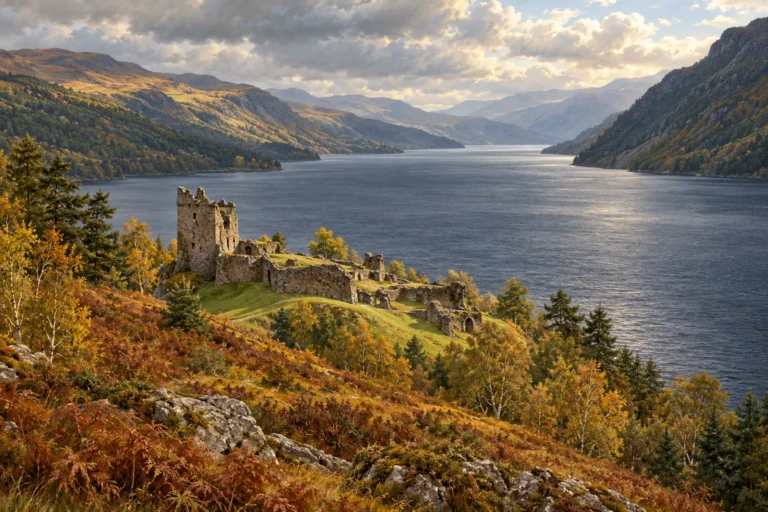
Highland folklore and modern legend · figure
The Loch Ness Monster
Nessie has many shapes in the telling. A guide to the stories, reports and images behind Scotland’s best-known lake monster.
Also found as: Nessie · Loch Ness Monster
Research reviewed 28 October 2026.
Who is Nessie?
Nessie is the familiar name of the legendary creature associated with Loch Ness. For this library, the figure brings together a group of accounts rather than a single continuous biography. A medieval miracle, a newspaper report, a photograph and a modern drawing have different authors, purposes and evidential value. They deserve to be read separately before being joined.
Begin with Columba and the water beast for the medieval narrative. Follow Is the Loch Ness Monster real? for the assessment of photographs, sonar and environmental DNA. The place guide supplies the real geography, including the distinction between the loch and its outflowing river.
Different accounts, different creatures
The medieval river beast
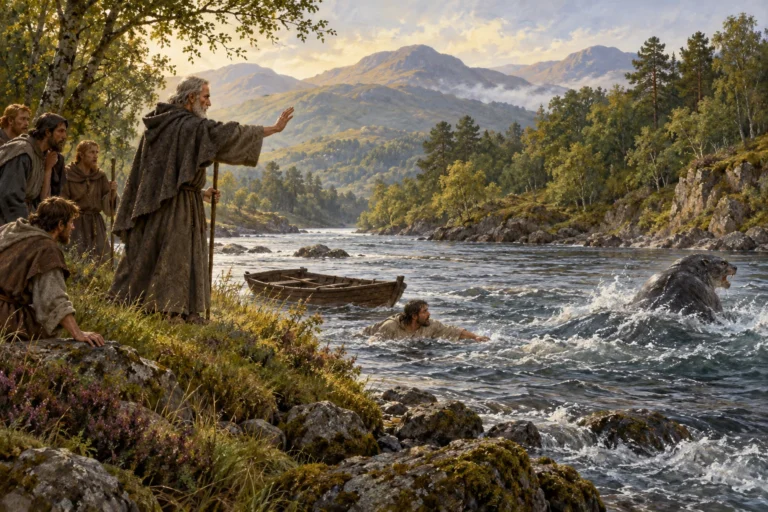
Adomnán’s chapter describes an attacking creature in the River Ness. It leaves its species and overall shape unspecified. It does not use the name Nessie. A long-necked lake creature in a modern illustration should therefore not be read back into the early text.
The whale-like disturbance of 1933
The Inverness Courier report of 2 May 1933 describes a couple watching a disturbance near Abriachan. The reported creature rolls and plunges, with a body compared to a whale. The report invokes older monster or water-kelpie belief, but does not document that earlier tradition in detail. Its wording is neither a clear plesiosaur description nor independent confirmation that an unknown animal was present.
The long-necked silhouette
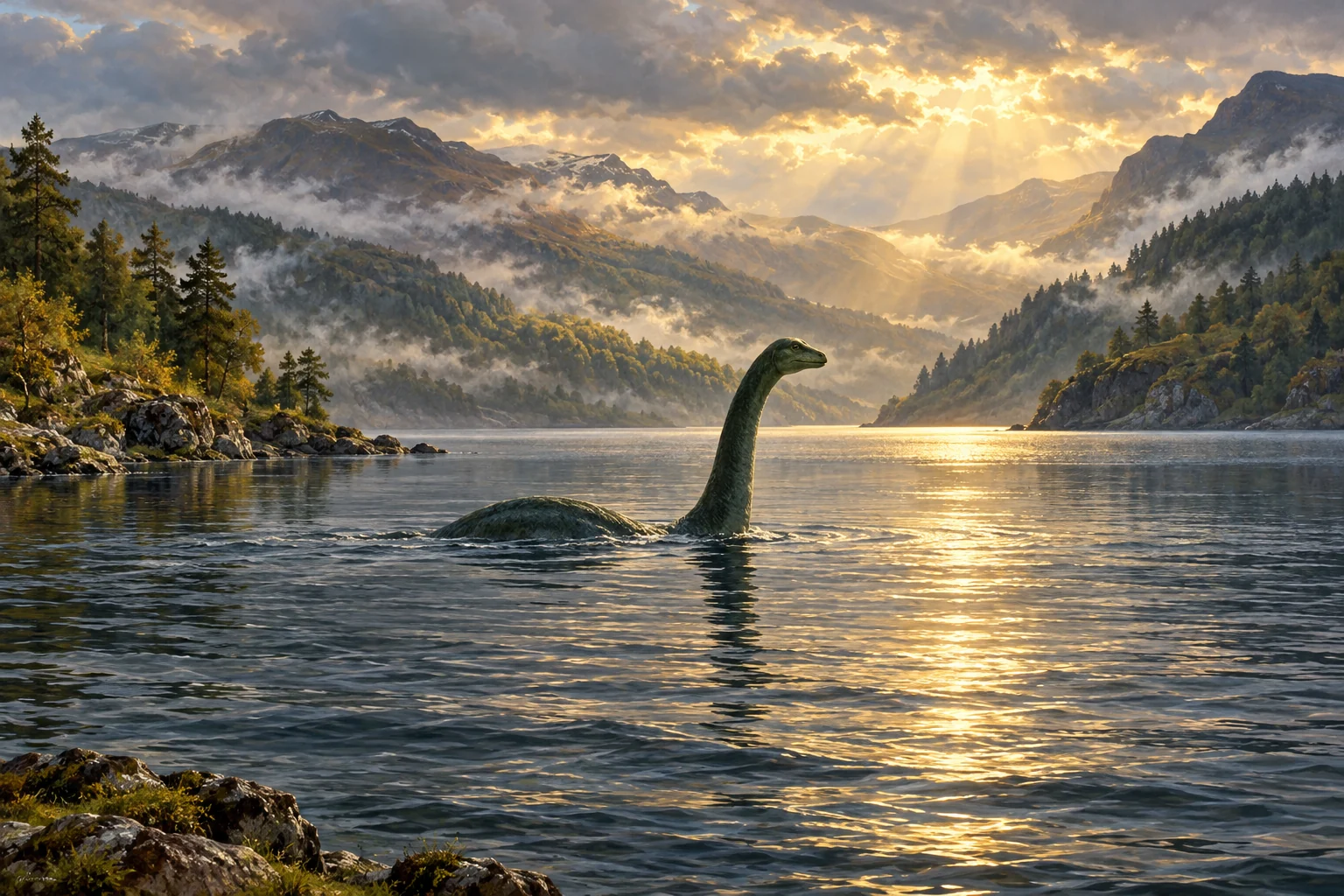
The 1934 “surgeon’s photograph” supplies a very different image: a head and neck above the water. The Science Museum Group’s catalogue identifies it as a hoax involving a model on a toy submarine. Its place in the legend remains worth examining, even though it cannot establish a living creature. Our illustration deliberately uses the recognisable imagined form, with that distinction made explicit.
Do witnesses simply copy the pictures?
A 2025 University of St Andrews research summary reports that hooped forms were common in the postcards studied but rare in the sightings database. That challenges a simple claim that witnesses reproduce the standard souvenir image. It does not establish an unknown animal, or show that every kind of expectation is irrelevant. The particular comparison is narrower than either conclusion.
How to follow the legend
There are two useful ways through this collection. Follow the accounts in their own terms, asking what each narrator says happened; then follow the evidence, asking what survives and what it can support. Neither route requires filling a gap with a more definite animal than the source describes.
Nessie also makes a useful comparison with the Stoorworm. Both connect a frightening creature with northern waters, but Assipattle’s story has a completed adventure and a landscape-making ending. Modern Nessie reporting repeatedly leaves the observation unresolved. They are related subjects for comparison, not interchangeable versions of one plot.
For younger readers, the Nessie colouring sheet offers a friendly imagined creature. The activity’s purpose is creative; the evidence review remains the place to discuss whether a sighting has been verified.
Sources for this entry
- Adomnán, Life of Saint Columba. English translation in the William Reeves edition, Edinburgh: Edmonston and Douglas, 1874; electronic text at CELT, University College Cork. Book II, chapter XXVIII, “An Aquatic Monster driven off by virtue of the blessed man’s prayer” (II.27 in some modern editions). Read source — Complete chapter examined; principal source for the retelling. Book or article record
- Inverness Courier, correspondent, Strange Spectacle in Loch Ness. What was it?. 2 May 1933; consulted the transcription reproduced in The Bibliography of Fantastic Beliefs. Read source — The wording of the early press account, not a newly verified eyewitness interview. A transcription rather than a newspaper facsimile.
- Science Museum Group, Photograph of the Loch Ness Monster. Collection object 1983-5236/31788, Daily Herald Archive. The catalogued print is dated 1962; the underlying “surgeon’s photograph” was published in 1934. Read source — Museum identification of the image as a hoax; print date distinguished from image date.
- University of St Andrews, Myth versus memory: why Nessie spotters haven’t got the hump. 3 July 2025; institutional summary of Charles Paxton and Adrian Shine’s Endeavour study. Read source — The specific comparison between hooped imagery and reported shapes, not a general claim that expectation never affects observation.
Research coverage
Selected medieval, early modern-press and visual accounts are distinguished here. The full history of reported sightings, every photograph and all Nessie books have not been collated. This guide identifies a legendary subject; it does not certify an animal species.
The Myths · Scottish collection · Editorial approach
Further Reading