Welsh lake traditions · story
The Fairy Island of Llyn Cwm Llwch
A mountain lake offers a doorway into a hidden garden, but its guests must leave every gift behind. Other tellings place a threatening guardian beneath the same water.
Also found as: The enchanted island of Llyn Cwm Llwch · Llyn Cwm Llwch
Research reviewed 18 October 2026.

Read the island story
This retelling follows the island account that John Rhŷs quotes from Edward Davies. The lake-draining stories are separate traditions in the discussion below.
On one day of the year, a door opened in a rock beside the lake. Those who entered could pass into a place that could scarcely be seen from the shore: an island garden full of beauty and life. The day was said to be May Day, though the earlier account itself expresses some uncertainty.
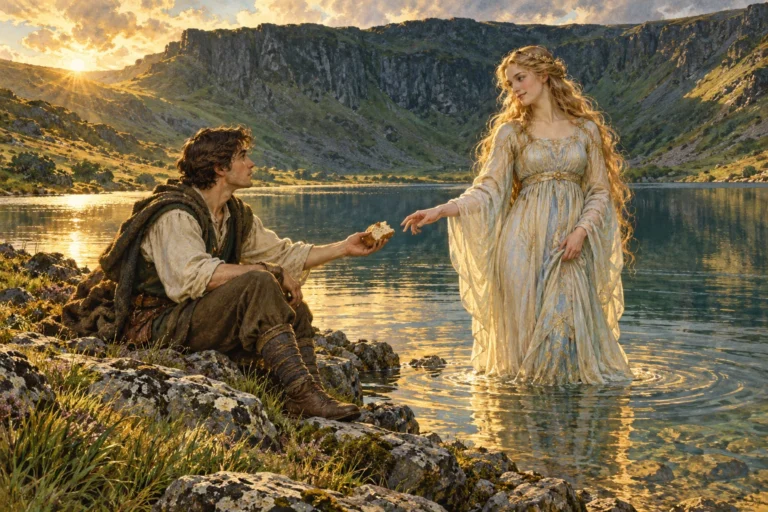
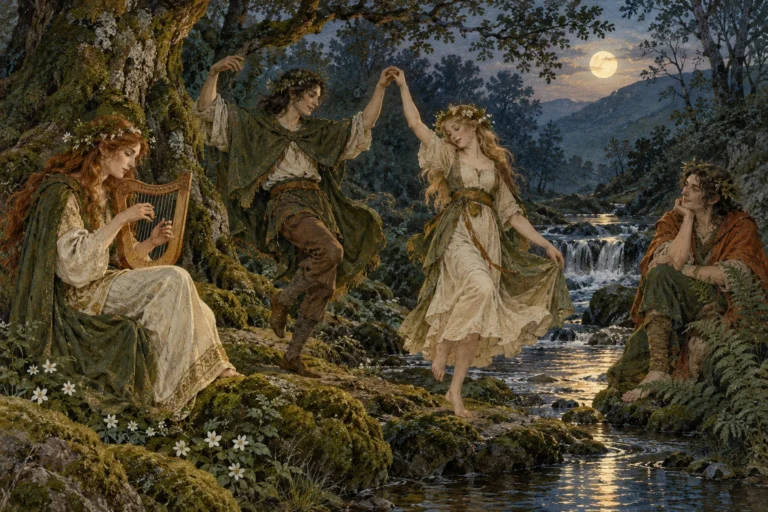
The island’s inhabitants welcomed their visitors. There were flowers, fruit and pleasures beyond the ordinary world. People could enjoy what they found there, but they were forbidden to carry anything away.
For a time the rule was kept. Then one visitor decided to take home flowers which had been given to him in the garden. He crossed back with what he had been told to leave behind.
The account says that he lost his senses as a punishment. More than his own visit was ruined. The doorway never opened again, and the island’s welcome was lost to everyone who had once been allowed to enter.
Versions and variations
Davies through Rhŷs
Rhŷs identifies his island passage as coming from the Rev. Edward Davies’s Mythology and Rites of the British Druids, published in 1809, pp. 155–157. Davies’s original volume has not been directly inspected here. Rhŷs’s quotation is the examined witness. A letter from Ivor James identifies the lake as Llyn Cwm Llwch and brings local material into the discussion.
The red-coated man and the old woman
The attempt to drain the lake forms a different episode. The Davies passage has an adventurer confronted by a terrifying form. In the tradition reported by Ivor James, men and boys start digging an outlet. A man in a red coat appears seated in an armchair and threatens flooding, with Brecon particularly at risk. James also reports an old woman in another version. These figures should not be silently merged into a single named lake deity.
Thomas’s linked sequence, 1908
The Welsh Fairy Book gives the island, the stolen flower and a much later draining attempt as parts of one continuous account. Its island offers music, fruit and knowledge of future events. One visitor pockets a flower. Centuries after access is lost, treasure-seekers try to drain the lake. Thunder interrupts the work, and a giant with long hair and a beard appears above the water to threaten the Usk valley.
Thomas then adds the “token of the cat”. An old man explains that a cat put into this lake had appeared in Llyn Syfaddon, still bearing an identifying garter and stone. Within the tale this supplies a supposed underground connection. It is not a hydrological finding. The text’s enormous measurement for the excavated trench is likewise a narrative claim, not a modern survey.
Thomas’s preface acknowledges Rhŷs and other collections and says that material has sometimes been combined. His version is therefore best read as a literary retelling in a known collecting tradition, rather than automatically treated as an independent local interview.
How far back can the story be traced?
Rhŷs also discusses a reference printed in J. D. Rhŷs’s 1592 grammar, reporting marvels about a lake below the mountain. That passage does not supply the May Day door and stolen-flower plot. It would be misleading to date the complete island story to 1592 on that evidence alone.
A real lake and a lost invitation
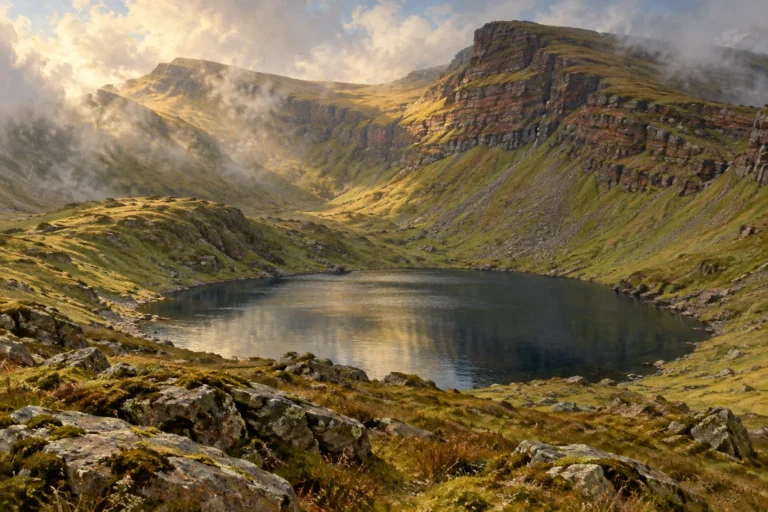
The British Geological Survey explains Llyn Cwm Llwch through glacial erosion and the moraine around its basin. This is a different kind of evidence from a narrative about a hidden island.
The island story turns hospitality into a test of restraint. The visitor is permitted to enjoy another world but not to possess it. The draining accounts shift the emphasis: people try to expose or seize what the lake conceals, and its inhabitant threatens the settled country below.
The Lady of Llyn y Fan Fach also links a Welsh lake with a conditional relationship between humans and another people. Elidyr and the Golden Ball has a breach of trust involving an object taken from an otherworld. These parallels make useful reading companions without proving that the stories share one original event.
Sources for this entry
- John Rhŷs, Celtic Folklore: Welsh and Manx, volume I. Oxford: Clarendon Press, 1901. Chapter I, pp. 20–23: Davies’s island account and Ivor James’s letter. Read source — Distinguishes the forbidden island, red-coated lake guardian and old-woman variant, with their reported sources. About this book
- W. Jenkyn Thomas, The Welsh Fairy Book. 1908. “Llyn Cwm Llwch”. Read source — Later literary sequence combining the island, draining attempt, giant and cat tradition. About this book
- W. Jenkyn Thomas, The Welsh Fairy Book. 1908. Preface. Read source — Acknowledges earlier collections and the combining of material. About this book
- Rhian Kendall, British Geological Survey, Pen y Fan, South Wales. Office Geology; consulted 18 October 2026. Llyn Cwm Llwch and its glacial setting. Read source — Geological explanation of the lake basin and surrounding moraine.
Research coverage
Rhŷs’s island quotation, Ivor James’s reported variants and Thomas’s complete literary account were examined. Davies’s original book and the original 1592 grammar were not collated. No physical fairy island, doorway or underground connection to Llyn Syfaddon is established.
The Myths · Welsh collection · Editorial approach
Further Reading