Manx coastal folklore · place
Bulgham and the Cornah Coast
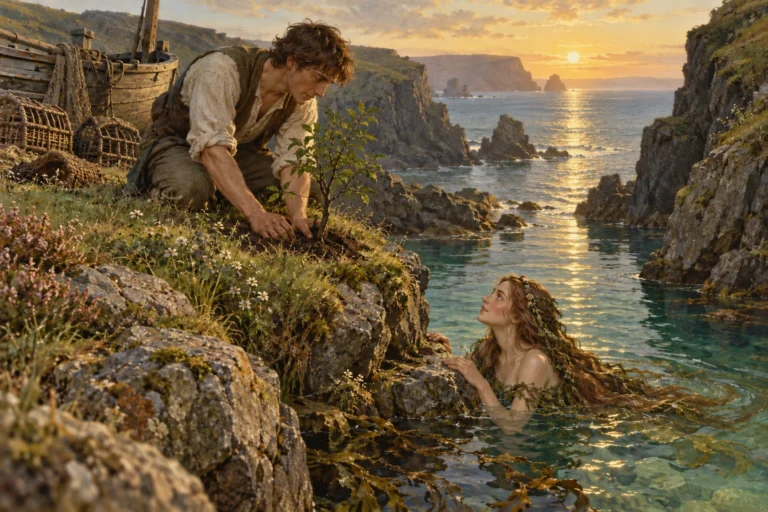
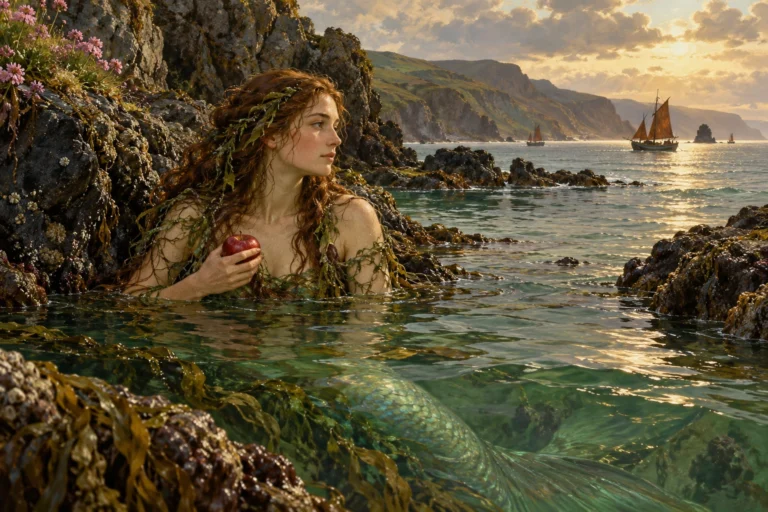
Cliffs, a fishing household and an apple tree form the landscape of Morrison’s Mermaid of Gob-ny-Ooyl.
Also found as: Gob-ny-Ooyl · Cornah gill
Research reviewed 18 October 2026.
The coast in Morrison’s telling
Sophia Morrison places the Sayle family at the bottom of Cornah gill and sends Evan to the Bulgham cliffs to look for birds’ eggs. Fishing, making osier lobster pots and keeping a few animals establish the family’s livelihood before the mermaid becomes part of it.
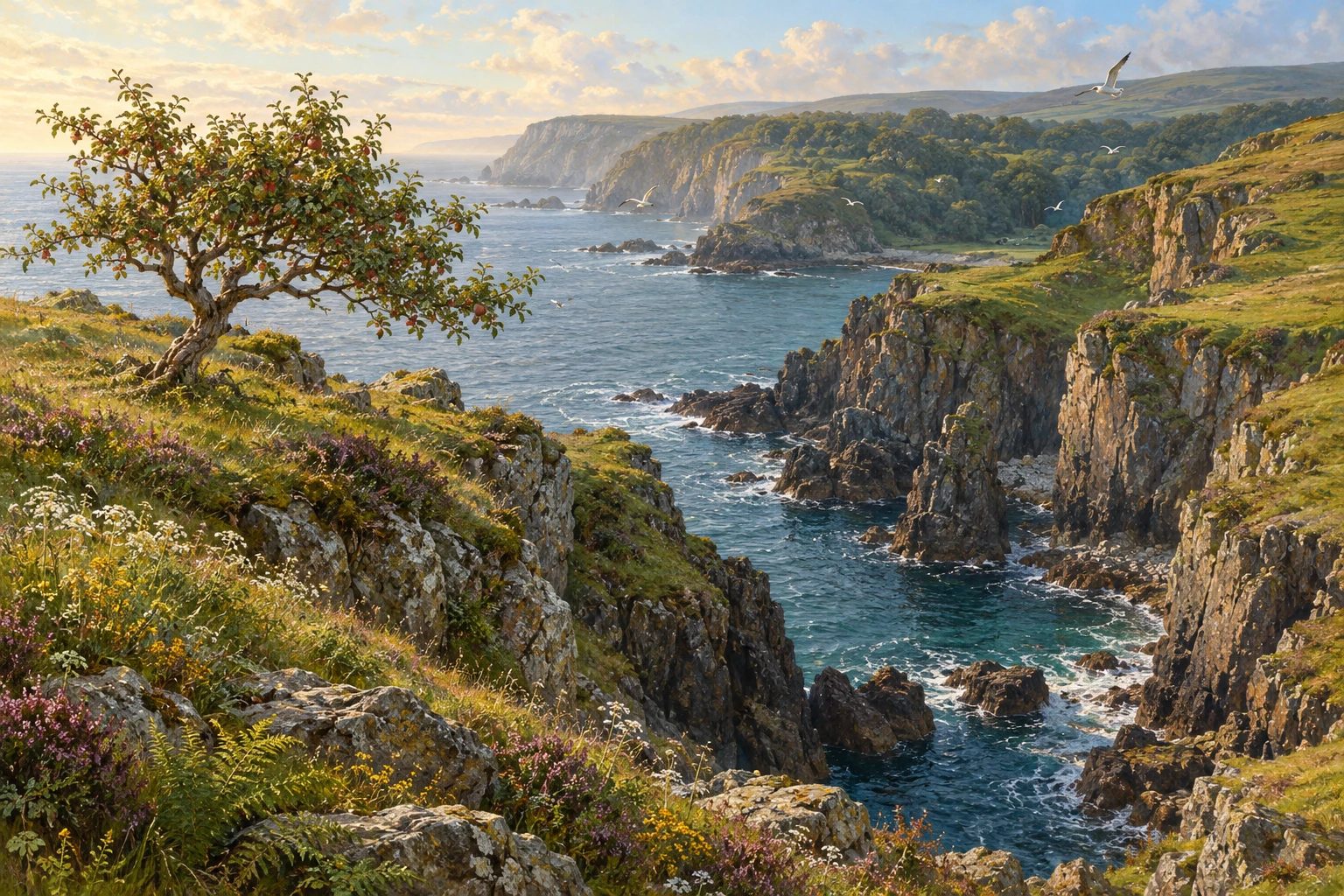
Gob-ny-Ooyl names the mermaid’s place in the story. Evan eventually plants an apple tree on the brow above her haunt, so that fruit will fall towards the water. The shore becomes a meeting place between the things a household grows and the sea on which its living depends.
The spelling Cornah is retained here from the 1911 text. This guide follows the narrative’s place references without pretending that its short description supplies an exact modern route.
A local story with a collecting history
Morrison’s account differs from the captured and vengeful mermaids printed in A. W. Moore’s collection. Those stories belong in the wider comparison, but they are not evidence for additional incidents at this creek.
Miller’s published archival note supports the broad Bulgham association, but identifies no surviving tree.
The distinction between a printed setting and a verified site is especially important in a story that leaves behind a natural marker. A narrator’s tree can give the ending a sense of permanence without becoming an object whose survival has been independently demonstrated.
What the place can tell us
The coast helps explain the tale’s imagery: birds’ eggs gathered from cliffs, apples called land eggs, pots made ashore and luck sought on the water. These connections can be read from Morrison’s text without inventing a mermaid cave or a marked historical planting spot.
No family record examined for this entry identifies Evan Sayle. No survey or botanical evidence establishes that the tale’s apple tree survives. The open ending also gives no confirmed destination for Evan or the mermaid.
The illustration is a coastal interpretation with a symbolic apple tree. It is not a photograph of Gob-ny-Ooyl and should not be used to locate the story’s creek. Historical maps, place-name work and local oral material remain the next steps for a more exact identification.
Sources for this entry
- Sophia Morrison, Manx Fairy Tales. London: David Nutt, 1911. “The Mermaid of Gob-ny-Ooyl”. Read source — The Sayle family, Evan, apples and the mermaid’s departure. About this book
- A. W. Moore, The Folk-Lore of the Isle of Man. 1891. Chapter IV, “Mermaids”: “The Captured Mermaid”, “The Mermaid’s Courtship” and “The Mermaid’s Revenge”. Read source — Different mermaid narratives with printed attributions, used as comparisons rather than variants of Evan’s story. About this book
- Stephen Miller, J. R. Moore’s Notebook of Manx Folk Songs (circa 1910). Manx Notes 196, 2014. pp. 1–2; especially Morrison’s letter of 28 September 1910 and note 8. Read source — Published letter reference; original archival document not inspected.
Research coverage
Morrison’s named landscape and Miller’s published collecting reference were examined. The exact inlet, planting place and historical family have not been established. Moore’s mermaid accounts are used only as comparisons.
The Myths · Manx collection · Editorial approach
Further Reading