Tipperary folklore · place
Slievenamon
The Tipperary mountain named as the home of the Horned Women connects a household tale with a larger legendary landscape.
Also found as: Sliabh na mBan · Slievenaman
Research reviewed 18 October 2026.
The mountain in the tale
Slievenamon is a mountain in County Tipperary. In the Horned Women, its name gives the intruders somewhere to return to. The heroine cries that their mountain is burning, and the women abandon their work in her house to hurry away.
Wilde and Jacobs call it the mountain of the Fenian women in the warning cry, then name Slievenamon when the women flee. The episode makes the distant landscape part of a domestic escape. A household can only be secured because the unwelcome visitors also have a home they fear losing.
The woman’s cottage and the helpful well are not precisely located in the examined telling. The presence of a named mountain does not allow every other part of the scene to be plotted around a modern village.
A name with several narrative connections
Jacobs’s notes connect Slievenamon with a race in which Fionn chooses a bride and identify the successful woman as Gráinne. That is a separate explanatory tradition cited by the editor. It is not an episode in the Horned Women, and it should not be merged with the pursuit of Diarmuid and Gráinne without comparing the relevant versions.
Kennedy’s “The Black Stairs on Fire” uses another mountain setting for a similar alarm. His widow and granddaughter deal with different intruders and different household objects. The comparison shows how a recognisable escape device can acquire a particular local landscape.
Campbell’s Scottish notes give Dunvuilg and Dunbhulaig forms for the same kind of cry. Some of those fairies are willing helpers; one company is driven away by an envious neighbour. A named supernatural home does not automatically make the inhabitants hostile.
What is established
The mountain is a real geographical place. Modern place information can establish that setting and its approaches, while nineteenth-century books document particular legendary associations. Neither kind of source verifies a gathering of horned spinners.
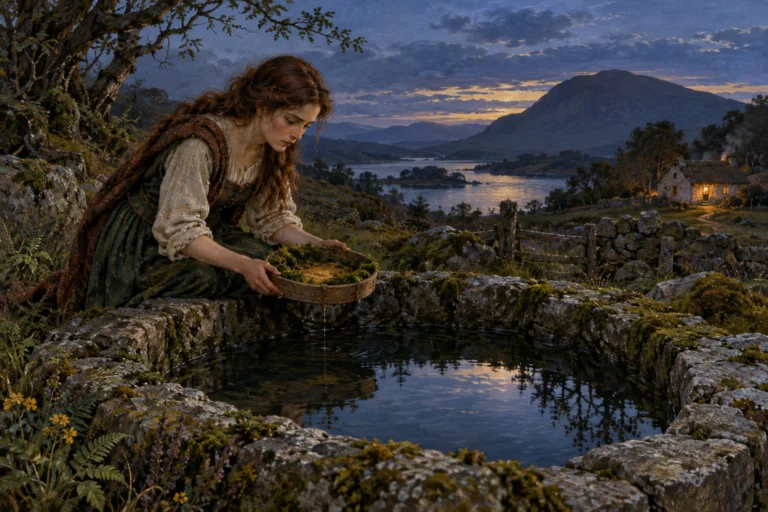
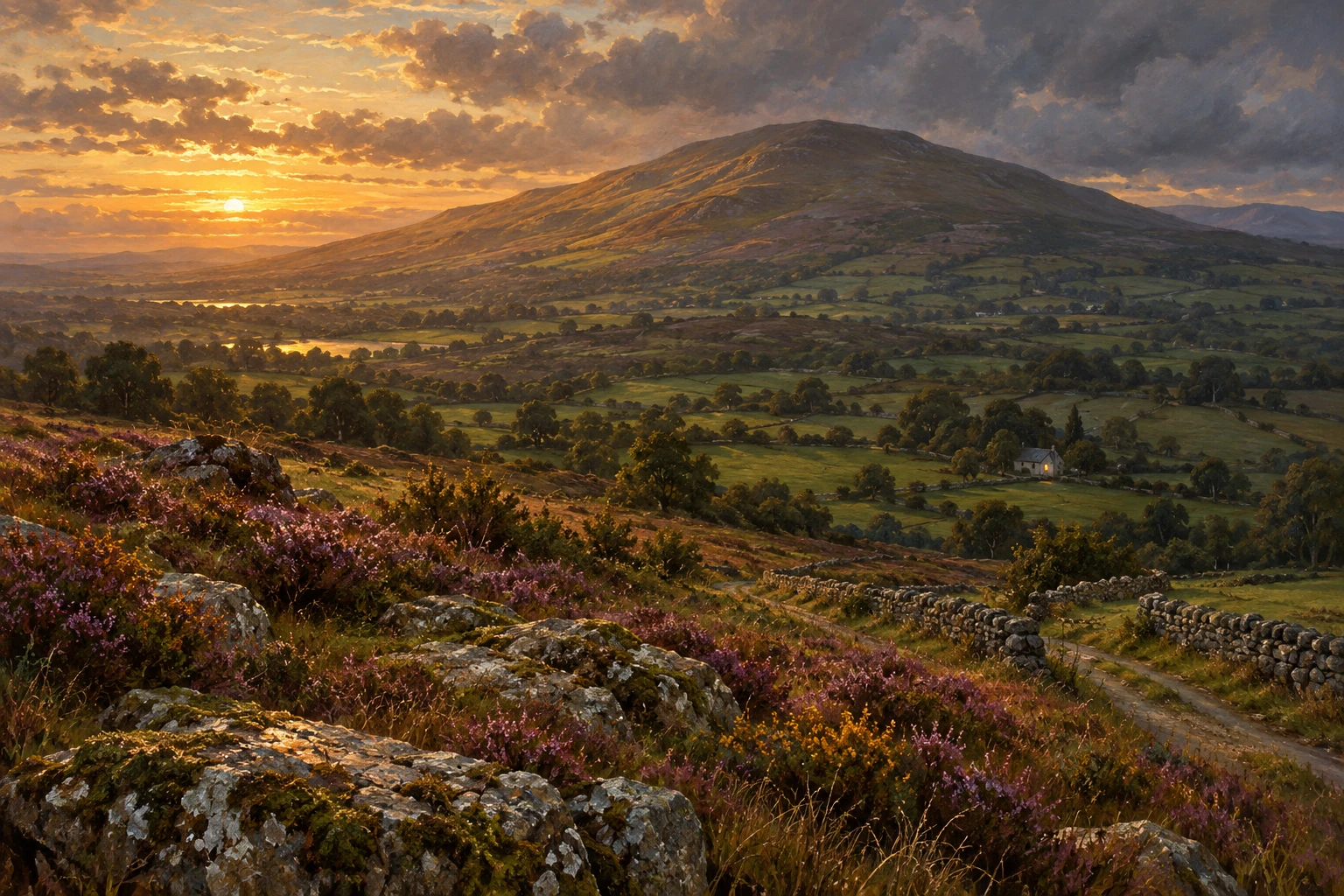
The illustration is an imagined mountain landscape. It does not identify the heroine’s well, reconstruct a historical cottage or mark a confirmed supernatural site. No archaeological interpretation of the mountain’s monuments is attempted in this entry.
The next research step is to compare locally collected Irish-language versions and separate the mountain’s Fenian traditions from its household and fairy lore. Until that is done, this guide gives named printed witnesses rather than treating one explanatory story as the origin of all the others.
Sources for this entry
- Lady Wilde, Ancient Legends, Mystic Charms & Superstitions of Ireland. First published 1887; consulted New Edition, Chatto & Windus, 1919. “The Horned Women”, pp. 10–12. Read source — Horned visitors, well helper and household defences. The narrator’s claims about the tale’s age are not established dates. About this book
- Joseph Jacobs, Celtic Fairy Tales: Notes and References. 1892. IV, “The Horned Women”. Read source — Identifies Wilde, Kennedy and Scottish comparisons; these references are not all independent tellings of the same episode. About this book
- Patrick Kennedy, Legendary Fictions of the Irish Celts. First published 1866; consulted 1891 edition transcription. “The Black Stairs on Fire”, chapter III, p. 164 onwards. Read source — An earlier printed parallel with a widow, granddaughter, speaking household objects and a different mountain. About this book
- J. F. Campbell, Popular Tales of the West Highlands, volume II. Consulted 1890 edition transcription. XXVIII, “The Smith and the Fairies”, pp. 57–65, including comparative notes. Read source — The MacEachern narrative sent by the Rev. Thomas Pattieson; Mrs MacTavish’s rescue and spinning accounts and John MacLean’s Kintyre variant. About this book
- Tipperary Tourism, Slievenamon Walk. Online place information; consulted 18 October 2026. Location and mountain approach. Read source — Modern geographical context, kept separate from the folklore.
Research coverage
The Horned Women, Jacobs’s associated note and the specified Irish and Scottish parallels were examined. Modern geographical context was checked separately. This is not a full survey of Slievenamon traditions or archaeology.
The Myths · Irish collection · Editorial approach
Further Reading