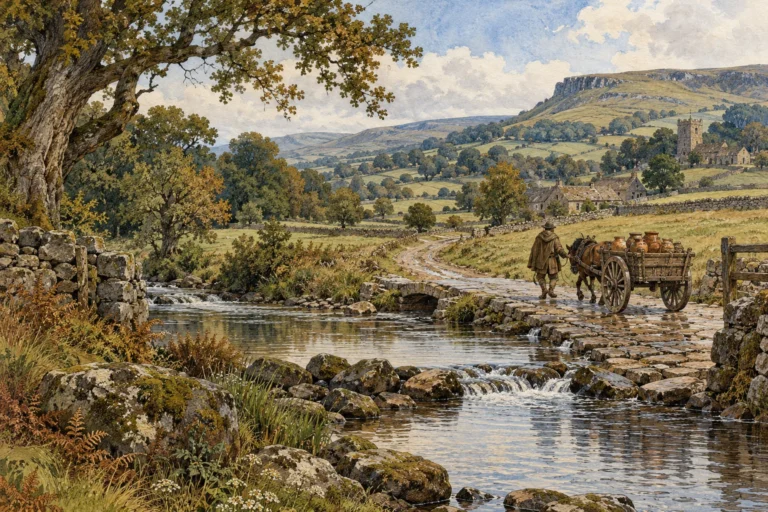
place · England
Nottingham and Robin Hood
Church, market, prison and sheriff: Nottingham supplies much more than a castle backdrop to the outlaw stories.
Also found as: Nottingham · St Mary’s Nottingham · Sheriff of Nottingham · Nottingham Castle. Research reviewed 18 October 2026.
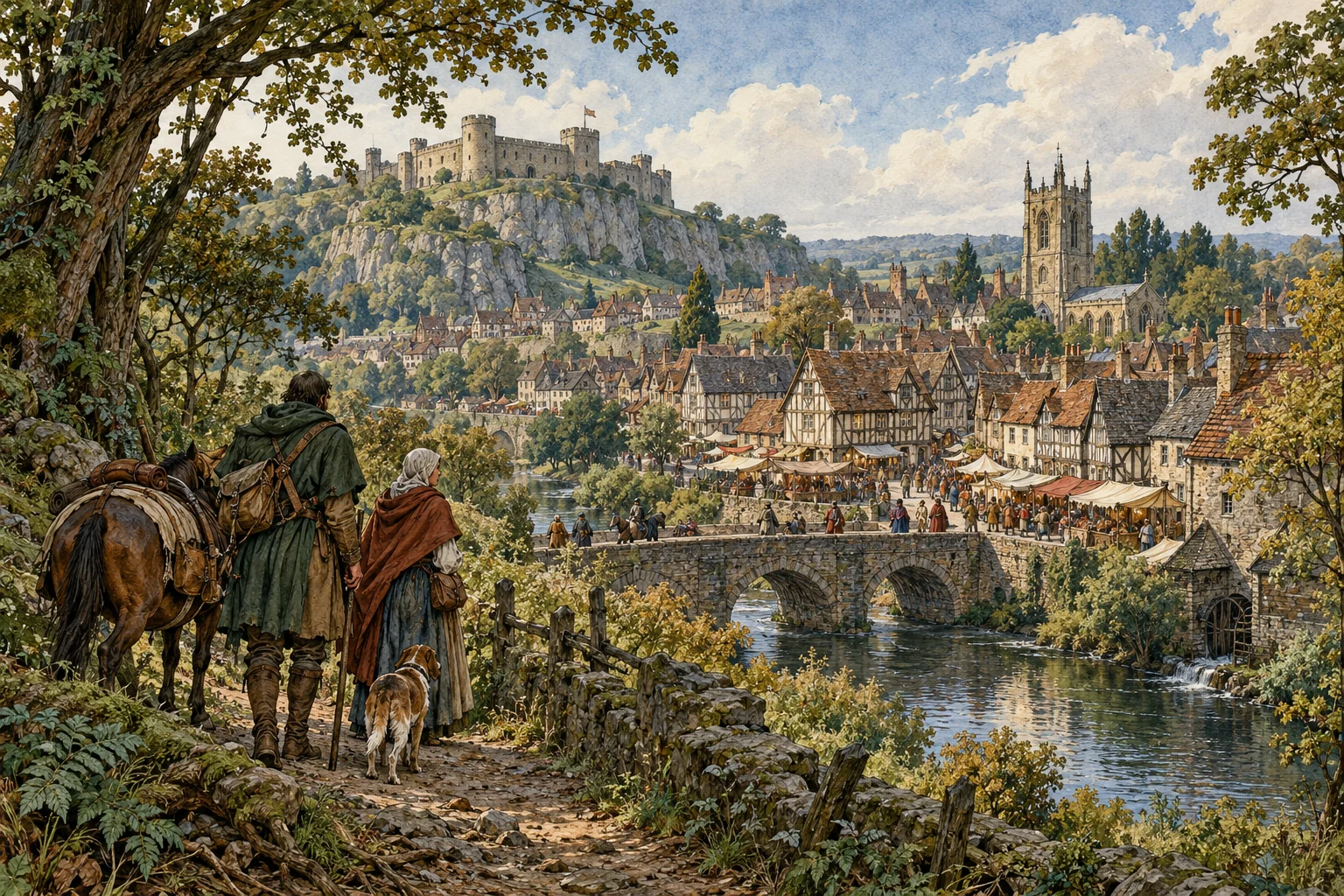
In the Monk, Robin enters Nottingham to hear mass at St Mary’s. Recognition in the church leads to capture; the rescue turns on royal authority, the sheriff’s hospitality and the keys to the prison. These are the town’s institutions seen through an outlaw adventure. Church, capture and rescue.
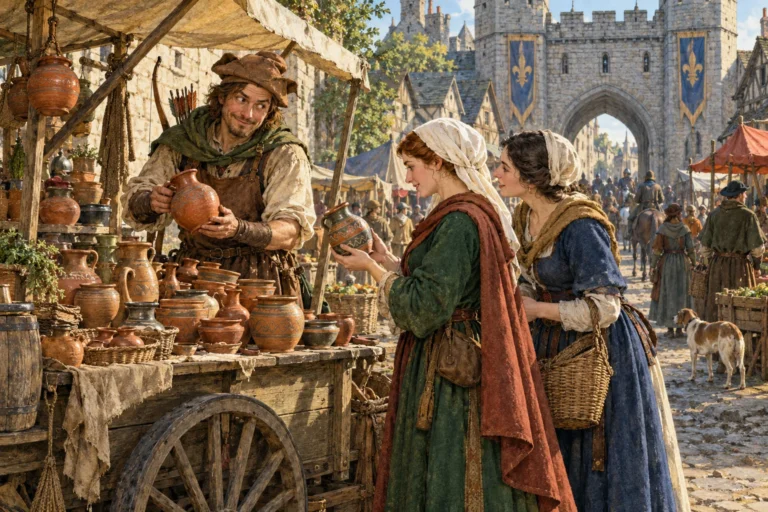
In the Potter, Nottingham becomes a market and a household. Robin sells cheap pots opposite the sheriff’s gate. The sheriff’s wife invites him to dinner, and the shooting that follows allows him to bait a trap. The humour depends on ordinary trade and courtesy as much as on archery. Market episode.
The real castle site has its own history. Nottingham City Council dates the beginning of building to 1068. That is evidence about the site, not confirmation that a particular Robin Hood duel or imprisonment happened within it. An imagined medieval castle in an illustration should not be mistaken for the present building. Council history.
Associations and distinctions
The sheriff changes with the story
The sheriff is an officer and an antagonist in these texts, not a consistently named individual. In the Potter he survives humiliated; in other Robin Hood narratives the conflict becomes deadly. Combining every sheriff episode into one documented career would erase how the tales work.
The modern city remembers
Nottingham Castle’s Robin Hood exhibition presents ballads, archery and the quarterstaff encounter as experiences for modern audiences. It is a present-day interpretation of the legend. Its inclusion of a story does not establish a medieval event at the museum site. Exhibition description.
Context and evidence
Nottingham, Sherwood and Barnsdale form an overlapping story geography. The ballads move between named places with a freedom that should not be treated as a precise itinerary.
This entry uses the published texts for the legendary associations and the council for the limited castle-history statement. It does not identify a surviving gaol room, a specific historical sheriff or the exact position of Robin’s imagined market stall.
Sources for this entry
- Francis James Child, editor, The English and Scottish Popular Ballads, volume III. Boston, Houghton, Mifflin, 1888. No. 119; stanzas 20–33 and 61–76. St Mary’s, sheriff and prison. Read source · About this book
- Francis James Child, editor, The English and Scottish Popular Ballads, volume III. Boston, Houghton, Mifflin, 1888. No. 121; stanzas 29–78. market, household and return. Read source · About this book
- Nottingham City Council, Lenton and Park walk. Web page, consulted 18 October 2026. “History: Nottingham Castle”. historical castle site, distinct from story evidence. Read source
- Nottingham Castle, Robin Hood Adventures. Web page, consulted 18 October 2026. Exhibition description. present-day interpretation of ballads and archery/quarterstaff stories. Read source
Research coverage
The named texts and selected editorial notes have been examined. This entry does not claim to collate every manuscript, broadside, oral performance or modern adaptation.
The Myths · Robin Hood collection · Editorial approach
Further Reading