Midwives and supernatural sight · story
Fairy ointment
A nurse discovers that a salve can reveal a hidden household. What she sees afterwards makes that knowledge dangerous.
Also found as: Dame Goody · Morada and the fairy prince
Research reviewed 18 October 2026.
Read the story
The midnight summons
This retelling follows Joseph Jacobs’s Dame Goody version. The separate Morada narrative is compared below.
Dame Goody was a nurse who cared for mothers and babies. Late one night, a small, squinting man arrived on a black horse and asked her to attend his wife. He took her to a cottage where a woman lay with a newborn child.
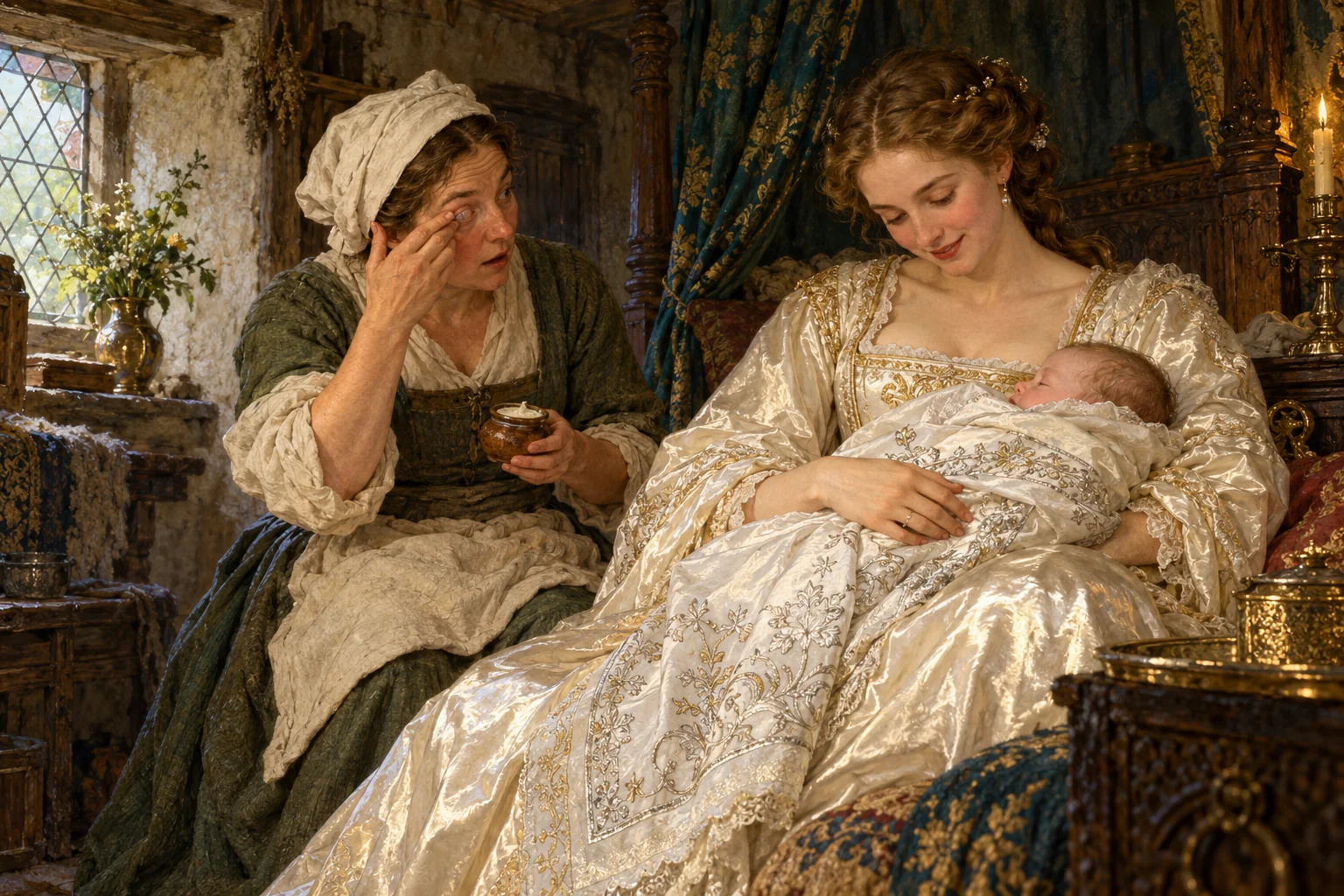
The nurse was given ointment for the baby’s eyes. Curious about what it did, she touched a little to her own right eye. At once the room appeared transformed. The mother wore white silk, the child was wrapped in splendid silver clothing, and what had looked plain revealed unexpected richness. The other children seemed troublesome little imps.
She finished her work, received more money than she usually earned, and was taken home. She kept her new sight to herself.
At the market
On market day she recognised the father moving among the stalls. He was helping himself to food without paying, apparently invisible to everyone else. She greeted him.
He was startled that she could see him. Which eye was she using? When she told him it was the right, he struck it. The story ends with that eye blinded for life. The ointment had revealed what she was not meant to see; meeting its owner in daylight brought the consequence.
Versions and variations
Jacobs and his acknowledged changes
Jacobs’s note traces his story to Mrs Bray’s Tamar and Tavy material through E. Sidney Hartland. He says that he supplied the name Dame Goody and altered how the woman’s profession was described. Her name should therefore not be treated as an independently documented historical person.
Morada near Holne: a different Devon account
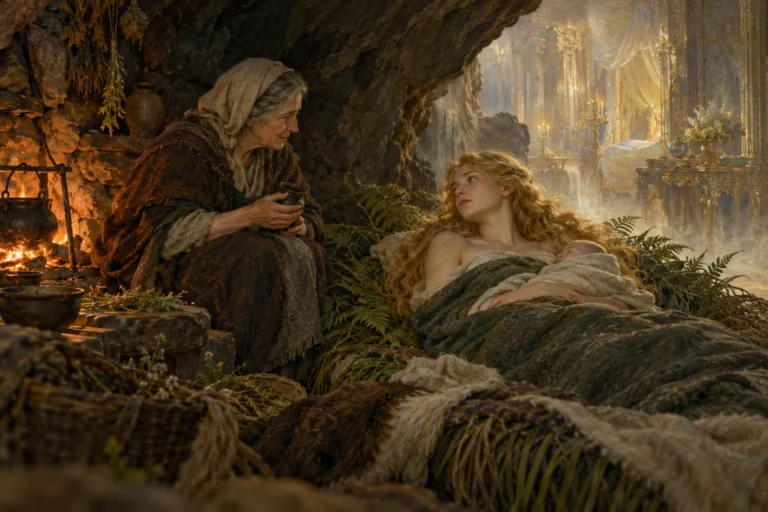
Baring-Gould prints a narrative supplied through T. W. Whiteway from Nurse Warren’s grandmother. Its midwife is Morada. A handsome young fairy prince takes her blindfolded to his wife, who is spending a period of exile on Dartmoor after an unequal marriage. The account explicitly distinguishes these fairies from pixies.
The eye, the meeting and the payment change
Morada accidentally retains the pot and tries it at home on her left eye. She later meets the prince on the road while travelling towards Ashburton, rather than recognising a thief in a market. He takes away the sight, apologises and gives further money in gratitude for her care of his wife. This is not Jacobs’s abrupt punishment for exposing market theft.
Context and evidence
Both narratives connect practical nursing work with access to a hidden household, and both make altered sight costly. Yet their fairy fathers behave differently, and the exact reason for the final encounter changes. The comparison is stronger when those distinctions remain intact.
Neither narrative establishes a medical effect of an actual salve. These are stories about perception and forbidden knowledge. Mrs Bray’s original text and the intermediary Hartland passage have not been separately collated here; Jacobs’s description of that chain is labelled as his evidence.
Sources for this entry
- Joseph Jacobs, English Fairy Tales. First published 1890; later revised impression transcribed at Wikisource. XL, “Fairy Ointment”. Read source — Complete Dame Goody telling. About this book
- Joseph Jacobs, English Fairy Tales. First published 1890; later revised impression transcribed at Wikisource. Notes and References, XL. Read source — Acknowledges Mrs Bray through Hartland and Jacobs’s own changes to the midwife’s name and description. About this book
- Sabine Baring-Gould, A Book of the West, volume I: Devon. London: Methuen, 1899. Dartmoor fairy account, Morada near Holne, pp.187–193. Read source — A different named midwife narrative, attributed through T. W. Whiteway to Nurse Warren. About this book
Research coverage
The passages named below have been read and compared. This entry does not claim to include every oral performance, manuscript witness or modern adaptation; unexamined leads are identified separately.
The Myths · English collection · Editorial approach
Further Reading