Local folklore · story
The Hedley Kow
A woman finds a pot of gold which keeps changing into less valuable things. The trickster can alter the treasure, but struggles to spoil her delight.
Also found as: Hedley bogie · Hedley Cow
Research reviewed 17 October 2026.
Read the story
This retelling follows Jacobs’s More English Fairy Tales (1894). Henderson’s different Hedley episodes are set out below.
An old woman who earned small favours by helping her neighbours was walking home one summer evening when she found a pot beside the road. No owner was in sight. She looked inside and found it full of gold. It seemed more wealth than she could ever need.
The pot was heavy, so she wrapped her shawl around it and dragged it behind her. After a while she stopped to rest and looked again. The gold had become silver. Instead of grieving, she considered what a relief it was: silver would bring plenty of comfort and much less worry about thieves.
On she went. At the next pause the load was iron. That too could be useful. She could sell it and still have more than she had possessed when she began her walk. Another look revealed a large stone. Even now she found something to welcome: it would make a fine doorstop.
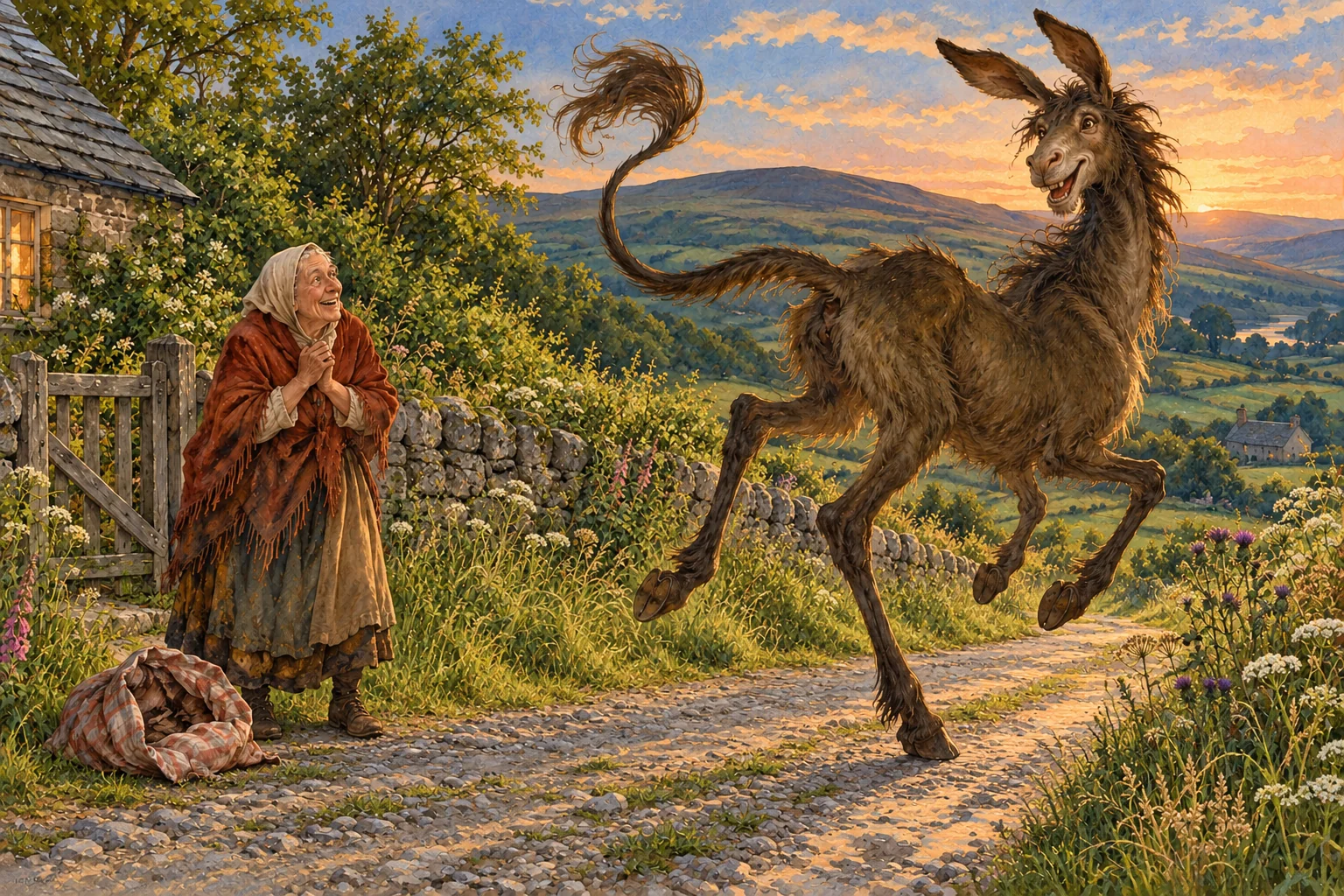
By the time she reached home she was pleased with the whole adventure. She turned towards her burden at the gate. The stone began to move and grow. It became a great horse-like creature, with long legs, ears and tail, laughing as it sprang away.
The woman recognised the Hedley Kow. Instead of mourning the gold, silver, iron or stone, she delighted in having seen the famous creature itself. Other people would have much to say about it, but she had met it. The shape-changer had carried out its trick; it had not persuaded her that she was unfortunate.
Versions and variations
The reported oral chain behind Jacobs
Jacobs’s note names Mrs Balfour as his source and says she received the tale from Mrs M. in South Northumberland. Mrs M. attributed it to her mother, who had told it about somebody known in her youth. Jacobs also reports Mrs M.’s claims to have seen the Kow as a donkey and a wisp of straw. These are the book’s stated lines of transmission, not independently checked sightings.
Henderson’s straw and animal episodes
Henderson describes an old woman who picks up a truss of straw. It grows unbearably heavy, then comes alive and moves off laughing. He also gives a false horse which escapes Forster’s harness, a cow which frustrates milking, and deceptive appearances that lure two young men into a bog. These are associated Hedley Kow narratives, not full alternative versions of Jacobs’s descending sequence of treasures.
What changes between the texts
Henderson’s victims are mocked and inconvenienced. Jacobs’s woman repeatedly turns apparent loss into advantage. The comic force moves from the creature’s success to the human response. The tale need not be presented as a lesson that material hardship is harmless in order to appreciate that reversal.
Context and evidence
The Kow is a shape-changing bogie in these accounts, not simply an enchanted cow. Henderson connects it with Hedley near Ebchester and with neighbouring routes and the Derwent. That geography belongs beside the source history, while the identity of Jacobs’s unnamed woman remains unestablished.
Compare the Pwca of Trwyn’s unusual journeys and the domestic mischief of the Cauld Lad. Similar actions do not make them the same local character. Jacobs himself places the Hedley account beside Henderson’s material, so a citation should preserve that comparison rather than claim that Henderson contains the whole gold-pot story.
Sources for this entry
- Joseph Jacobs, More English Fairy Tales. New York: G. P. Putnam’s Sons; London: D. Nutt, 1894. “The Hedley Kow”. Read source — Main narrative: a succession of apparent losses which the woman interprets as good fortune. About this book
- Joseph Jacobs, More English Fairy Tales. New York: G. P. Putnam’s Sons; London: D. Nutt, 1894. Notes and References, “The Hedley Kow”. Read source — Records Mrs Balfour’s intermediary role, Mrs M.’s family account and a comparison with Henderson’s 1866 edition. About this book
- William Henderson, Notes on the Folk-Lore of the Northern Counties of England and the Borders. New edition, London: Folk-Lore Society, 1879. Chapter VII, Hedley Kow passages beginning “The Hedley Kow was a bogie”. Read source — Straw, animal and misleading-appearance narratives, distinct from Jacobs’s treasure sequence. About this book
Research coverage
The complete Jacobs tale and its source note, and Henderson’s full Hedley Kow group in the 1879 edition, were examined. Jacobs cites Henderson’s 1866 pages in his note; this entry does not pretend that those pages are the pagination of the 1879 edition. Balfour’s underlying notes and later oral accounts have not been collated.
The Myths · English collection · Editorial approach
Further Reading