Norfolk treasure legends · story
The Pedlar of Swaffham
A Norfolk pedlar follows a dream to London Bridge, only to hear a stranger laugh at dreams. The stranger’s own story sends him home to a treasure beneath his feet.
Also found as: The Swaffham pedlar · John Chapman’s dream
Research reviewed 18 October 2026.
Read the story
This retelling follows the shorter version in Joseph Jacobs’s More English Fairy Tales. The fuller two-pot narrative and evidence concerning John Chapman appear below.
A poor pedlar lived at Swaffham with little to show for his journeys. He carried his wares from place to place, his dog beside him, but could scarcely earn enough to live. One night he dreamed that he should go to London Bridge, where he would hear joyful news.
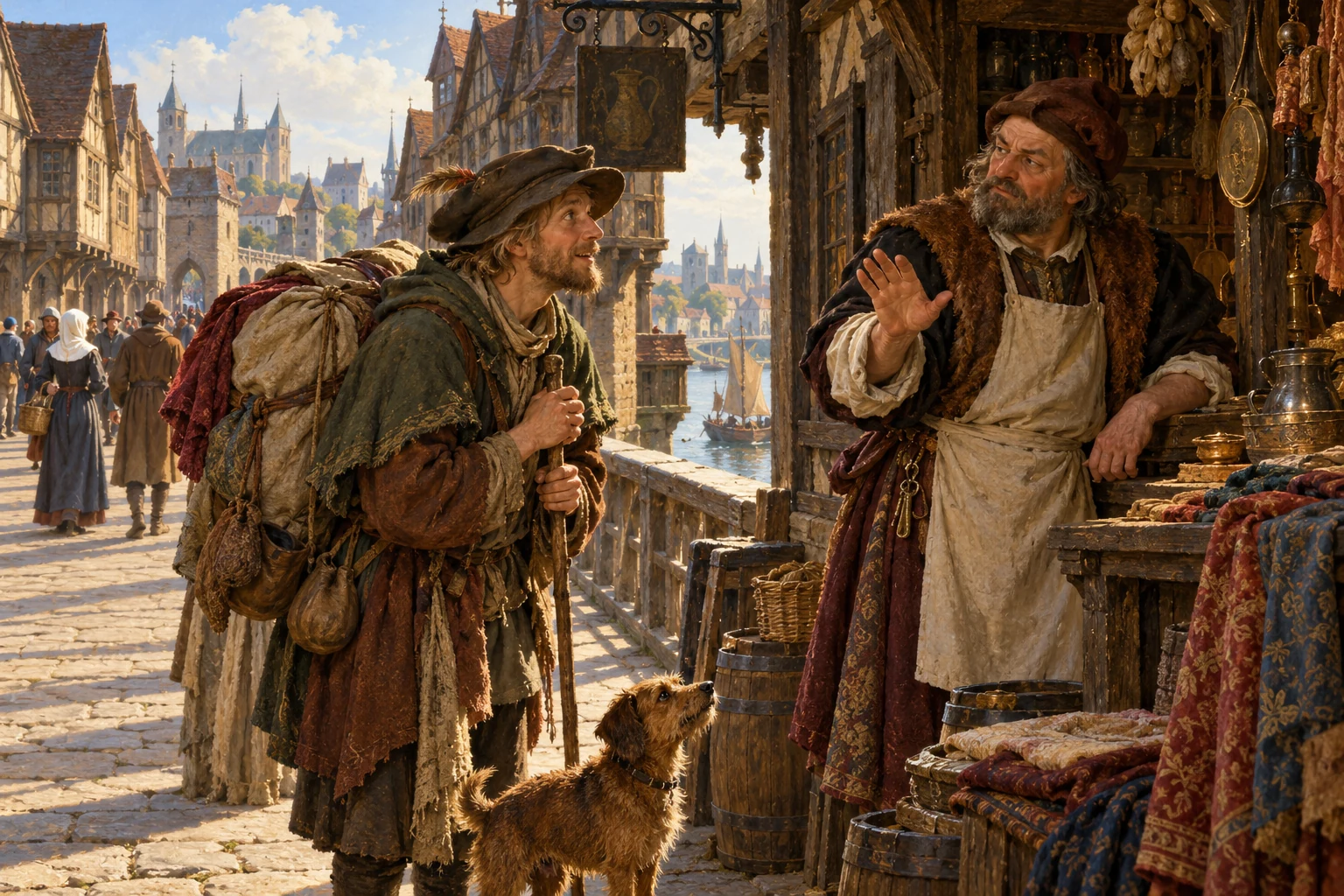
He thought little of it at first. When the dream came a second time, and then a third, he decided to make the journey. He reached the bridge with its crowded shops and waited for the promised news.
Nothing happened on the first day. Nothing happened on the second. On the third, a shopkeeper who had noticed him standing about asked what he wanted. The pedlar admitted that a dream had brought him there.
The shopkeeper laughed. Dreams were no reason to travel. He himself had dreamed of a treasure buried beneath a great oak in an orchard behind a pedlar’s house at a place called Swaffham. It would be ridiculous to go all that way looking for it.
The pedlar listened carefully. He did not explain why the news pleased him. Instead he thanked the stranger and went back to Norfolk, where he dug beneath the tree and found the treasure.
The money transformed his life. In this telling he used his wealth to rebuild the church. The narrator ends by pointing to an image of the pedlar with his pack and dog, a memorial which seems to bring the traveller’s good fortune into the town’s visible history.
Versions and variations
Jacobs, Nutt and de la Pryme
Jacobs’s note says Alfred Nutt rewrote the story from Abraham de la Pryme’s diary entry of 10 November 1699. That diary manuscript has not been examined for this entry. The directly consulted text is the 1894 retelling, with its three dreams, repeated waiting and single treasure discovery. The pedlar is not named in the main narrative.
John Chapman and two pots of money
The Norfolk county history prints a longer account within a letter from William Dugdale to Roger Twysden dated 29 January 1652–3. The shopkeeper’s dream identifies John Chapman by name. The pedlar finds a pot of money and keeps the vessel among his household brass. A visitor later translates its Latin inscription, which says that another pot below it is twice as good. Chapman returns to the digging place and finds the second hoard.
In this version the church gift is also more specific. Chapman keeps his new wealth quiet, asks about the cost of a proposed north aisle, then offers to pay for it and a tall steeple. This differs from the simpler assertion that the poor traveller rebuilt the church. The extra pot, inscription and concealed wealth form a substantial alternative ending.
What sort of memorial?
Jacobs’s story speaks of a stone image. The county history discusses carved woodwork and glass, then questions how the figures should be interpreted. It proposes that a pedlar might be a rebus on the surname Chapman, meaning a trader or dealer. It even questions whether an accompanying animal was understood correctly. These antiquarian arguments are interpretations of objects, not a settled demonstration of how the legend began.
Jacobs also lists stories from elsewhere with a similar dream-and-treasure pattern. Those references are valuable research leads, but his confident theory about the tale’s eastern origin is not treated here as a proven history of transmission.
Was there a real John Chapman?
The parish identifies Chapman as a churchwarden during the rebuilding of the church. The older county history likewise treats his benefaction as historical while doubting the dream explanation. A real donor and a traditional treasure story can coexist without every detail of one verifying the other.
The joke depends on two different responses to the same kind of dream. The shopkeeper refuses to act on his, yet his dismissal gives the traveller precisely the information he needs. The treasure is at home, but the journey supplies the knowledge that makes home newly valuable.
Neither the examined church account nor the antiquarian text establishes a recovered hoard, a verified orchard tree or a contemporary record of Chapman dreaming on London Bridge. The linked figure guide keeps those gaps separate from the evidence for his place in the town’s memory.
Sources for this entry
- Joseph Jacobs, More English Fairy Tales. 1894. LXIII, “The Pedlar of Swaffham”, and its source note. Read source — Retelling credited to Alfred Nutt from de la Pryme’s diary; compared with the longer Norfolk account. About this book
- Francis Blomefield, continued by Charles Parkin, An Essay Towards a Topographical History of the County of Norfolk, volume VI. London: William Miller, 1807. Swaffham, especially pp. 211–213: Chapman, Dugdale’s letter and the church carvings. Read source — Printed account of two treasure pots, historical benefaction and competing interpretations of the carvings. Original archival documents were not inspected. About this book
- Swaffham Parish Church, Our Heritage. Parish account; consulted 18 October 2026. Church rebuilding and John Chapman. Read source — The parish’s account of its building and carvings; not evidence for dream-directed treasure.
Research coverage
The 1894 retelling and its note were compared with the printed Swaffham passage in the 1807 county history and the parish’s heritage account. The original de la Pryme diary, Dugdale letter and parish documents were not directly inspected. International parallels await their own source comparisons.
The Myths · English collection · Editorial approach
Further Reading