Northumbrian transformation legends · story
The Laidly Worm of Spindleston Heugh
A jealous queen turns Princess Margaret into a ravenous worm. Her brother reaches the Northumberland coast ready for battle, but rescuing her requires him to put his weapons aside.
Also found as: The Laidley Worm · The Loathly Worm · Margaret and Childe Wynd · The Laidley Worm of Spindleston Heughs
Research reviewed 17 October 2026.
Read the story
An original retelling of Joseph Jacobs’s prose account in English Fairy Tales. Jacobs adapted the ballad associated with the Rev. Robert Lamb and added material from the related Kempion tradition; the comparisons below keep those layers visible.
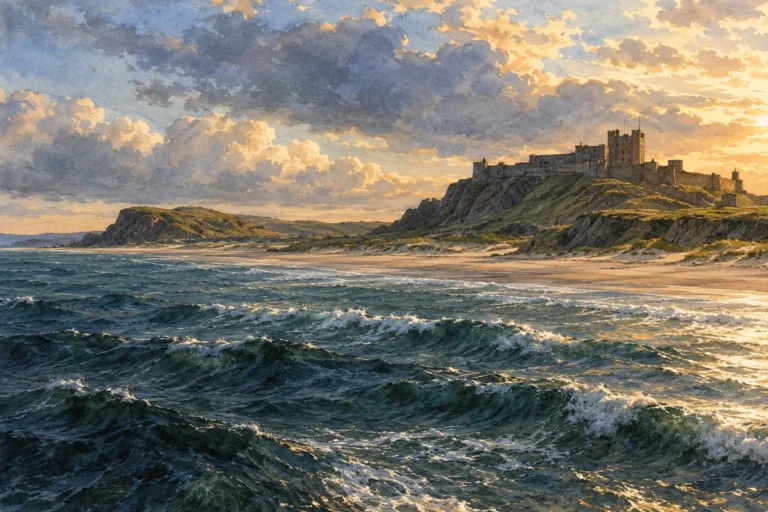
At Bamburgh Castle, Princess Margaret kept her father’s household after her mother died. Her brother, Childe Wynd, had gone abroad to seek his fortune. For a long time the king mourned his wife. Then, while hunting, he met a beautiful woman and resolved to marry again.
Margaret was unhappy at the thought of another queen taking her mother’s place, but she prepared a welcome. When the procession reached the castle, she stood at the gate with the keys, bowed before her father and offered them to his new wife. Everything within, she said, was now the queen’s.
One of the accompanying knights praised Margaret’s beauty. The queen heard a comparison she could not bear. She answered sharply that he ought to have excepted her, and decided that the princess would not remain beautiful for long.
That night she descended to a secluded dungeon and worked her witchcraft. Margaret was to become a monstrous worm, unable to recover her human shape until Childe Wynd returned and kissed her three times.
Morning brought screams from the princess’s chamber. The women who came to dress her found a dragon coiled on the bed. They fled as it unfolded itself. Margaret crawled from the castle towards Spindleston Heugh, where she curled around the rock and raised her terrible head.
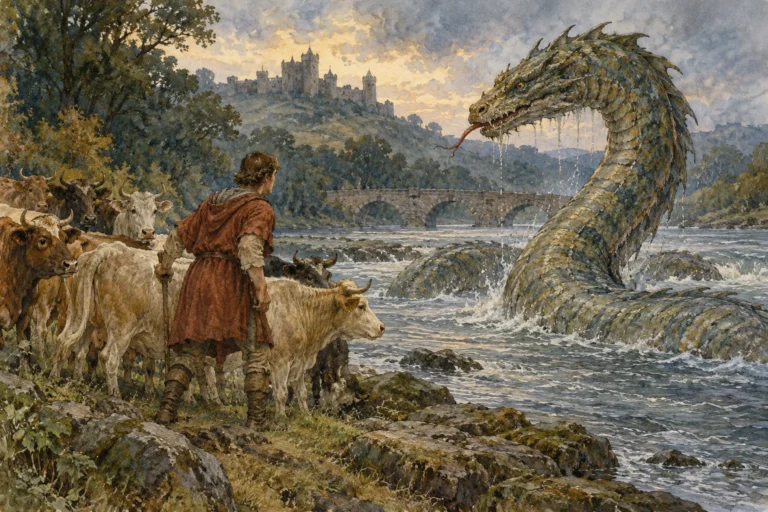
Hunger drove her out again. Soon the surrounding country lived in fear of the creature devouring whatever it encountered. At last the people consulted a warlock. He studied his books, consulted his familiar spirit and told them who the worm really was.
They must set aside seven cows, he said. At sunset, every drop of their milk must be taken to the stone trough beneath the Heugh. That would feed the worm and spare the countryside. To restore Margaret, however, they must send overseas for her brother.
The milk quietened the monster. The message brought Childe Wynd and thirty-three companions to work building a ship. Its keel was made of rowan. When they rowed towards Bamburgh, the queen sensed the danger and sent her imps to raise storms or bore through the hull. They returned defeated: the rowan wood prevented their magic from harming it. Jacobs, The Laidly Worm, enchantment and voyage.
She ordered armed men to resist a landing. Then she forced the worm itself to guard the harbour. As Wynd’s ship approached, Margaret’s monstrous body drove it away. The rowers made another attempt, and another, but three times the worm thrust them back from the shore.
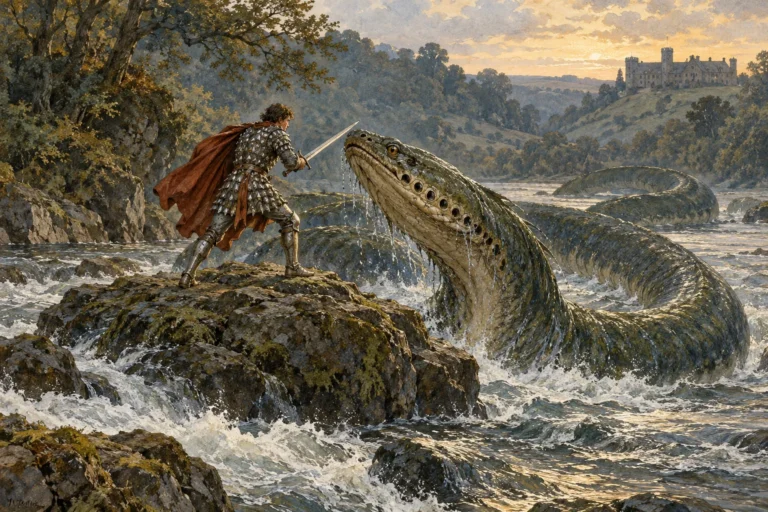
Wynd turned the ship. The queen believed he had abandoned the rescue. Instead he rounded the next point and landed at the creek beyond. With sword drawn and bow ready, he hurried towards the creature that had blocked his return.
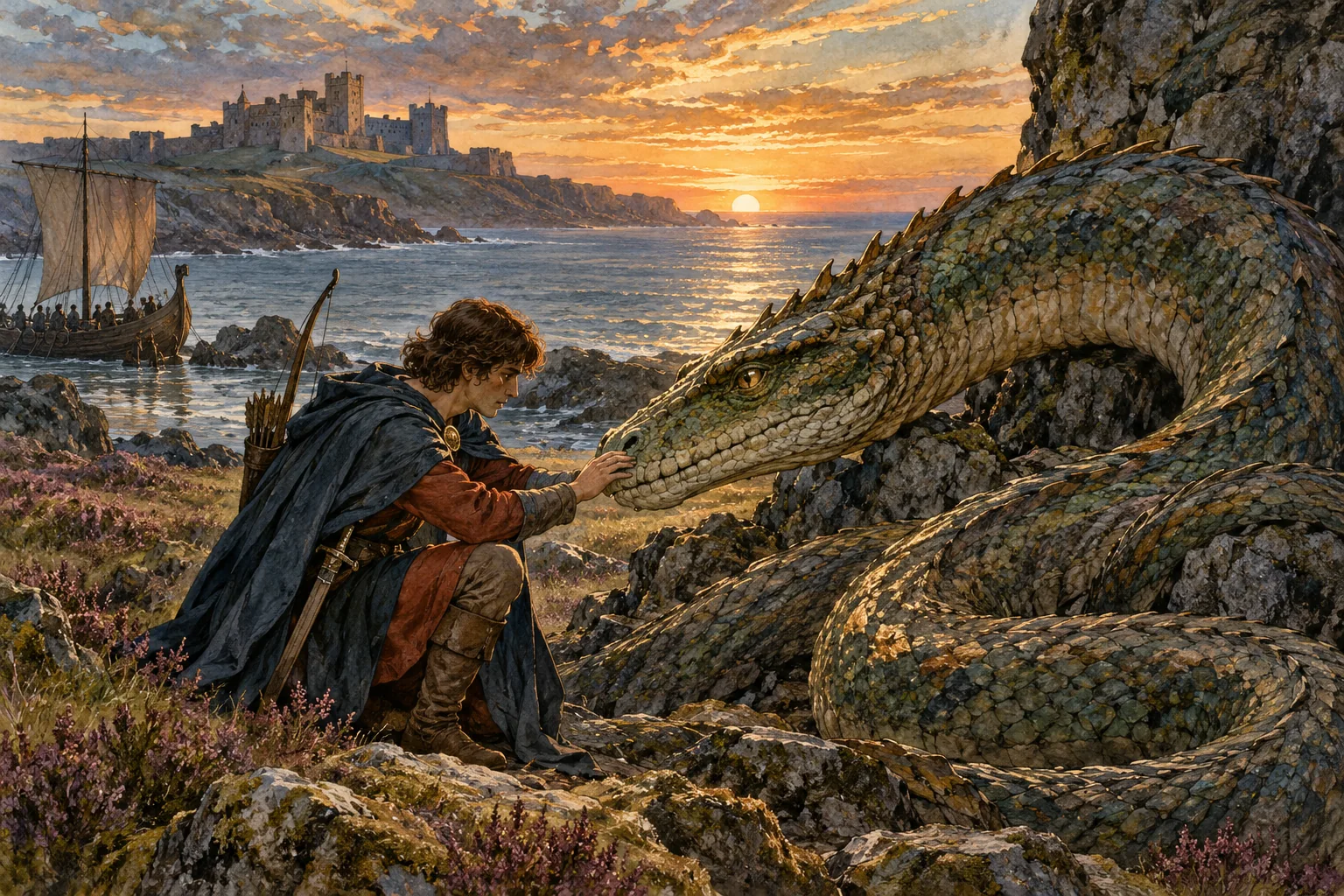
His arrival on land had broken the queen’s command over the worm. It did not attack. As he raised his weapon, his sister’s voice came from its jaws, asking him to put down the sword, relax the bow and give her three kisses.
He hesitated. What if the voice itself was a trick? Margaret asked again. Sunset was approaching; if she was not released before it, she would remain a worm.
He kissed her once. Nothing changed. A second kiss left the terrible shape before him. He kissed her a third time, and the worm reared with a hiss and roar. His sister stood where it had been. Wynd wrapped her in his cloak and took her home.
The queen waited alone in her chamber. Wynd touched her with a rowan twig, and she shrank into a huge, ugly toad. Hissing and croaking, she hopped down the castle steps.
In Jacobs’s ending, Wynd takes his father’s place as king and Margaret is restored to her home. The tale leaves the queen outside that happiness: whenever an uncanny toad appears near the castle, the storyteller says, it is the witch whose own spell has returned upon her. Jacobs, landing, three kisses and ending.
Versions and variations
A ballad with a named literary maker. Child prints Lamb’s Laidley Worm from Hutchinson’s 1778 View of Northumberland. He rejects the accompanying claim that it was a medieval song by Duncan Frasier, judging nearly all its lines to be Lamb’s composition while allowing older tradition and fragments behind it. Child also reports a similar Berwickshire recitation in Kinloch’s manuscript; resemblance to print does not itself establish independent transmission. Jacobs expressly used Lamb through Child, with touches from Kempion. Child, No. 34, pp. 306–313; Jacobs, note XXXIII.
Hunger, wood and rescue. Lamb’s stanza 10 makes the worm’s venom destroy vegetation for seven miles in each direction. Jacobs instead develops destructive hunger and introduces the warlock who prescribes milk from seven cows. Lamb equips the ship with rowan masts and sends witch-wives against it; Jacobs gives it a rowan keel and hostile imps. In Lamb, Margaret enters a hole and emerges human after the kisses. Jacobs stages an immediate transformation with a hiss and roar. These are differences within an acknowledged adaptation, not evidence of two historical rescues.
The queen’s fate also changes. In Lamb, Wynd curses her into a toad with words; Jacobs adds a rowan twig. Lamb reunites the children with their living father, whereas Jacobs explicitly makes Wynd king. Both leave the toad haunting Bamburgh.
A further ending, separately reported. Child quotes Kinloch’s prose tradition in which the queen occupies a cavern that opens every seven years on Christmas Eve. A rescuer must perform actions with Wynd’s sword and horn, then kiss the toad three times. One attempt fails at the last kiss. This offers the guilty queen a possible release absent from Lamb’s permanent sentence. We have examined Child’s quotation, not Kinloch’s manuscript.
Context and evidence
This is a dragon story in which killing the dragon would kill the person who needs rescuing. Margaret’s body threatens her neighbours, but the moral responsibility rests with the queen who transformed her. Feeding the worm creates time for recognition and recovery. The brother’s decisive act is an embrace of the frightening creature rather than a sword stroke. Read English dragons and worms for the contrast with Lambton and Wantley. The Bamburgh and Spindlestone guide follows the named landscape while distinguishing its actual monuments from the ballad’s imagined royal household.
Sources for this entry
- Joseph Jacobs, English Fairy Tales. First published London: David Nutt, 1890. Narrative and note examined in Project Gutenberg eBook 7439; this transcription does not identify its print impression.. 'The Laidly Worm of Spindleston Heugh'; Notes and References XXXIII, 'The Laidly Worm'; preface.. Read source — Directly examined prose adaptation used as the stated base for the retelling. Jacobs credits Lamb through Child and additional touches from Kempion. About this book
- Francis James Child, editor; ballad communicated by the Rev. Robert Lamb, The English and Scottish Popular Ballads, Volume I. Original Volume I, Part II, Boston and New York: Houghton, Mifflin and Company, 1884; examined in the unaltered Dover republication, New York, 1965, transcribed by Project Gutenberg.. No. 34, 'Kemp Owyne', discussion pp. 306–308; appendix 'The Laidley Worm of Spindleston Heughs', pp. 311–313, especially stanzas 1–39 and Kinloch prose tradition.. Read source — Directly examined Lamb ballad and Child's provenance discussion. Child reprints William Hutchinson, A View of Northumberland (1778), II, pp. 162–164; the Hutchinson volume and Kinloch manuscript were not separately inspected. About this book
- William Henderson, Notes on the Folk-Lore of the Northern Counties of England and the Borders. New edition, with many additional notes. London: published for the Folk-Lore Society by W. Satchell, Peyton and Co., 1879; first edition 1866.. Chapter VIII, 'Worms or Dragons', Lambton Worm account, beginning 'The Lambton Worm, partly from the romantic character of its history', through the reported relics; following Laidley Worm account.. Read source — Directly examined collector's narrative. Henderson explicitly borrows the Lambton account from Cuthbert Sharpe's Bishoprick Garland; his family recollection of belief in the curse is a separately identified addition. About this book
Research coverage
Jacobs's full prose account, its source note, Lamb's full 39-stanza ballad as reprinted by Child, Child's editorial account and quoted Kinloch sequel examined; Henderson's related summary checked. The underlying Hutchinson print, Kinloch manuscript and a full audit of Kemp Owyne/Kempion recensions remain further work. The fabricated medieval attribution is not accepted as a date.
The Myths · English collection · Editorial approach
Further Reading