English folklore · figure
English Dragons and Worms
A guide to three northern dragon traditions: the Lambton monster, the enchanted Princess Margaret and the comic Dragon of Wantley. Similar bodies and motifs conceal very different stories.
Also found as: Northern English worms · English dragon legends · Loathly worms
Research reviewed 17 October 2026.
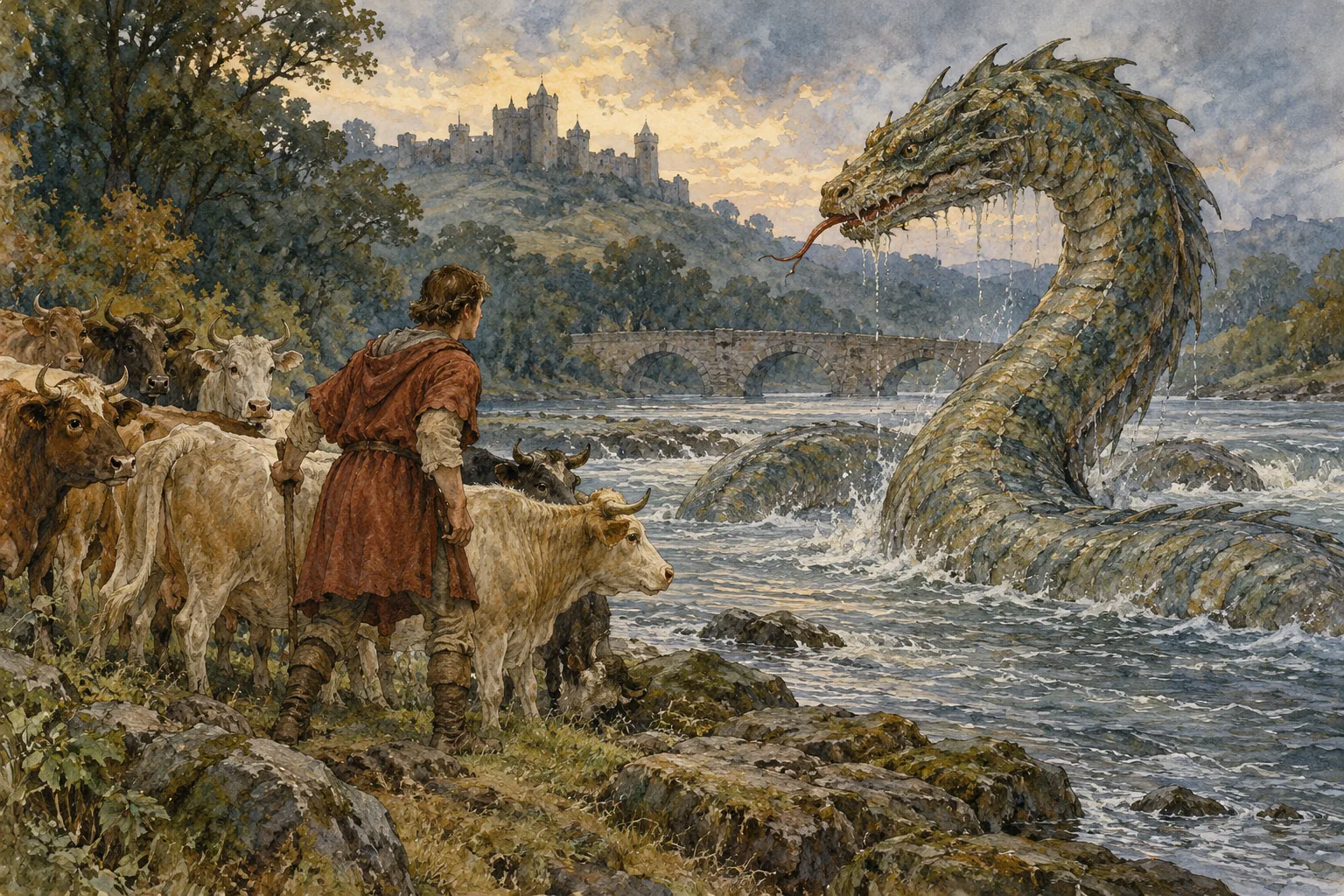
A dragon is not always an enemy to kill. In the three northern English traditions gathered here, one creature carries the consequences of a young man’s carelessness, another is an innocent woman under a spell, and a third is an enormous comic antagonist. Calling all three dragons helps readers compare them. It does not mean that their storytellers imagined a single species with fixed rules.
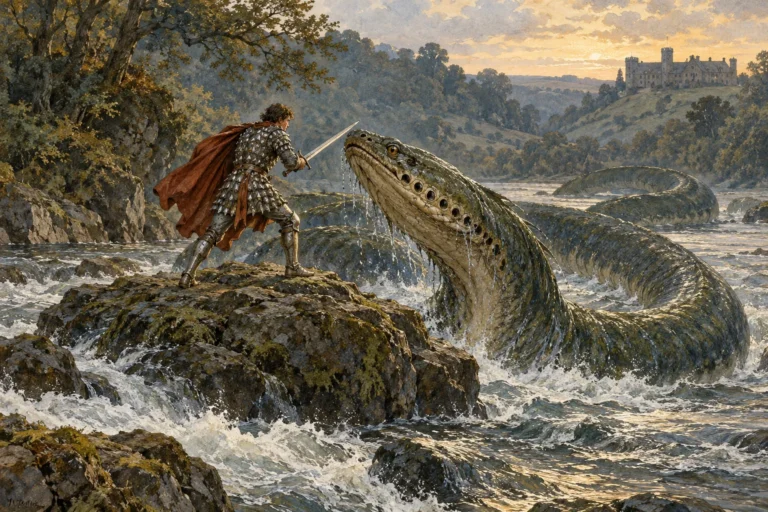
The Lambton Worm begins as a small, strange catch in the Wear. In Henderson’s account it becomes a coiling monster able to reunite its severed parts. The milk of nine cows keeps it temporarily satisfied. The returning heir needs both spiked armour and flowing water: one weakens the creature, the other prevents its body joining again. The story then shifts from the monster’s death to a broken vow and the threatened deaths of the hero’s descendants. Henderson, Chapter VIII, Lambton account.
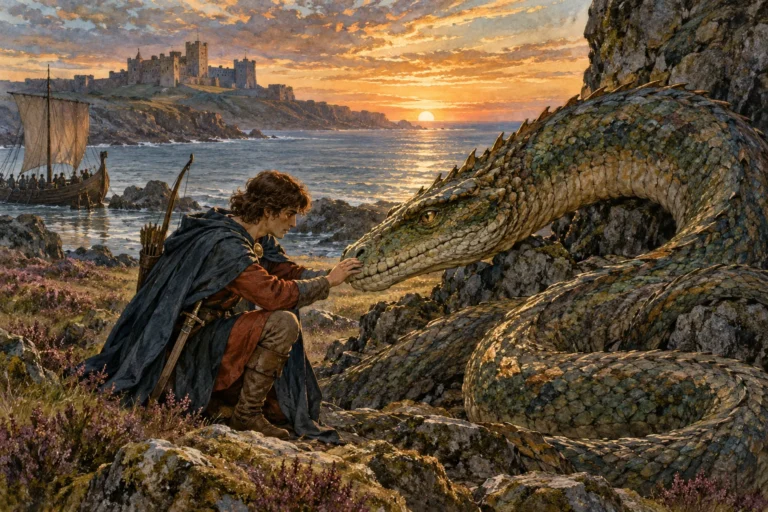
The Laidly Worm makes that apparent enemy a person. Margaret has been transformed by her jealous stepmother. Feeding her with milk from seven cows protects the neighbourhood while a rescue becomes possible. Her brother must recognise his sister and kiss the body he came prepared to attack. In Jacobs’s version, rowan protects his ship and subsequently changes the queen into a toad. These functions belong to that account; they are not evidence that every English dragon fears rowan. Jacobs, The Laidly Worm and note XXXIII.
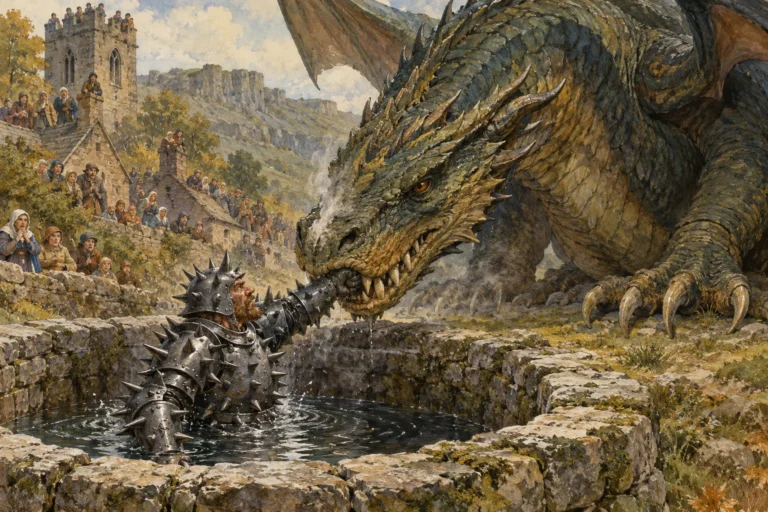
Wantley’s dragon has wings, claws, iron teeth and a great appetite, but also an offended voice. It swears when More interrupts its drink and complains bitterly when he discovers its weak point. The spiked armour recalls Lambton, yet its effect is comic: More resembles a terrifying hedgehog, and the decisive weapon is his boot. Neither the enchanted woman nor the inherited curse belongs to this plot. Percy, Volume III, Book III, XIII.
The word worm in these titles should not lead an illustrator to draw an ordinary earthworm. Henderson groups the tales under “Worms or Dragons” and describes large serpentine creatures. Even his discussion records a Lambton sculpture with ears, legs and wings that differ from the central coiling narrative. That is a useful warning against turning a collector’s descriptions into a rigid visual classification. A new illustration should identify the particular text it follows. Henderson, chapter title and reported Lambton figures.
Milk, armour and rivers invite comparison, but a shared detail does not establish a shared origin. We can demonstrate a different kind of connection more securely: Jacobs names Henderson as his source for Lambton, and names Lamb through Child for the Laidly story. Percy identifies printed copies for Wantley. These are traceable routes through books, editing and retelling. Counting each later book as a fresh oral witness would exaggerate the evidence. Jacobs, note LXXXV; Child, No. 34 and appendix.
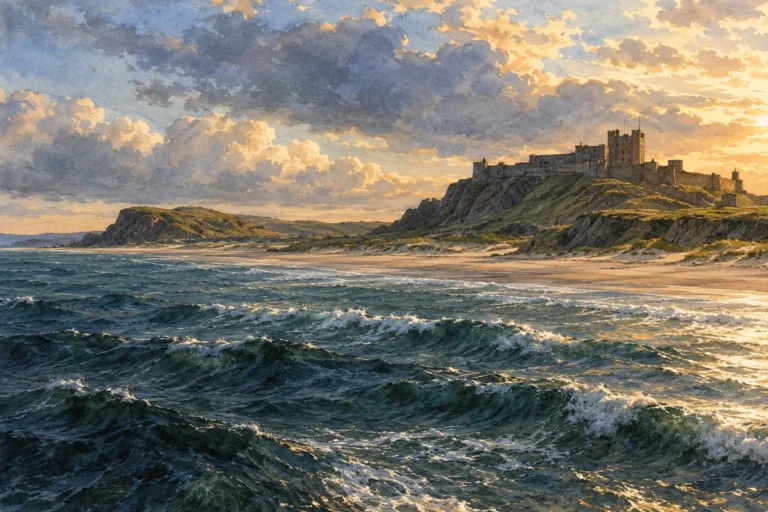
The places matter too. The Wear, Bamburgh, Spindlestone and the Yorkshire of the Wantley ballad give the stories local shape. The Bamburgh and Spindlestone guide treats the built and archaeological landscape separately. A real castle can provide a story’s setting without proving that its imagined royal household existed. This guide is a starting cluster within England’s collection, with each story’s examined versions available to follow in the source books.
Versions and variations
The comparison here is between named narratives, not a proposed universal dragon mythology. Lambton’s rejuvenating body is defeated; Margaret’s altered body is restored; Wantley’s creature is ridiculed and killed. The story pages distinguish these broad contrasts from variations inside one tradition, such as Jacobs’s named hound, Lamb’s rowan masts and the different printed wording of More’s final kick.
Henderson’s nineteenth-century chapter also speculates about prehistoric animals behind dragons. It is evidence for the collector’s ideas, not zoological evidence for the creatures. Harland and Wilkinson’s discussion of Unsworth mistakenly assigns the seven heads in Wantley’s opening comparison to the Wantley monster itself; the ballad gives those heads to Hercules’s opponent. Reading the complete narrative avoids repeating that error. Henderson, Chapter VIII, opening discussion; Harland and Wilkinson, pp. 64–65 and 265.
Context and evidence
The term “English” here describes the selected stories’ named settings and their place in English collections. It does not claim that their motifs stop at a national boundary. Child’s Scottish comparisons already show how transformation and release travel beyond Northumberland. Wider comparisons can be added as their actual sources are examined; they should preserve local names, versions and publication histories rather than merge them into a single invented tradition.
Sources for this entry
- William Henderson, Notes on the Folk-Lore of the Northern Counties of England and the Borders. New edition, with many additional notes. London: published for the Folk-Lore Society by W. Satchell, Peyton and Co., 1879; first edition 1866.. Chapter VIII, 'Worms or Dragons', Lambton Worm account, beginning 'The Lambton Worm, partly from the romantic character of its history', through the reported relics; following Laidley Worm account.. Read source — Directly examined collector's narrative. Henderson explicitly borrows the Lambton account from Cuthbert Sharpe's Bishoprick Garland; his family recollection of belief in the curse is a separately identified addition. About this book
- Joseph Jacobs, English Fairy Tales. First published London: David Nutt, 1890. Narrative and note examined in Project Gutenberg eBook 7439; this transcription does not identify its print impression.. 'The Laidly Worm of Spindleston Heugh'; Notes and References XXXIII, 'The Laidly Worm'; preface.. Read source — Directly examined prose adaptation used as the stated base for the retelling. Jacobs credits Lamb through Child and additional touches from Kempion. About this book
- Joseph Jacobs, More English Fairy Tales: Notes and References. 1894 edition.. Note LXXXV, 'The Lambton Worm': Source, Parallels and Remarks.. Read source — Jacobs's explicit acknowledgement of rewriting Henderson; also checked against the actual Laidly Worm text where the note gives an inconsistent milk count. About this book
- Francis James Child, editor; ballad communicated by the Rev. Robert Lamb, The English and Scottish Popular Ballads, Volume I. Original Volume I, Part II, Boston and New York: Houghton, Mifflin and Company, 1884; examined in the unaltered Dover republication, New York, 1965, transcribed by Project Gutenberg.. No. 34, 'Kemp Owyne', discussion pp. 306–308; appendix 'The Laidley Worm of Spindleston Heughs', pp. 311–313, especially stanzas 1–39 and Kinloch prose tradition.. Read source — Directly examined Lamb ballad and Child's provenance discussion. Child reprints William Hutchinson, A View of Northumberland (1778), II, pp. 162–164; the Hutchinson volume and Kinloch manuscript were not separately inspected. About this book
- Thomas Percy, editor; Henry B. Wheatley, edition editor, Reliques of Ancient English Poetry, Volume III. London: George Allen & Unwin, 1927 reprint of Wheatley's edition first issued by Swan Sonnenschein in 1885. Percy's collection first published 1765.. Book III, XIII, 'The Dragon of Wantley', pp. 279–288; poem pp. 283–288, lines 1–152; footnote to line 29; editorial introduction and 1767 communication.. Read source — Directly examined main narrative and source commentary. Percy identifies a Pepys printed copy collated with other copies, not an oral field recording. About this book
- John Harland and T. T. Wilkinson, Lancashire Legends, Traditions, Pageants, Sports, &c.. London: George Routledge and Sons; Manchester: L. C. Gent, 1873.. Appendix, 'The Dragon of Wantley', pp. 264–270, introductory attribution and complete ballad; 'The Dragon of Unsworth', pp. 63–65, concluding comparison.. Read source — Directly examined second printed text and competing local attribution. Editors describe a route through Gregson's Fragments to a Randal Taylor broadside dated 1685; that broadside was not inspected directly. About this book
Research coverage
A comparative guide to three examined northern traditions, not a catalogue of every English dragon. Modern reported sightings, saints' dragon legends, St Leonard, Mordiford, the full Sockburn tradition and wider European or Asian comparisons remain outside this initial cluster.
The Myths · English collection · Editorial approach
Further Reading